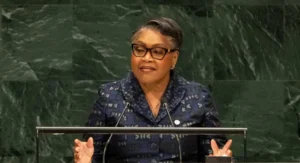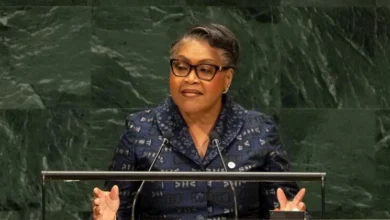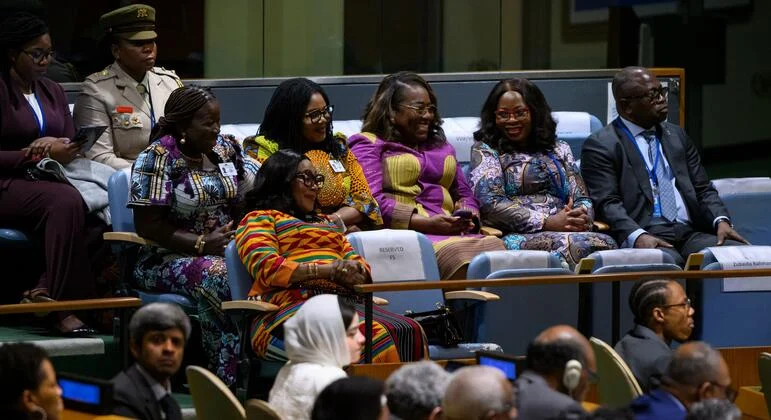
The annual high-level general debate of the United Nations General Assembly entered its fourth day on Friday, September 26, 2026, shifting the global spotlight away from the traditional superpowers and toward the vulnerable frontlines of the climate crisis. Representatives from Small Island Developing States (SIDS), stretching across the vast expanses of the Caribbean and the Pacific, took to the iconic General Assembly podium to deliver a unified and urgent message. They warned that rising global temperatures, sea-level rise, and shifting weather patterns are no longer distant projections or theoretical scenarios, but immediate, existential threats actively redrawing national borders and compromising economic survival.
Beyond environmental degradation, these island leaders underscored how systemic global inequalities—ranging from unfair international financial architectures to skyrocketing global military budgets—continue to undermine their sustainable development. As distant conflicts disrupt critical global supply chains, the ripple effects are felt acutely on isolated shores, driving up the costs of food, fuel, and transportation. Day four of the debate served as a stark reminder that the international community’s failure to address climate change and economic disparity carries profound security implications for the most vulnerable nations on Earth.
Main Facts and Core Grievances
The overarching theme of the fourth day of the debate was a demand for accountability, structural reform, and immediate intervention. SIDS leaders articulated a series of interconnected crises that threaten their sovereignty and long-term viability. Chief among these was the reality of accelerating sea-level rise, which is already contaminating freshwater aquifers, eroding coastal infrastructure, and, in extreme cases, forcing community relocations.
Furthermore, leaders highlighted the severe structural bias embedded within the global financial system. Despite contributing the least to historical global greenhouse gas emissions, small island nations face exorbitant borrowing costs, restrictive lending criteria, and insufficient access to concessional climate finance. Speakers argued that funds currently classified as international aid or climate assistance often arrive as loans, further entrenching debt distress in countries already reeling from climate-induced economic shocks.
Another prominent pillar of the day’s discourse was the protection of ocean ecosystems. For island and coastal States, the ocean is not merely a geographic feature or an economic resource, but the foundation of national identity, food security, and maritime security. The degradation of marine environments through overfishing, plastic pollution, and ocean acidification poses a direct threat to their populations’ livelihoods.
Finally, the debate cast a sharp light on the staggering global disparities in public spending. SIDS delegates contrasted the trillions of dollars routinely mobilized for global military expenditures and conflicts with the chronically underfunded pledges made by developed nations to support climate adaptation and mitigation in the Global South.
Chronology and Event Context
The high-level general debate is the annual centerpiece of the United Nations General Assembly, convening heads of state, government leaders, and foreign ministers at the UN Headquarters in New York. The 2026 session opened earlier in the week, following the high-level Summit of the Future, which sought to forge a new international consensus on how to deliver a better present and safeguard the future.
While the opening days of the general debate traditionally feature addresses from permanent members of the UN Security Council and major economic powers, the schedule systematically broadens to encompass delegations from every member state. Day four historically provides a vital platform for nations that lack the geopolitical leverage of larger states, allowing them to command global attention and place their unique regional crises onto the international agenda.
The context of the 2026 debates is shaped by a compounding series of global shocks. Coming on the heels of successive years of record-breaking global temperatures, severe marine heatwaves, and increasingly destructive tropical cyclones, the urgency expressed by island nations reflects mounting scientific consensus that critical climate tipping points are rapidly approaching. At the same time, ongoing geopolitical tensions and trade disruptions have exacerbated inflation and supply chain vulnerabilities worldwide, hitting import-dependent island economies with disproportionate severity.
Supporting Data and Economic Realities
The arguments presented by SIDS leaders on Friday are grounded in a substantial body of empirical data compiled by international bodies such as the Intergovernmental Panel on Climate Change (IPCC), the World Meteorological Organization (WMO), and the Organisation for Economic Co-operation and Development (OECD).
According to scientific assessments, global mean sea levels are rising at an accelerating rate, driven by the melting of land ice and the thermal expansion of warming oceans. For low-lying atoll nations in the Pacific, such as Tuvalu, Kiribati, and the Marshall Islands, much of their landmass sits mere feet above current sea levels. Projections indicate that even moderate scenarios of sea-level rise will render parts of these nations uninhabitable within the coming decades, raising unprecedented legal and humanitarian questions regarding statehood, maritime boundaries, and climate displacement.
In the economic sphere, data from the UN Conference on Trade and Development (UNCTAD) highlights the unique structural vulnerabilities of SIDS. These nations typically suffer from narrow economic bases, heavy reliance on tourism and imported goods, and high transportation costs. Consequently, when global supply chains are disrupted by geopolitical conflicts—such as those affecting major maritime transit chokepoints—import-dependent island nations experience acute spikes in the prices of basic commodities, including food, medicine, and fossil fuels.
Regarding climate finance, a persistent gap remains between pledges and disbursements. While developed nations previously committed to mobilizing $100 billion annually for climate action in developing countries—a target later scaled up in subsequent climate negotiations—accessing these funds remains bureaucratically complex and inadequate to meet the trillion-dollar financing needs of the climate transition. SIDS representatives pointed out that the current international financial architecture, largely designed in the post-World War II era through Bretton Woods institutions, fails to account for vulnerability criteria, instead relying on gross domestic product (GDP) per capita metrics that often disqualify middle-income island states from receiving concessional development assistance.
Official Responses and Regional Perspectives
Throughout the Friday sessions, regional coalitions, including the Alliance of Small Island States (AOSIS) and the Pacific Islands Forum (PIF), coordinated their messaging to maximize diplomatic impact.
Pacific leaders brought forward an issue of historical and ongoing injustice: the enduring legacy of nuclear testing conducted in the region during the mid-20th century. Decades after the cessation of atmospheric and underground nuclear detonations by foreign powers, local communities continue to grapple with intergenerational health impacts, environmental contamination, and cultural displacement. Speakers emphasized that nuclear justice must form an integral component of broader environmental and human rights discussions at the UN.
Caribbean representatives focused heavily on the increasing frequency and intensity of Atlantic hurricanes, which can devastate an entire nation’s GDP in a matter of hours. Leaders called for the rapid operationalization and capitalization of the Loss and Damage Fund, agreed upon at previous UN Climate Change Conferences (COP), insisting that financial support must be delivered swiftly, predictably, and without driving vulnerable nations deeper into debt.
While representatives of major industrialized nations and donor countries acknowledged these concerns in their own addresses—frequently reiterating commitments to multilateralism and climate action—the friction between the demands of the Global South and the delivery capacity of the Global North remained palpable. Developed nations face competing domestic budgetary pressures, political polarization, and economic headwinds, complicating their ability to scale up international climate finance to the levels demanded by island states.
Broader Impact and Implications
The testimonies delivered on the fourth day of the UN General Assembly debate resonate far beyond the confines of the New York headquarters, carrying profound implications for international law, global security, and multilateral diplomacy.
First, the plight of SIDS serves as a legal and geopolitical stress test for the international community. The prospect of entire nations losing their physical territory due to sea-level rise challenges foundational concepts of international law, including the definition of statehood, sovereignty, and the permanence of Exclusive Economic Zones (EEZs) that govern vast ocean resources. Several legal scholars and diplomats are actively pushing for international declarations to ensure that maritime boundaries and state recognition remain intact even if territories become submerged or uninhabitable.
Second, the intersection of climate vulnerability and economic insecurity highlights the concept of climate-induced security risks. As resource scarcity, food insecurity, and displacement mount, the potential for internal political instability and regional migration pressures increases. By framing climate change not merely as an environmental issue, but as an existential threat to peace and security, island nations are increasingly aligning their advocacy with the UN Security Council’s agenda, urging deeper integration of climate risks into traditional security analyses.
Finally, the sharp critiques of global military spending versus development aid point to a deeper crisis of global priorities. As the international community navigates an era of heightened geopolitical competition and fragmented multilateralism, the demands voiced by small island States serve as a moral compass. They challenge wealthy and powerful nations to reconcile their strategic expenditures with the collective preservation of the planet, reminding the General Assembly that the survival of the smallest and most vulnerable nations is inextricably linked to the stability and security of the entire global community.