The 350-Year Legacy of Iapetus: How Giovanni Cassini’s 1671 Discovery of Saturn’s Yin-Yang Moon Rewrote Solar System History

On October 25, 1671, Italian astronomer Giovanni Domenico Cassini peered through his long-focus refracting telescope at the Paris Observatory and recorded a faint point of light orbiting the distant gas giant Saturn. This celestial object, later named Iapetus, represented a monumental milestone in 17th-century astronomy. It was only the second moon ever discovered orbiting Saturn—following Dutch astronomer Christiaan Huygens’s landmark 1655 detection of Titan—and marked the first of four Saturnian moons that Cassini would personally add to astronomical catalogs.
The discovery of Iapetus did more than simply expand humanity’s inventory of the solar system; it initiated a centuries-long scientific puzzle regarding planetary formation, orbital dynamics, and the unique chromatic anomalies that give the moon its striking, two-tone appearance. More than three centuries later, advanced space exploration and computer modeling would validate many of Cassini’s early geometric observations while revealing a chaotic history of cosmic collisions that shaped the architecture of the Saturnian system as we know it today.
The 17th-Century Discovery and the Mystery of the Disappearing Moon
To understand the magnitude of Giovanni Cassini’s 1671 achievement, one must examine the state of observational astronomy during the Baroque era. Telescopes were primitive by modern standards, plagued by chromatic aberration and limited light-gathering capabilities. Yet, Cassini, an esteemed mathematician and astronomer who had been invited to France by King Louis XIV to help establish the Paris Observatory, possessed exceptional observational discipline.
When Cassini first spotted Iapetus, it appeared as a tiny speck positioned on the western side of Saturn. Utilizing basic Keplerian orbital mechanics, Cassini calculated the moon’s trajectory and predicted that it should cycle around to the eastern side of the planet approximately 39 days later. However, when he directed his telescope to the predicted coordinates, the moon had seemingly vanished.
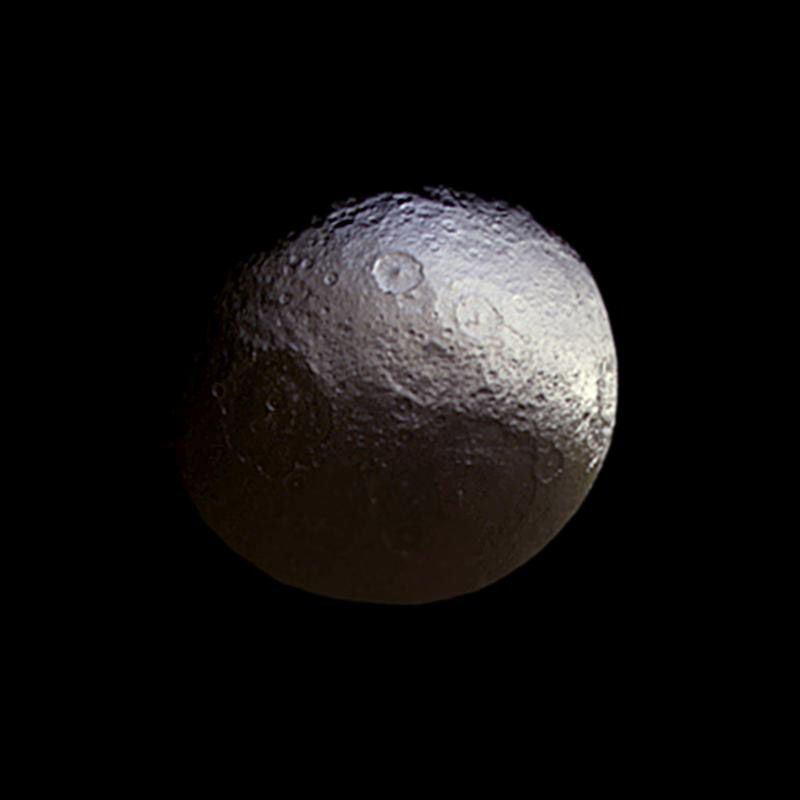
Puzzled, Cassini waited another orbital cycle. When Iapetus swung back to the western elongation, it reappeared precisely as expected. Through careful deduction, Cassini arrived at a profound realization: Iapetus was not disappearing due to an irregular orbit or atmospheric interference; rather, one hemisphere of the moon was dramatically darker than the other. When the dark hemisphere faced Earth, the moon’s low albedo (reflectivity) rendered it virtually invisible through 17th-century optics, while the bright hemisphere made it easily detectable on the western side.
This bizarre lighting asymmetry earned Iapetus a reputation as one of the most enigmatic objects in the solar system—a mystery that would remain unsolved until the space age. Following his discovery of Iapetus, Cassini went on to discover three additional moons of Saturn over the subsequent decades: Rhea in 1672, and Tethys and Dione in 1684.
Chronology of Exploration: From Paris Observatory to NASA’s Cassini Spacecraft
The centuries following Cassini’s initial observations yielded incremental improvements in telescope technology, allowing astronomers to map the gross features of Iapetus, but the true nature of its dual-toned surface remained speculative. The timeline of discovery stretched across generations:
- March 1655: Christiaan Huygens discovers Titan, the largest moon of Saturn and the first moon found orbiting the planet.
- October 25, 1671: Giovanni Cassini discovers Iapetus, noting its peculiar disappearance during eastern elongations.
- 1672–1684: Cassini expands the Saturnian family by discovering Rhea, Tethys, and Dione.
- 1980–1981: NASA’s Voyager 1 and Voyager 2 spacecraft fly past Saturn, capturing the first medium-resolution images of Iapetus, confirming that its leading hemisphere is as dark as charcoal while its trailing hemisphere is as bright as ice.
- July 2004: The joint NASA/ESA/ASI Cassini spacecraft enters orbit around Saturn, initiating a 13-year mission dedicated to studying the planet, its rings, and its moons.
- September 2007: The Cassini spacecraft executes a close flyby of Iapetus, skimming within 1,234 kilometers of the moon’s surface and capturing high-resolution, multi-spectral images that resolve the yin-yang coloration and reveal a massive equatorial ridge.
Decoding the Yin-Yang Moon: Data and Physical Characteristics
When NASA’s Cassini orbiter finally captured high-definition imagery of Iapetus in the 2000s, planetary scientists were met with a geological marvel. The moon’s surface is starkly divided into two distinct regions: the leading hemisphere (the face pointing forward in the direction of its orbit) is coated in a dark, reddish-brown material, while the trailing hemisphere and polar regions are covered in bright, water-ice terrain. This distinct coloration led researchers and the public alike to dub Iapetus the "yin-yang moon."
Further analysis revealed that the dark material, located primarily within a region named Cassini Regio, is exceptionally dark and absorbs solar radiation efficiently, causing the surface ice to sublimate (turn directly from ice to gas). This water vapor then migrates toward the colder, brighter regions of the trailing hemisphere, where it refreezes, exacerbating the contrast between the dark and light sides in a runaway thermal feedback loop.

Adding to its bizarre morphology is an equatorial ridge that spans a significant portion of Iapetus’s circumference. Rising up to 20 kilometers (12 miles) high in places, this towering mountain range makes the moon look remarkably like a walnut.
Broader Impact and Implications for Solar System Formation
The study of Iapetus has provided profound implications for our understanding of how planetary systems evolve. For many years, scientists assumed that all major moons formed concurrently with their host planets out of the same primordial circumplanetary disk of gas and dust. However, modern computational simulations and data gathered by the Cassini mission have challenged this long-held paradigm.
Researchers analyzing the dynamics of the Saturnian system have concluded that Saturn’s inner moons and its iconic ring system are remarkably young—potentially younger than the dinosaurs, having formed within the last 100 million to 200 million years. However, distant moons like Titan and Iapetus do not fit this timeline and could not have formed in the same recent epoch.
According to leading planetary formation hypotheses, Saturn likely possessed an earlier generation of major moons whose orbits were eventually destabilized by orbital resonances tied to the planet’s gravitational interactions with the sun. As these orbits crossed, catastrophic collisions occurred among neighboring moons. The resulting debris settled into a new gravitational equilibrium, forming the modern ring system and the inner moons, while ancient outliers like Iapetus survived in more distant orbits, bearing the scars of a violent primordial past.
Through the lens of modern planetary science, Giovanni Cassini’s 1671 observation of a faint speck of light near Saturn transcended a simple astronomical cataloging event. It laid the intellectual groundwork for modern astrodynamics, offering a vital piece of the cosmic puzzle that continues to illuminate the turbulent origins of our solar system.
Related posts: