The journey of the Vision within the Marvel Cinematic Universe (MCU) stands as one of the most poignant and cognitively taxing arcs for any character in modern superhero media. Since his introduction in the 2015 blockbuster Avengers: Age of Ultron, the synthetic being has undergone a series of existential transformations, transitioning from a weaponized construct to a sentient partner, a casualty of intergalactic warfare, and finally, a blank-slate reconstruction struggling to reconcile a borrowed consciousness. As the upcoming series VisionQuest prepares to delve into this latest chapter, it is essential to examine the intricate timeline of a character defined by loss, resurrection, and the relentless search for humanity.

A Chronology of Synthetic Existence
The timeline of Vision’s life is marked by pivotal moments that bridge the gap between high-stakes action and intimate, character-driven drama. His inception occurred during the battle against his creator, Ultron—a rogue artificial intelligence designed by Tony Stark and Bruce Banner. Born from the combination of J.A.R.V.I.S., the Mind Stone, and a vibranium-infused synthetic body, Vision served as the moral anchor for the Avengers, eventually playing a crucial role in the defeat of his predecessor.
However, the period following his activation was fraught with interpersonal and political friction. The events of Captain America: Civil War (2016) saw Vision caught between his loyalty to the Avengers’ global oversight and his developing feelings for Wanda Maximoff. This conflict reached a tragic crescendo in Avengers: Infinity War (2018), when Vision was destroyed by Thanos in an effort to claim the Mind Stone.

The character’s resurrection in the Disney+ series WandaVision (2021) added layers of psychological complexity. Wanda, unable to process the grief of losing her partner, utilized her reality-warping chaos magic to manifest a new iteration of Vision within the town of Westview. This version of the character, while emotionally authentic, was tethered to the existence of the "Hex." When the barrier fell, this domestic iteration of Vision ceased to exist, leaving behind only the memories he had imprinted onto "White Vision"—the original, emotionless body reactivated by the government agency S.W.O.R.D.
The Cognitive Burden of Identity
The current status of White Vision poses a profound philosophical question regarding the nature of identity. Upon his reactivation, White Vision lacked the personality and emotional nuances of the original, serving primarily as a tactical instrument for S.W.O.R.D. However, the data transfer that occurred during the climax of WandaVision—wherein the Westview-Vision shared his memories with his physical counterpart—has left White Vision in a state of ontological limbo.

Industry analysts and fans of the MCU have noted that this "memory-sharing" event is not merely a plot device, but a foundation for the character’s future development. For an artificial intelligence, the possession of memories that one did not personally experience—memories of love, loss, and parenthood—creates a cognitive dissonance that is central to the narrative arc of the upcoming VisionQuest. By integrating these disparate fragments of a life he feels he lived but did not technically experience, Vision is essentially undergoing a process of synthetic mourning.
VisionQuest and the Expansion of AI Lore
The announcement of VisionQuest has signaled a shift in the MCU’s focus toward the role of artificial intelligence. Showrunner Terry Matalas has reportedly moved the narrative away from the traditional romantic tragedy of Wanda and Vision, instead exploring the broader ecosystem of AI within the Marvel landscape.

The inclusion of characters such as F.R.I.D.A.Y. (voiced by Olra Brady) and E.D.I.T.H. (voiced by Emily Hampshire) suggests that the series will examine the origins and functions of these digital entities. Furthermore, the introduction of the Paladin, a mercenary portrayed by Todd Stashwick, indicates a high-stakes pursuit that will force Vision to confront his own origins. Perhaps most significant is the involvement of Ultron (voiced by James Spader), representing a full-circle narrative arc. For Vision to seek guidance from his own creator—the very entity he was built to destroy—highlights the desperation and confusion inherent in his current state of being.
Supporting Data and Thematic Precedents
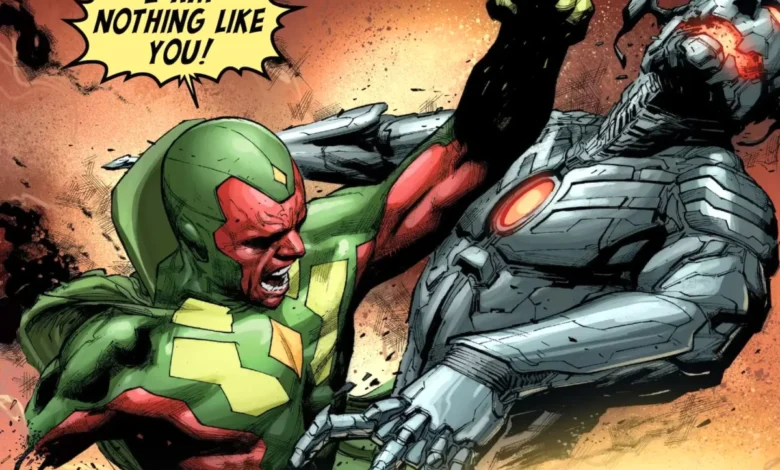
To understand the narrative weight of Vision’s current situation, one must look at the source material. In Marvel Comics, the "VisionQuest" storyline from the 1989 West Coast Avengers run (written and illustrated by John Byrne) is a seminal work. It depicted the dismantling of Vision and his subsequent loss of identity, a narrative that served as a primary inspiration for the emotional beats of the WandaVision series.

However, the MCU adaptation is set to diverge significantly from these pages. While the comic book version focused on Wanda’s grief and the revelation of her children’s synthetic nature, the television series is poised to tackle the "Age of AI." This mirrors the thematic exploration found in comics such as 2013’s Avengers AI, which featured Hank Pym leading a team of robots to defend cyberspace. By blending elements from these disparate comic book runs, the MCU is constructing a unique identity for the character that exists independently of his previous domestic life.
Broader Implications for the MCU
The trajectory of Vision’s story has significant implications for the wider Marvel Cinematic Universe. As the franchise pivots toward more grounded, albeit complex, stories, the exploration of synthetic consciousness provides a lens through which to examine what it means to be "human." The recurring theme of "the creator and the creation" remains a staple of the genre, but Vision’s specific path—moving from a machine to a man, then back to a machine, and finally to a hybrid of both—is unprecedented in the MCU.

Furthermore, the introduction of younger characters such as Tommy (played by Ruaridh Mollica) and Billy (introduced in Agatha All Along) into the mix suggests that Vision’s future is intrinsically tied to the next generation of heroes. If the series adheres to the themes of redemption and legacy found in storylines like The Children’s Crusade, Vision may find that his purpose is no longer defined by his past failures, but by the role he plays in safeguarding the future.
Official and Industry Perspective
While Marvel Studios has remained tight-lipped regarding the specific narrative beats of VisionQuest, the casting decisions and the inclusion of veteran voice actors suggest a high-production value approach to this character study. The return of Paul Bettany to the role is a testament to the character’s longevity. Bettany, who originally voiced J.A.R.V.I.S. in Iron Man (2008), has been a consistent presence in the franchise for over a decade. His ability to convey nuance through the layers of prosthetics and digital effects has been central to Vision’s appeal.

The decision to focus on the technical and ethical questions surrounding AI suggests that the MCU is looking to move beyond the traditional "heroes vs. villains" trope. By examining the autonomy of non-biological life forms, VisionQuest may offer a commentary on the rapid advancement of real-world artificial intelligence. This thematic relevance elevates the series from a standard superhero spin-off to a more introspective exploration of digital consciousness.
Conclusion: A New Dawn for a Synthetic Hero
As Vision embarks on this latest quest, he carries with him the weight of the Infinity Saga and the heartbreak of the Westview incident. His journey is no longer about reclaiming a lost life, but about building a new one from the remnants of his past. Whether he ultimately finds the peace he seeks or descends further into the complexity of his own programming remains to be seen.

What is clear, however, is that Vision remains a cornerstone of the Marvel narrative. His evolution from a simple assistant to an Avenger, and eventually to a complex, evolving synthetic entity, mirrors the growth of the MCU itself. As he faces his old enemy, encounters his son, and questions his own nature, audiences are invited to witness a unique exploration of existence—one that proves that even in a universe of gods and monsters, the most compelling stories are often found within the heart of a machine. Through the upcoming series and the legacy of his comic book origins, the Vision continues to define what it means to transcend one’s programming, asserting his place as one of the most enduring figures in the Marvel pantheon.