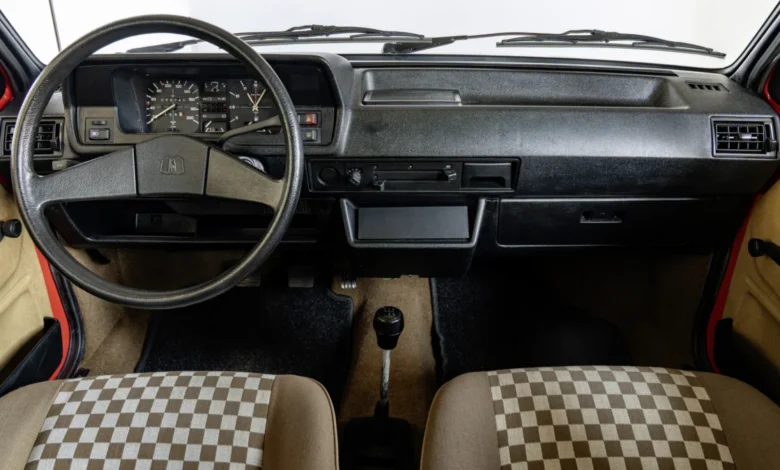
Long before the automotive industry embraced complex drive mode selectors, sophisticated cylinder deactivation technology, and varying levels of hybrid powertrain assistance, automotive engineers faced a severe regulatory and economic crisis. The energy shocks of the late 1970s and early 1980s drastically shifted global market demands. With tightening fuel economy standards imposed by governments worldwide and soaring petroleum prices at the pump, manufacturers had to abandon sheer horsepower as their primary marketing metric. Innovation during this era required creative mechanical engineering to squeeze every possible mile out of a gallon of fuel without completely sacrificing everyday drivability. Volkswagen’s unique contribution to this fuel-saving movement was a specialized manual gearbox design featuring a final shift gate marked simply with a capital letter "E."
The historical context of this engineering choice cannot be overstated. During the late 1970s, the oil crises shattered the post-war paradigm of cheap, abundant fuel. Automakers in the United States, Europe, and Asia scrambled to comply with newly minted legislative frameworks, such as the Corporate Average Fuel Economy (CAFE) standards introduced in the U.S. in 1975. European manufacturers faced equally stringent domestic tax structures and fuel levies that heavily penalized thirsty engines. While American brands often struggled with downsized V8 engines and sluggish performance, European companies focused on lightweight front-wheel-drive platforms powered by efficient four-cylinder powerplants. It was within this climate of stringent regulatory pressure and technological transition that Volkswagen developed its distinctive overdrive transmissions.
The Chronology of Volkswagen’s Efficiency Push
The evolution of Volkswagen’s fuel-saving transmissions began in earnest at the dawn of the 1980s. Understanding the timeline of this development highlights how rapidly the automotive industry adapted to macroeconomic pressures before the widespread integration of computerized engine management systems.
In 1974, Volkswagen revolutionized the global compact car market with the introduction of the first-generation Golf, followed closely by the Jetta sedan and the U.S.-market Rabbit. These vehicles established the blueprint for modern front-wheel-drive hatchbacks and sedans. However, their initial gearboxes were standard four-speed or five-speed units optimized for general performance and urban agility rather than dedicated highway fuel economy.
By 1981, as the secondary oil crisis of 1979 continued to impact global markets, Volkswagen rolled out its innovative "3+E" and "4+E" transmission setups. These gearboxes appeared across core models, including the VW Rabbit LS, Golf, Jetta, and various European offerings. The nomenclature was immediately striking to drivers who peered down at the shift pattern.
Between 1981 and 1985, Volkswagen went a step further in the European market by consolidating these mechanical advancements into a dedicated trim level known as "Formula E" (or "Formel E" in German). This comprehensive efficiency package was made available across a wide array of models, ranging from the subcompact Polo to the larger Passat and Santana, as well as Audi 80 and 100 models of the same era.
By 1985, the automotive landscape was shifting again. The rapid advancement of electronic multi-point fuel injection, early variable valve timing concepts, and the standardization of conventional five- and six-speed manual transmissions rendered the specialized "3+E" and "4+E" setups largely obsolete. Engineers discovered they could achieve superior real-world fuel economy through electronic engine calibration and closely spaced, traditional gear ratios rather than relying on massive gear gaps.
Decoding the E-Gear: Economy, Extra, or Efficiency?
When drivers first encountered the capital "E" positioned at the far right of the H-pattern shifter—often beyond a gate that required a deliberate push or lift-up motion—widespread speculation ensued. Many motorists and contemporary automotive journalists naturally assumed that the letter stood for "Economy," reflecting the primary goal of the car. Others guessed it might stand for "Extra," implying an additional gear tacked onto the end of a standard transmission.
However, official engineering and marketing documents released by Volkswagen confirmed that the designated word was "Efficiency." The distinction was more than just semantic; it represented a specific engineering philosophy aimed at minimizing mechanical pumping losses and reducing internal engine friction at cruising speeds.
Rather than functioning as a completely new gear tier slotted between standard ratios, the "E" slot engaged a deeply recessed overdrive gear designed specifically to lower engine operating speeds while maintaining vehicle momentum. This setup aimed to minimize engine wear and improve official fuel economy ratings during sustained highway travel. The mechanical reality of this design meant that while the car could cruise effortlessly at high speeds with minimal noise and fuel consumption, the driver sacrificed immediate acceleration response unless they actively downshifted.
Rethinking Overdrive for Front-Wheel-Drive Platforms
The fundamental concept of overdrive was far from novel in the early 1980s. For decades, British and European luxury and sports cars had relied on external electro-hydraulic units, most notably the Laycock de Normanville overdrive system. These bulky devices were bolted directly onto the rear of a conventional transmission casing and were typically activated via a dashboard switch, a dedicated column stalk, or automatically through hydraulic pressure switches. They proved effective for rear-wheel-drive configurations, but they added significant weight, complexity, and cost.
Volkswagen’s approach with its front-wheel-drive architecture was radically different. Instead of utilizing an external auxiliary unit, VW engineers integrated the tall overdrive ratio directly inside the transaxle’s main gear casing. Control of this high ratio was placed entirely in the hands of the driver via the manual shift lever.
To examine the mechanics, consider the "3+E" gearbox found in the 1981 VW Rabbit LS. Structurally, the unit was effectively a standard four-speed transaxle casing modified with significantly wider gear spacing. The first, second, and third gears were tuned to cover approximately 90 percent of all urban driving scenarios, navigating stop-and-go traffic and secondary rural roads with adequate torque multiplication.
The "E" gear, conversely, was engineered exclusively for highway cruising. Utilizing a tall 0.70:1 overdrive ratio working through a 3.89:1 final drive, this configuration transformed how the small four-cylinder engine behaved at sustained velocity. While contemporary road tests confirmed that vehicles equipped with this transmission were not record-breakers in absolute fuel economy by modern standards, the mechanical impact was immediately measurable. When a driver shifted the Rabbit into "E" upon reaching highway speeds, engine revolutions dropped dramatically to approximately 2,500 rpm at 60 miles per hour.
This significant reduction in engine speed yielded tangible improvements at the fuel pump. Standard four-speed models of the era typically returned around 24 miles per gallon in mixed driving conditions. With the "E" gear engaged, overall fuel efficiency rose to an average of 28 miles per gallon, while dedicated highway figures frequently climbed as high as 42 miles per gallon.
Despite these impressive gains for the era, the system possessed notable limitations. The wide gap between third gear and the "E" overdrive meant the engine operated far outside its optimal power band. Consequently, the "E" gear was strictly intended for maintaining steady momentum on flat or gently rolling terrain. Any significant incline or requirement for sudden acceleration demanded a prompt downshift back into third gear to access the engine’s full power output.
The Formula E Package and Early Driver Coaching
In Europe, Volkswagen expanded upon the mechanical foundation of the overdrive transmission by creating the comprehensive Formula E package. Marketed actively between 1981 and 1985, this initiative combined mechanical modifications with early forms of aerodynamic enhancement and digital driver coaching.
The Formula E lineup—spanning models from the entry-level Polo up to the larger Passat and select Audi vehicles—featured more than just the "4+E" transmission. Vehicles specified with this package often received subtle aerodynamic interventions, such as front air dams, specialized wheel cover designs to reduce turbulence, and lower ride heights to minimize drag at high speeds.
Furthermore, Volkswagen integrated an early form of rudimentary electronic driver assistance. An electro-vacuum computer system continuously monitored engine load parameters against current engine revolutions per minute (RPM). When the system detected that the engine was operating under light load conditions at an RPM where an upshift would improve thermal and volumetric efficiency, it illuminated an amber arrow on the vehicle’s instrument cluster. This visual prompt instructed the driver to shift into a higher gear.
This early mechanical and electronic symbiosis served as a direct conceptual ancestor to the modern shift-indicator lights, eco-driving modes, and hyper-miling displays standard in today’s internal combustion and hybrid vehicles. It acknowledged that human driving behavior was a critical variable in achieving optimal fuel efficiency, establishing a precedent for man-machine cooperation in resource conservation.
Broader Industry Implications and Technological Obsolescence
The lifespan of the "3+E" and "4+E" transmissions was ultimately limited by rapid advancements in automotive engineering and powertrain design. By the mid-1980s, the automotive sector entered a new technological epoch characterized by the widespread adoption of electronic multi-point fuel injection, computer-controlled ignition timing, and the integration of variable valve timing architectures.
Furthermore, metallurgical and mechanical advancements allowed transmission designers to engineer standardized five-speed and eventually six-speed manual gearboxes that eliminated the massive, frustrating gear gaps inherent in the Volkswagen "E" setups. Engineers realized that by utilizing closer gear ratios paired with flexible, high-torque powerplants managed by early Engine Control Units (ECUs), they could achieve superior real-world fuel economy without forcing drivers to constantly manage a sluggish overdrive gear or compromise vehicle responsiveness.
From an analytical perspective, Volkswagen’s E-gearboxes represented a crucial bridge between two distinct eras of automotive design. They demonstrated how traditional mechanical engineering could be creatively adapted to meet sudden macroeconomic and regulatory crises before the advent of ubiquitous automotive computing. While the physical implementation of a dedicated "E" gate on a manual shifter faded into automotive history by the late 1980s, the foundational philosophy of optimizing gear ratios for maximum efficiency laid the essential groundwork for the ultra-efficient powertrains, multi-speed automatic transmissions, and continuous variable systems that dominate the global vehicle fleet today.