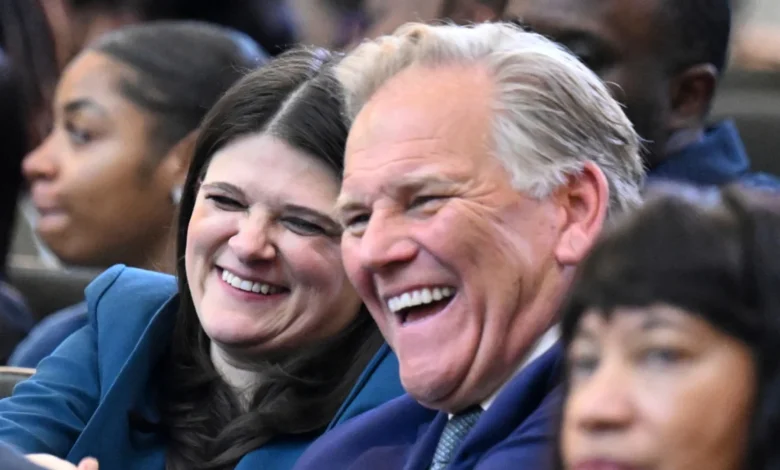
In a development that has sent shockwaves through the Michigan political establishment just forty-eight hours before the 2026 general election, Representative Haley Stevens, a former Democratic candidate for the U.S. Senate, has officially endorsed Republican nominee Mike Rogers. The move, which occurred at a Sunday morning service at Perfecting Church in Detroit, marks a jarring reversal for the Democratic congresswoman, who spent the duration of the 2026 primary season framing Rogers as a fundamental threat to the state’s values and the national interest. The endorsement has prompted an immediate and historic exodus of Stevens’ remaining campaign staff and has drawn sharp condemnation from the Michigan Democratic Party, which characterized the decision as an "eleventh-hour distraction" intended to undermine the party’s unified front in the final stages of the election.
A Chronology of Conflict and Reversal
The timeline of the relationship between Representative Stevens and Mike Rogers is defined by a series of aggressive public attacks, which makes this week’s endorsement particularly difficult for political analysts to reconcile with her previous record.
Throughout the spring and summer of 2026, Stevens positioned herself as the primary foil to Rogers. Following her loss in the Democratic primary—a contest where she notably outspent her opponent, Abdul El-Sayed, by a 12-to-1 margin—Stevens did not pivot toward party unity. Instead, she continued to utilize her digital platforms to build a comprehensive case against the Republican nominee.
In April 2026, Stevens launched a concerted social media campaign against Rogers, labeling him "the worst kind of politician." Her critiques were specific and wide-ranging, focusing on his post-congressional career and his legislative history. By August 2026, her rhetoric had hardened into a repetitive refrain; she referred to Rogers as a "rubber stamp" for Donald Trump’s agenda no fewer than thirteen times in public communications, warning voters that a vote for Rogers was a vote for the erosion of democratic norms.
The intensity of her opposition peaked in June 2026, when she centered her messaging on social issues. Stevens explicitly denounced Rogers’ record on LGBTQ+ rights as "repulsive" and took aim at his campaign staffing choices, specifically highlighting reports that his outreach team included individuals who had previously expressed admiration for extremist ideologies. Her stance on reproductive rights was equally uncompromising; she repeatedly criticized Rogers for his past support of a national abortion ban, asserting that he could not "hide his terrible record" on the issue.
Data and Financial Context
The backdrop of this endorsement is defined by the high-stakes financial reality of the 2026 Michigan Senate cycle. Stevens’ primary campaign was marked by immense expenditure, yet it failed to yield a nomination. The scale of her campaign spending—often cited as the largest self-funded or donor-supported effort in the recent history of Michigan Democratic primaries—suggests that Stevens had the resources to conduct extensive opposition research.
The documents and public statements she compiled during that period were intended to serve as the blueprint for the Democratic attack strategy against Rogers. By endorsing him now, she is essentially attempting to invalidate the very data and policy critiques that her own campaign team spent months curating. Political scientists observing the Michigan race note that such a reversal is statistically rare in modern American politics, where party polarization typically keeps candidates within their established ideological silos.
The Immediate Political Fallout
The reaction from Stevens’ own political circle was both swift and severe. Reports confirmed that her staff resigned en masse shortly after the announcement was made. This mass resignation suggests a deep-seated disconnect between the candidate and her senior advisors, many of whom had staked their professional reputations on the campaign’s previous anti-Rogers platform.
The Michigan Democratic Party (MDP) issued a formal statement shortly after the news broke, distancing the party from the congresswoman. "The people of Michigan are focused on the future and the issues that impact their daily lives, such as healthcare, economic stability, and civil rights," the statement read. "Representative Stevens’ decision to offer support to a candidate who represents the antithesis of these values is an individual choice that does not reflect the consensus of our party or our voters."
Furthermore, the lack of coordination in the endorsement—evidenced by the fact that Stevens had not scrubbed her own social media archives of her previous condemnations of Rogers—indicates that the decision was likely made in haste. While public figures often perform "digital housekeeping" when changing political allegiances, the persistence of tweets calling Rogers "disgraceful" and "MAGA Mike" alongside the new endorsement creates a stark, ongoing public record of ideological inconsistency.
Implications for the 2026 Senate Election
The impact of this endorsement on the final vote count remains a subject of intense debate among pollsters. Some argue that because Stevens lost her own primary, her influence over the Democratic base is significantly diminished, rendering the endorsement a "non-factor" that will be overshadowed by the broader party mobilization efforts. Others, however, suggest that the move could create confusion among independent voters who had previously used Stevens’ critiques as a baseline for understanding the Republican candidate’s platform.
From a strategic perspective, the endorsement raises questions about the long-term viability of bipartisan outreach in an era of intense political tribalism. By crossing the aisle in such a dramatic fashion, Stevens has effectively alienated the institutional Democratic support structure that sustained her career for years. The move is seen by some insiders as a potential precursor to a shift in her political identity, though it is unclear what, if any, future role she expects to play within the Republican framework.
Broader Analysis: The Erosion of Political Consistency
This episode serves as a case study in the volatility of the 2026 election cycle. In a political environment where candidates are increasingly held accountable for their digital histories, the ability to flip a stance on a major candidate carries significant risk. The "eleventh-hour" timing suggests a tactical maneuver, but the absence of a clear policy rationale—such as a specific change in Rogers’ platform or a new legislative compromise—makes it difficult for the electorate to interpret the move as anything other than a political pivot.
As voters head to the polls, the focus will inevitably return to the policy differences between the candidates. However, the Stevens-Rogers development adds a layer of unpredictability to the closing hours of the campaign. Whether this endorsement serves to legitimize Rogers among moderate voters or simply reinforces the existing skepticism toward political opportunism remains to be seen. What is clear is that the institutional backlash and the public record of contradiction have ensured that this moment will be cited in post-election analyses for years to come as a definitive example of the unpredictable nature of contemporary American politics.
The coming days will likely bring further scrutiny to the reasons behind this abrupt change of heart. For now, the Michigan Senate race—already one of the most closely watched in the country—has been thrust into a final period of intense scrutiny regarding the integrity of political messaging and the durability of party loyalties. The voters, ultimately, will be the final arbiters of whether this endorsement carries weight or is dismissed as a footnote in a volatile election season.