For more than seventy years, the Chevrolet Corvette has served as America’s definitive counter-argument to the dominant European sports car paradigm. Conceived in 1953 by General Motors head of design Harley Earl, the nameplate was envisioned as an accessible, fiberglass-bodied two-seater capable of captivating returning World War II veterans who had grown fond of agile imports. What began as a modest six-cylinder roadster outfitted with a two-speed automatic transmission quickly transformed into a heavyweight performance champion, largely thanks to Zora Arkus-Duntov—affectionately dubbed the "Father of the Corvette"—who successfully championed the integration of the small-block V8 engine.
Throughout its eight distinct generations, the Corvette has continually reinvented itself. The most radical engineering shift in its history materialized with the transition of the eighth generation to a mid-engine layout, a configuration that effectively decoupled the nameplate from decades of front-engine tradition. While purists fiercely debated the mechanical overhaul, objective performance metrics—most notably lateral acceleration—provided definitive context. Historically, the Corvette has faced scrutiny from two distinct consumer camps: one focused on straight-line acceleration and brand heritage, and a more critical audience obsessed with dynamic handling, chassis balance, and cornering threshold. To successfully challenge automotive royalty from Porsche, Jaguar, and Ferrari, mastering the latter has always been essential.
Evaluating Cornering Mechanics and the Skidpad Metric
Lateral acceleration, measured in gravitational force (g-force), serves as the ultimate litmus test for a vehicle’s mechanical grip. It defines precisely how much lateral force a car can sustain on a circular skidpad before its tires lose traction and the vehicle slides outward. Crucially, this metric largely neutralizes raw horsepower advantages and subjective driver skill, highlighting instead the interdependent performance of a vehicle’s tires, suspension geometry, and overall chassis balance.
To maintain methodological consistency across historical eras, automotive journalism relies heavily on standardized skidpad testing. Industry benchmarks are typically established using a 300-foot-diameter skidpad in modern evaluations, and a 200-foot layout in historical testing, most notably standardized by automotive publications such as Car and Driver. By analyzing these data points chronologically, automotive analysts can chart the technological evolution of American sports car engineering, tracking how chassis design and rubber compounds have evolved from the primitive bias-ply tires of the 1950s to the ultra-sticky modern compounds of the twenty-first century.
C7 Generation (2014–2019): The Pinnacle of Front-Engine Grip
When analyzing verifiable historical test data, the seventh-generation Corvette represents the absolute zenith of the front-engine platform’s lateral capabilities. Tested on a standardized 300-foot skidpad, the 2015 Chevrolet Corvette Z06, equipped with the aggressive Z07 performance package, astonished the automotive industry by registering an unprecedented 1.19 g of lateral grip. At the time of its release, this figure established a new benchmark for a series-production automobile.
Beyond its staggering cornering abilities, the C7 Z06 leveraged a supercharged 6.2-liter V8 engine generating 650 horsepower and 650 lb-ft of torque, paired with aggressive Michelin Pilot Sport Cup 2 ZP tires. Weighing approximately 3,558 pounds, the car simultaneously recorded blistering acceleration and deceleration metrics, stopping from 70 mph to a dead stop in just 128 feet while completing the quarter-mile in 11.0 seconds at 126 mph.
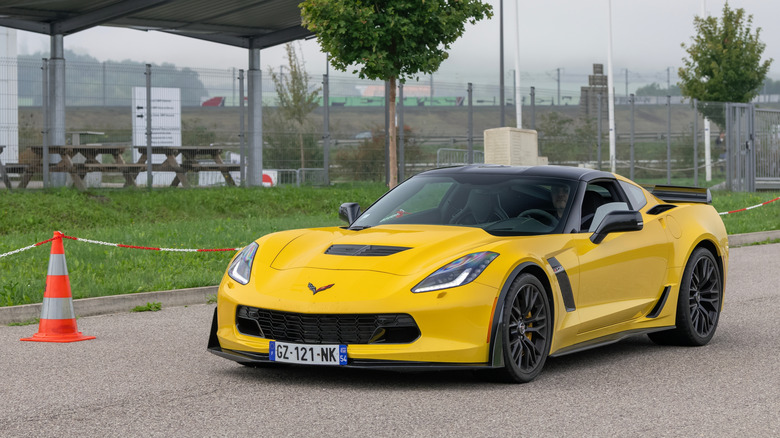
Further reinforcing the primacy of mechanical setup over brute horsepower, the 2017 Corvette Grand Sport—possessing 190 fewer horsepower than the Z06—managed a staggering 1.18 g on the same skidpad, demonstrating that disciplined chassis tuning and massive rubber can nearly match a flagship track weapon’s cornering threshold. Most remarkably, the C7 Z06’s benchmark 1.19 g figure remains higher than any lateral acceleration recorded for the subsequent mid-engine C8 generation in equivalent standardized testing.
C8 Generation (2020–Present): The Mid-Engine Evolution
The arrival of the mid-engine C8 Corvette promised a paradigm shift in vehicle dynamics. By relocating the engine behind the driver, engineers optimized weight distribution, reduced polar moment of inertia, and theoretically created a superior platform for cornering dominance. Equipped with cutting-edge tire technology—such as the Michelin Pilot Sport Cup 2 R tires featured on the Z07 package for the 670-horsepower, flat-plane-crank Z06—the C8 possessed all the theoretical prerequisites to shatter previous records.

However, empirical testing revealed a nuanced reality. On Car and Driver’s 300-foot skidpad, the Z07-equipped C8 Z06 recorded 1.16 g. While exceptionally high, this figure fell notably short of Chevrolet’s factory-claimed 1.22 g internal metric. Industry analysts later noted that testing discrepancies arose partly because test vehicles were delivered with tires inflated to door-placard street pressures rather than lower, manufacturer-recommended track pressures.
Across the broader C8 lineup, results remained impressive yet consistently shy of the front-engine C7’s high-water mark. The non-Z07 Z06 convertible achieved 1.12 g, while the base Stingray recorded 1.03 g. Even forced-induction halo variants like the 1,064-horsepower 2025 Corvette ZR1 managed 1.13 g, and its higher-output iterations plateaued around 1.15 g. Comparative testing by publications like MotorTrend corroborated these findings on a figure-eight course, where the C8 Z07 coupe recorded 1.16 g, affirming that while the mid-engine platform vastly improved everyday drivability and power delivery, its absolute ultimate skidpad grip sits a fraction of a g behind its immediate predecessor.
C6 Generation (2005–2013): Supercar Performance for the Masses
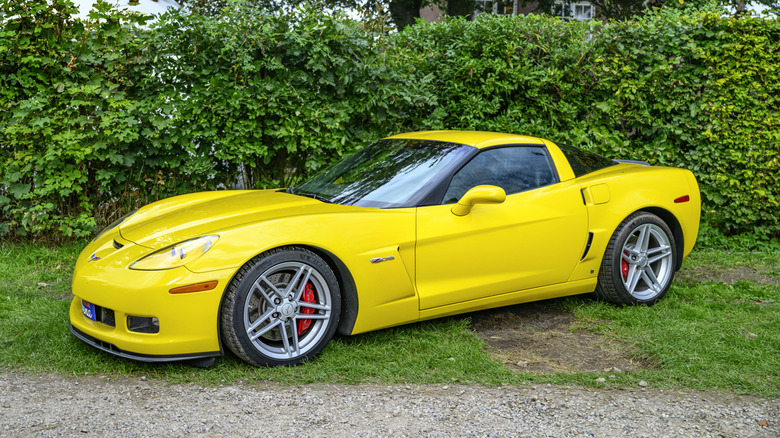
The sixth-generation Corvette cemented the nameplate’s reputation as a legitimate supercar slayer. The absolute performance ceiling for the C6 era belonged to the supercharged ZR1, a machine that famously outperformed General Motors’ conservative factory estimates. While GM rated the ZR1 at 1.05 g, independent testing by Car and Driver yielded a remarkable 1.07 g on Michelin Pilot Sport PS2 tires.
Powered by a 638-horsepower supercharged LS9 V8, the C6 ZR1 matched its cornering prowess with world-class braking, hauling the car down from 70 mph in just 142 feet—a braking distance that set a production-car record at the time of its release. More importantly, the ZR1 achieved its metrics while heavily undercutting exotic European rivals priced at three times its $105,000 MSRP. Track evaluations at circuits like Georgia’s Roebling Road Raceway further validated the C6 platform, where the ZR1 posted lap times faster than exotic luminaries like the Ferrari Enzo, prompting enthusiast media to crown it an ultimate analogue performance machine. Across lower trims, the C6 Z06 held a respectable 0.98 g, while Z51-equipped variants managed 0.95 g, leaving the generation roughly 0.12 g behind the peak C7 benchmark.
C5 Generation (1997–2004): A Modern Structural Renaissance
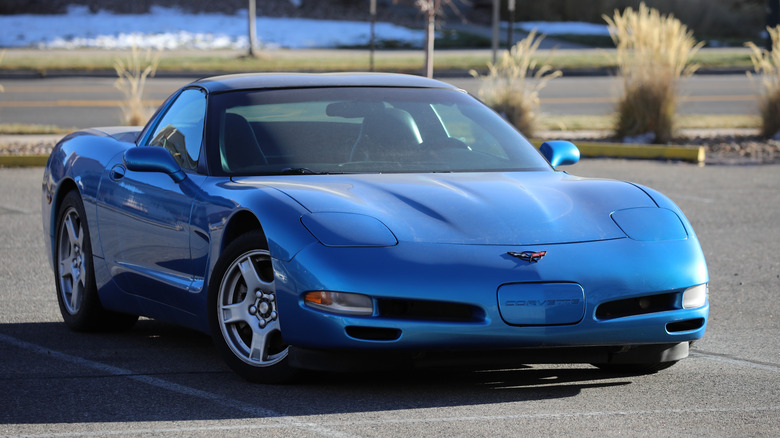
Introduced for the 1997 model year, the C5 generation modernized the Corvette through a hydroformed steel frame, a rear-mounted transaxle yielding near-50/50 weight distribution, and the introduction of the legendary LS-series small-block V8 engine.
The standout performer of this era was the 2001 Corvette Z06. Equipped with a 385-horsepower LS6 V8 (later bumped to 405 horsepower) and sticky Goodyear Eagle F1 SC tires, the C5 Z06 recorded 0.98 g on Car and Driver’s skidpad—a figure hailed at the turn of the millennium as a breakthrough for domestic sports car engineering. MotorTrend tests of the 2002 model recorded an even higher 0.99 g with stability control disengaged. Standard C5 models comfortably achieved 0.90 g, while the track-focused Z51 package matched the Z06’s 0.98 g threshold by 2005. The C5 generation successfully bridged the gap between vintage driving dynamics and modern limit-handling reliability.
C4 Generation (1984–1996): The Technology Leap
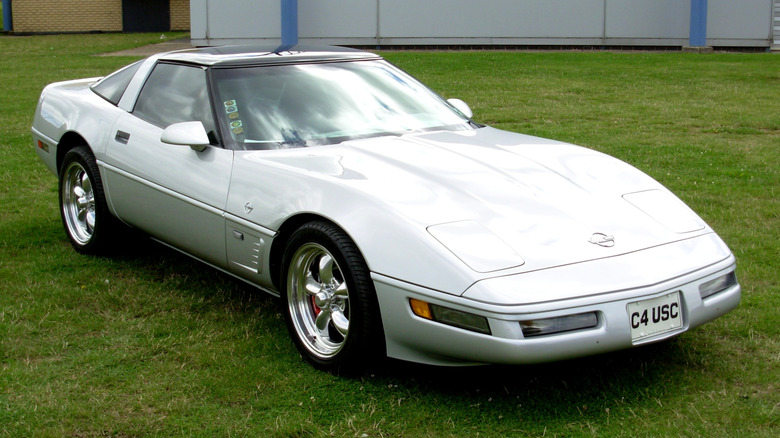
The C4 Corvette faced significant criticism upon its 1984 debut due to the underwhelming performance of its early "Cross-Fire Injection" V8 engine, derisively nicknamed "Cease-Fire" by enthusiasts. However, the C4 chassis represented a monumental leap forward in suspension engineering and structural rigidity.
When equipped with the Z51 handling package, the 1984 Corvette immediately posted an impressive 0.90 g on a 200-foot skidpad, comfortably outmaneuvering contemporary European benchmarks like the Porsche 928. Later evolutions transitioned to 300-foot testing parameters, where the 1988 model held 0.87 g and the 1996 Grand Sport achieved 0.89 g. Meanwhile, specialized halo variants like the 1990 ZR-1—powered by the DOHC LT5 engine developed with Lotus—pushed boundaries further, with Road & Track recording an exceptional 0.94 g. Despite these technical triumphs, standard C4 models sat roughly 0.09 g behind the subsequent C5 generation.
C3 Generation (1968–1982): The Era of Strict Emissions and Heavy Chassis
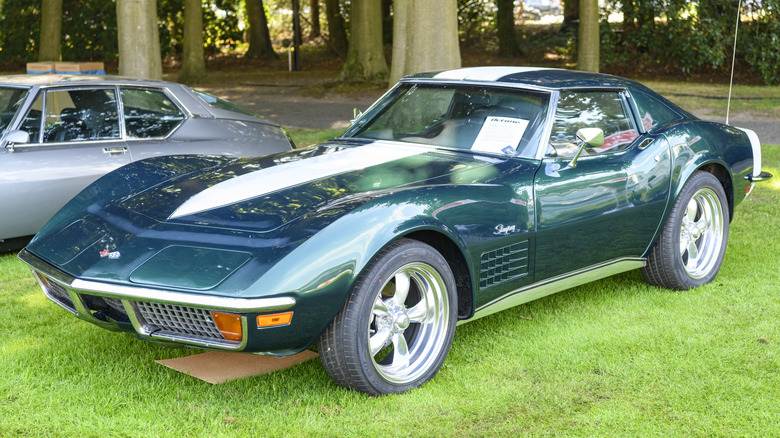
Spanning an extensive 14-year production run, the C3 Corvette witnessed the transition from high-compression muscle car powerhouses to strangling emission regulations that drastically reduced engine outputs.
In comprehensive testing conducted by Car and Driver in June 1971, four distinct C3 powertrains were evaluated, with the lightweight, LT1-powered variant capturing the generation’s apex at 0.80 g. This performance neatly aligned with the 0.75 to 0.78 g lateral acceleration band empirically cited by Zora Arkus-Duntov during testing sessions. A decade later, comparative evaluations between vintage and contemporary machinery placed a 1982 coupe at 0.82 g on modern radial tires, outperforming earlier big-block iterations despite possessing significantly less horsepower.
C2 Generation (1963–1967) and C1 Generation (1953–1962): Vintage Roots and Era Limitations
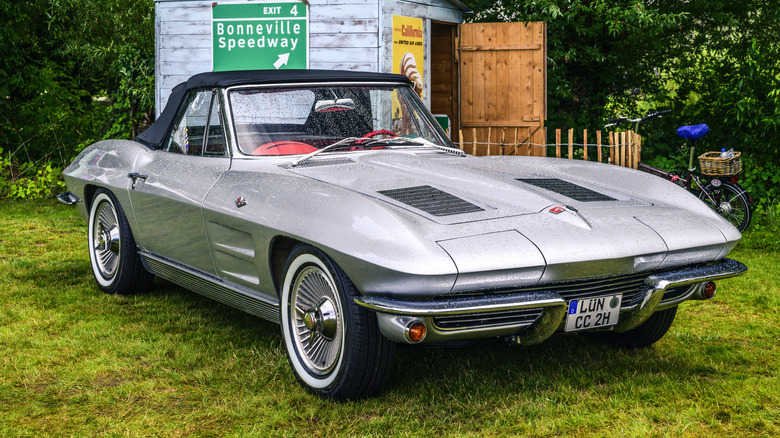
The formative decades of the Corvette nameplate relied on foundational engineering principles vastly removed from modern computer-aided design and compound tire chemistry. The second-generation C2 Sting Ray introduced independent rear suspension, a mechanical leap that transformed the car’s tractive capabilities on paper. However, historical testing underscores how far tire technology has advanced.
In retrospective evaluations conducted by outlets like Edmunds, a vintage 1966 Corvette Sting Ray equipped with bias-ply Firestone tires registered a modest 0.70 g of lateral grip—a figure surprisingly lower than modern family sedans like a contemporary Toyota Camry V6. Similarly, foundational C1 models from the 1950s and early 1960s, characterized by solid rear axles and narrow tread widths, struggled to match modern limits. When retrofitted with period-appropriate radial tires in later retrospective comparisons, a 1962 roadster managed 0.77 g, though its original bias-ply factory setup undoubtedly yielded lower real-world metrics. Described by period journalists as demanding beasts at the absolute limit, the C1 and C2 generations established the stylistic and cultural foundation upon which seven decades of American high-performance engineering were successfully built.