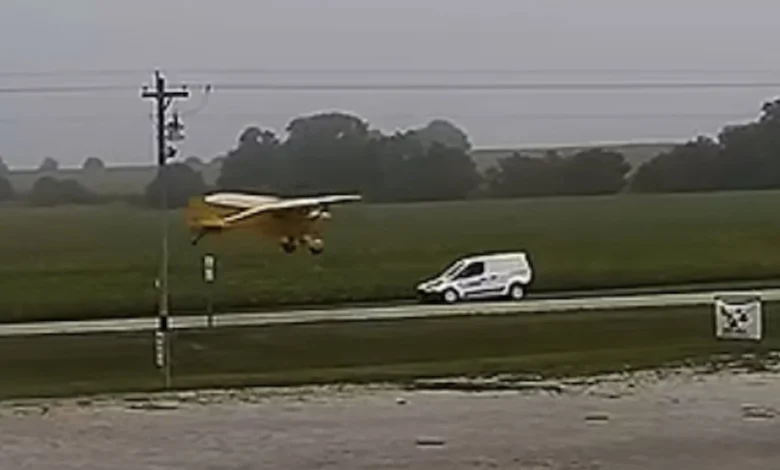
The morning routine for a local postal carrier in Gifford, Illinois, took a terrifying and unexpected turn on Sunday, September 20, when a small, vintage aircraft narrowly avoided a catastrophic collision with her delivery van before successfully touching down on a public highway. The incident, which unfolded rapidly along U.S. Route 136 in Champaign County near the Gordyville USA multi-event center, brought sudden panic to local motorists and drew a swift response from emergency authorities. Miraculously, despite the perilous proximity of the landing aircraft to heavy vehicular traffic and commercial delivery vehicles, no collisions occurred, and no injuries were reported among the civilian drivers, the postal worker, or the pilot.
Local affiliates and regional news outlets, including WCIA, quickly brought national attention to the remarkable event, capturing eyewitness testimony and security camera footage that illustrated just how close the aircraft came to disaster. As federal and state transportation authorities began evaluating the sequence of events, aviation enthusiasts and local residents alike were left marveling at the sheer fortune that prevented a tragedy on a seemingly ordinary Sunday morning.
Chronology of the Incident
The sequence of events began unfolding shortly before midday on Sunday, September 20. According to preliminary reports from the Illinois State Police and local eyewitness accounts, the pilot of a small aircraft encountered deteriorating or otherwise hazardous meteorological conditions while aloft, prompting an urgent necessity to set the plane down as quickly as possible.
Opting against navigating further through the unidentified weather system, the pilot lined up the aircraft with U.S. Route 136, a narrow, two-lane highway flanked by open fields and local commercial properties. As the aircraft descended rapidly, it bypassed nearby wide-open agricultural land in favor of the paved thoroughfare, creating an immediate hazard for vehicles traversing the highway.
A United States Postal Service mail carrier, driving her designated delivery van along the route, suddenly found herself sharing the asphalt with a descending airplane. According to witnesses, the aircraft cleared the roof of the mail van by mere feet, narrowly avoiding what could have been a fatal impact. Simultaneously, several commercial semi-truck drivers operating in the vicinity were forced to slam on their brakes, pulling aggressively onto the highway shoulders to avoid colliding with the unexpected airborne intruder.
Eyewitness accounts compiled in the immediate aftermath underscored the shocking nature of the landing. Josh Parrott, a local resident whose attention was drawn to the highway by the sudden screech of tires, described the terrifying closeness of the maneuver to reporters.
"I just heard three screeches, kind of like you would hear at an airport or somewhere like that, or maybe somebody hitting the brakes real hard, and then looked over to see what was happening," Parrott recounted. "And, lo and behold, there was a plane landing. I saw the wings barely over the mail truck. Came really close landing right on top of the mail truck."
The sudden acoustic disruption also prompted Parrott’s next-door neighbor, Hayden Henderson, to investigate. Emerging from his home, Henderson was greeted by the surreal sight of an airplane taxiing to a halt on the two-lane road. Comparing the auditory experience to the passage of a heavy freight train, Henderson noted that the aircraft’s engine remained actively engaged upon touchdown, discounting initial assumptions of a total mechanical failure and pointing instead toward an external impetus for the emergency landing.
Aircraft Identification and Specifications
Publicly available Federal Aviation Administration (FAA) records, corroborated by visual evidence from news coverage and eyewitness photographs, identified the aircraft involved in the incident as a 1949 Piper PA-15 Vagabond, bearing the tail number 4574H. Distinctive Piper branding was visibly displayed on the front cowling of the small yellow plane.
The Piper PA-15 Vagabond holds a notable place in aviation history. Developed in the post-World War II economic climate, the aircraft served as the direct successor to the legendary Piper Cub. To reduce manufacturing overhead and conserve critical building materials during a period of industrial adjustment, Piper designers shortened the aircraft’s wingspan significantly compared to its predecessor, as documented by the Piper Flyer Association.
Aviation experts observing the incident noted that the distinctive structural design choices of the 1949 Vagabond—specifically its shortened wingspan—may have inadvertently aided the pilot during the chaotic landing sequence. The compact footprint of the aircraft potentially reduced its lateral profile, assisting the pilot in threading the needle between roadside infrastructure, the postal van, and the evasive semi-trucks occupying the narrow confines of U.S. Route 136.
Official Response and Investigation
Law enforcement agencies and local first responders converged on the scene shortly after the aircraft came to a halt. Officers from the Illinois State Police secured the perimeter, temporarily closing U.S. Route 136 to ensure public safety and facilitate a preliminary investigation into the cause of the unscheduled landing.
While the pilot declined to provide an official statement to local media outlets, the Illinois State Police issued a brief summary indicating that the emergency maneuvers were executed "due to weather." Officials did not immediately elaborate on the specific meteorological phenomena—such as localized fog, severe wind shear, or an unexpected storm cell—that forced the aircraft down.
Questions arose among transportation observers regarding the pilot’s decision-making process, particularly given that security camera footage from the adjacent Gordyville USA facility clearly displayed expansive, unobstructed open fields running parallel to the highway. For an aircraft of the Piper Vagabond’s vintage and design—a classic tail-dragger configuration historically engineered to operate from unimproved surfaces—an open field might theoretically have presented a softer, less congested touchdown zone away from vehicular traffic and utility poles. Nevertheless, aviation safety analysts emphasize that split-second decisions made by pilots under duress must prioritize immediate structural integrity and obstacle clearance, factors that may have influenced the pilot’s ultimate trajectory toward the paved roadway.
Resolution and Re-Opening of the Route
Fortunately, the hazardous weather conditions that prompted the emergency landing proved to be transient. As meteorological conditions improved later in the afternoon, law enforcement authorities maintained a temporary closure of the highway to accommodate the departure of the aircraft.
With the roadway cordoned off to civilian traffic to provide a safe clearance corridor, the pilot boarded the Piper Vagabond, started the engine, and utilized the straight stretch of U.S. Route 136 as an improvised runway. The vintage aircraft successfully accelerated and took off from the highway, resuming its flight toward its original destination.
Following the aircraft’s departure, state troopers conducted a final safety inspection of the asphalt, cleared the highway of any residual debris, and fully reopened U.S. Route 136 to the public. The postal carrier, having narrowly survived an encounter that fundamentally disrupted her daily schedule, reportedly gathered her composure and completed her designated mail delivery route.
Broader Implications for Aviation and Highway Safety
Unscheduled emergency landings on public highways, while statistically rare, represent a distinct category of aviation incidents that test the coordination between local law enforcement, federal safety regulators, and civilian motorists. When a pilot experiences an in-flight emergency—whether precipitated by mechanical malfunction, fuel exhaustion, or sudden adverse weather—federal aviation guidelines prioritize the preservation of human life above all else, occasionally necessitating high-risk descents onto non-aviation infrastructure.
The Gifford incident highlights the unpredictable nature of general aviation operations and the resilience of transportation infrastructure workers. While commercial aviation operates under rigorous air traffic management and instrument-guided protocols, the general aviation sector relies heavily on the situational awareness and split-second judgment of individual pilots navigating uncontrolled airspace.
Furthermore, the event serves as a reminder of the vital role played by local first responders and state police forces in rapidly securing public rights-of-way during unexpected crises. The seamless transition from emergency containment to orderly departure prevented what could have been a multi-fatality traffic collision and preserved a piece of aviation history in the process. As the FAA and state authorities close the book on the Gifford landing without enforcement action or recorded injuries, the incident remains a remarkable footnote in regional transportation history—a testament to fortunate timing, pilot navigation under pressure, and the enduring dedication of postal workers who complete their rounds against all odds.