Harry Kane leads Bayern Munich to commanding Champions League victory over Atletico Madrid as European ambitions solidify

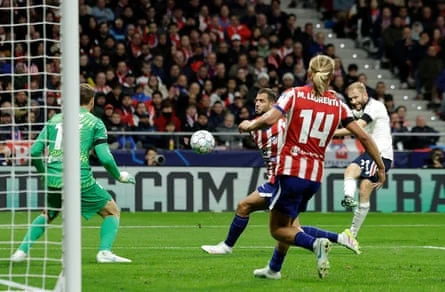
The atmosphere at the Metropolitano Stadium was thick with the weight of recent history for Harry Kane, yet the England captain’s return to the site of his 2019 Champions League final heartbreak served as the stage for a compelling statement of intent. On Tuesday night, Bayern Munich dismantled Atlético Madrid with a tactical clinicality that underscored their status as genuine contenders for this season’s continental crown. Despite a goalless individual tally for the newly crowned Ballon d’Or winner, Bayern’s 2-0 victory was a testament to the collective strength of a side that appears increasingly comfortable navigating the high-stakes pressure of European competition.
A Measured Performance of European Authority
From the opening whistle, it was evident that Vincent Kompany’s Bayern Munich had arrived in Madrid with a clear objective: to dominate the space and dictate the tempo. While the final scoreline read 2-0, the gulf in quality and physicality was arguably wider than the numbers suggested. Bayern maintained nearly 70% possession during the first half, pinning an Atlético side—usually renowned for their defensive rigidity—into their own defensive third for extended periods.
The tactical battle was defined by Bayern’s relentless pressing. Diego Simeone’s men, often masters of the "low block," found themselves suffocated by a high-intensity engine room led by Konrad Laimer and the creative vision of the midfield unit. For fifty-four minutes, Atlético successfully resisted the onslaught, relying on the shot-stopping capabilities of Jan Oblak and the desperate, compact maneuvering of their back line. However, the pressure eventually became unsustainable, leading to the breakthrough that shattered the deadlock.
Chronology of a Decisive Night
The match began with a flicker of ambition from the hosts, as Julián Álvarez sent a warning shot wide within the first two minutes. It proved to be a fleeting moment of offensive optimism for Atlético. By the 20-minute mark, the game had settled into a predictable rhythm: Bayern controlled the ball, while Atlético waited for rare, isolated counter-attacks that rarely materialized.

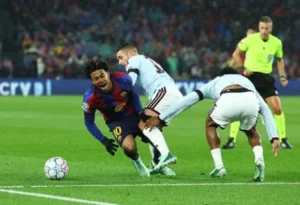
The turning point arrived nine minutes into the second half. A sustained period of pressure saw a deflected strike from Tom Bischof land fortuitously in the penalty area. In a moment of defensive miscommunication between Robin Le Normand and Marc Pubill, the ball was left loose. Lennart Karl reacted with the sharpness of a veteran, poking the ball past Oblak to silence the home crowd.
Following the goal, Simeone attempted to alter the trajectory of the match with a triple substitution, introducing Lee Kang-in, Koke, and Ademola Lookman. The tactical shift brought a temporary surge in energy, with Marcos Llorente forcing a significant save from Manuel Neuer in the 65th minute. Yet, Bayern’s defensive structure, anchored by Dayot Upamecano, remained resolute. As Atlético pushed for an equalizer, they left gaps in their own defensive lines, which Bayern exploited with surgical precision. The match was effectively sealed in the closing stages when Konrad Laimer, displaying composure beyond his years, dismantled the Atlético defense to drive a strike into the top corner, securing the 2-0 victory.
Statistical Dominance and Tactical Analysis
The metrics from the encounter illustrate a lopsided affair. Bayern registered nineteen shots over the course of the ninety minutes, compared to a meager output from the hosts. The visitors’ ability to transition from defense to attack was the hallmark of their performance, with Alphonso Davies and Konrad Laimer effectively operating as auxiliary attackers.
For Atlético, the statistics represent a troubling trend in their European campaign. Their inability to retain the ball in the midfield third meant that their star forwards, Alexander Sörloth and Julián Álvarez, were frequently isolated. Sörloth, in particular, was a lonely figure, often tasked with chasing long balls against a physically dominant Bayern backline. The data confirms that this was not merely a defeat for Simeone’s side, but a systemic failure to disrupt a technically superior opponent.
Contextualizing the European Landscape
This victory arrives at a pivotal moment in the Champions League group phase. With the new league-table format emphasizing cumulative points and goal difference, every away win carries significant weight. Bayern’s victory puts them in a commanding position to secure a high seed for the knockout rounds.

The broader landscape of European football saw significant activity elsewhere on the same night. Paris Saint-Germain’s 6-0 demolition of Villarreal served as a stark warning to the rest of the continent, with the French side setting a Champions League record for the fastest four-goal lead in history. Meanwhile, Inter Milan secured a clinical 3-0 victory over Feyenoord, and Galatasaray continued their impressive form with a 2-0 win over Stuttgart. These results, coupled with the tragic passing of Tenerife player Jesus de Miguel—which prompted a continent-wide moment of silence—added a somber tone to an evening of high-stakes competition.
Implications and Future Aspirations
For Harry Kane, the night was about more than just three points; it was about the psychological shedding of the past. Having lost the 2019 final in this very arena, his return was heavily scrutinized. While he did not register on the scoresheet, his involvement in the buildup play, his movement off the ball, and his role as the primary conduit for Bayern’s attacks confirmed his influence remains undiminished following his Ballon d’Or win.
The implications for Bayern Munich are clear: they are a team without glaring weaknesses. Their tactical flexibility—shifting from possession-based dominance to rapid, direct attacking play—suggests a side capable of going the distance in the tournament. As the competition moves toward the business end of the year, Bayern’s ability to win in difficult environments like the Metropolitano serves as a blueprint for their title aspirations.
"This stadium brings back bad memories, but I hope to be able to replace them with good ones," Kane had remarked on the eve of the match. While the final of the competition is still months away, the victory on Tuesday suggests that the England captain is on the right path to rewriting his personal history in Madrid. For now, the focus shifts to the domestic league and the next round of European fixtures, but the message delivered to the rest of the Champions League field is unambiguous: Bayern Munich is ready to challenge for the ultimate prize.
As the squad departs Spain, they do so with the confidence of a team that has faced down a formidable opponent and emerged largely unscathed. The challenge for Kompany now lies in maintaining this consistency. In a competition defined by razor-thin margins, performances like this one are the building blocks of a championship campaign. With the momentum firmly on their side, Bayern Munich has firmly established itself as the team to beat in this year’s Champions League, setting a standard of excellence that their rivals will find difficult to match.