The Rediscovery of the Ghana Cuckooshrike in Côte d’Ivoire Marks a Major Victory for West African Conservation Efforts

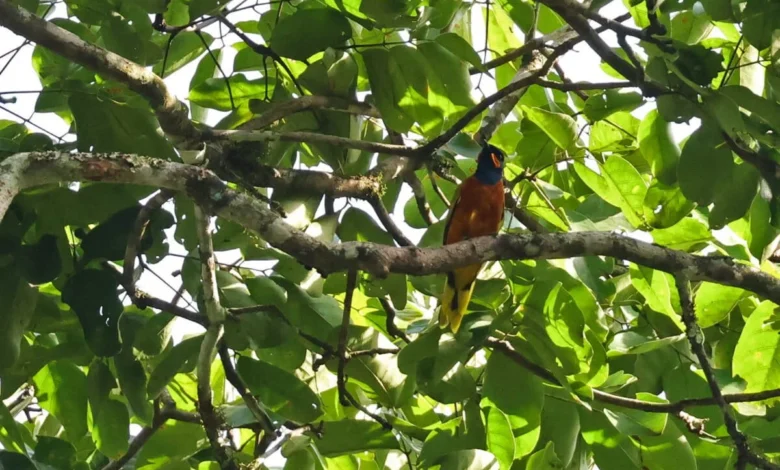
The elusive Ghana cuckooshrike (Lobotos lobatus), a vibrant bird species that had effectively vanished from the scientific record for over a decade, has been officially sighted within the dense, humid canopy of Côte d’Ivoire’s Taï National Park. This remarkable rediscovery, confirmed by researchers from the International Bird Conservation Partnership (IBCP), concludes a 13-year period of uncertainty regarding the status of a bird once feared to be on the precipice of extinction. The finding serves as both a biological triumph and a stark reminder of the urgent need for habitat preservation within the rapidly fragmenting Upper Guinean Rainforest.
A Decade of Silence and the Hunt for a Lost Species
The Ghana cuckooshrike, characterized by its striking plumage—a brilliant orange body accented by contrasting black and yellow wings—has long been a target for ornithologists tracking the biodiversity of West Africa. Before the recent mission in Taï National Park, the last verified scientific documentation of the species occurred in 2013 within the Atewa Forest of Ghana. Following that encounter, the bird entered a period of silence that lasted more than a decade, leading to its inclusion on the "Search for Lost Birds" (SLB) list, a collaborative initiative designed to track and rediscover avian species that have evaded scientific observation for ten years or more.
The expedition that led to the bird’s discovery was a testament to the persistence of field biology. Stephanie Bartlett and Paulo Ditzel, research fellows with the IBCP, spent months navigating the challenging terrain of the Taï National Park. Their success relied heavily on a sophisticated methodology involving intensive audio-visual surveys and the indispensable expertise of local West African research partners, whose intimate knowledge of the forest’s avian movements proved vital to the project’s success.
The encounter itself was fleeting. According to reports from the field, Ditzel identified the bird’s subtle movements within the canopy and alerted Bartlett, who utilized her camera as a primary diagnostic tool. "They’re scared of you," Bartlett noted, explaining that the birds are notoriously elusive and prone to avoiding human presence. "You don’t get to get close to them, and so often you have to use the camera as a tool for identification." The resulting photograph provided the definitive evidence required to remove the species from the "lost" status, providing the first concrete proof that the population persists in the Ivorian wild.
Ecological Context and the Upper Guinean Rainforest
To understand the gravity of this discovery, one must examine the state of the Upper Guinean Rainforest. This ecological region, stretching across several nations from Guinea to Ghana, is one of the world’s most significant biodiversity hotspots. However, it is also among the most threatened. Centuries of logging, agricultural expansion, and, more recently, the encroachment of artisanal gold mining have carved the once-continuous forest into isolated, fragmented patches.
The Ghana cuckooshrike serves as a bio-indicator for the health of these forests. As an insectivore that thrives in the upper levels of the canopy, its presence suggests that the specific micro-habitats it requires—likely characterized by mature, high-canopy trees and a stable insect population—are still intact within Taï National Park. Conversely, the bird’s 13-year absence highlights the severe impact of habitat loss. If the species is unable to navigate between fragmented forest patches, the population becomes genetically isolated, rendering it significantly more vulnerable to localized extinction events caused by climate change, disease, or further environmental degradation.
The Challenges of Conservation Without Data
For conservationists, the Ghana cuckooshrike presented a classic "data-deficient" dilemma. John Mittermeier, director of the Search for Lost Birds and a representative of the American Bird Conservancy, has frequently highlighted the difficulty of protecting a species that remains unseen. "You can’t really make an effective conservation plan for a species that nobody’s seen in 10 years," Mittermeier stated. "You’re not sure how it’s doing. You’re not sure where it is."
Without verified sightings, the scientific community struggled to determine whether the bird was truly extinct, critically endangered, or simply existing in such low densities that it had become nearly impossible to detect. The recent sighting in Taï allows researchers to shift from a stance of "searching" to a strategy of "management." By confirming the bird’s presence, the IBCP and its partners can now focus on habitat monitoring, population estimates, and identifying the specific threats that may be hindering the species’ recovery.

The Role of Local Expertise and Institutional Support
The rediscovery was not the work of a single team, but rather the result of a concerted, multinational effort. Saint Guillaume Odoukpe, an ornithologist and assistant professor at the Université Félix Houphouët-Boigny in Côte d’Ivoire, played a crucial role in coordinating the expedition. His involvement underscores the importance of fostering local capacity in biodiversity research.
"Taï is a treasure for biodiversity conservation in Côte d’Ivoire and indeed throughout West Africa," Odoukpe remarked following the discovery. He expressed a strong belief that the park, which remains one of the largest protected areas of primary tropical rainforest in West Africa, holds many more secrets. His sentiment echoes a broader movement within the scientific community to elevate local researchers to the forefront of conservation science, ensuring that the stewardship of regional biodiversity remains grounded in the expertise of those who live and work within the ecosystem.
Implications for Future Exploration
The successful location of the cuckooshrike has reinvigorated interest in the "lost birds" initiative. It suggests that even in an age of satellite imagery and global surveillance, there is still immense value in traditional, boots-on-the-ground field biology. The event has acted as a catalyst, prompting researchers to consider what other species might be hiding in plain sight, waiting for the right combination of patience, technology, and local knowledge to be revealed.
However, the euphoria of the discovery is tempered by the ongoing reality of the threats facing Taï National Park. Illegal gold mining, which often leads to mercury contamination of water sources and the destruction of forest undergrowth, remains a persistent danger. Similarly, illegal hunting continues to exert pressure on the park’s wildlife. The survival of the Ghana cuckooshrike is intrinsically linked to the efficacy of the enforcement mechanisms protecting the park.
A Call to Continued Vigilance
As the scientific community celebrates this breakthrough, the focus is already shifting toward the next phase of the project: protection. The IBCP and the university partners in Côte d’Ivoire are expected to release more detailed data regarding the habitat conditions where the bird was spotted. This data will be instrumental in advocating for more robust protection of those specific corridors within the park.
In the broader scope of global environmental policy, the Ghana cuckooshrike is a symbol. It represents the thousands of species currently listed as "data-deficient" or "lost" that could be saved if enough resources are directed toward exploration and habitat preservation. The message from the researchers is clear: the natural world still holds surprises, but those surprises are increasingly fragile.
John Mittermeier’s concluding remarks to the media summarize the philosophical shift brought about by this discovery: "We have this sense sometimes that there’s nothing left to explore. But actually, there’s so many things left to explore, and in a way, these lost birds are a call to exploration."
The rediscovery of the Ghana cuckooshrike is not merely a bullet point in a taxonomic database; it is a vital piece of the puzzle in understanding the resilience of the Upper Guinean Rainforest. As the international conservation community looks to the future, the bird stands as a small, orange-and-black testament to the necessity of protecting the planet’s remaining wild spaces. The work to ensure this bird does not disappear for another 13 years—or forever—begins now, grounded in the hard-won evidence that it is, against the odds, still there.