Congress Passes Landmark Ackerson Meadow Land Interchange Act to Streamline Yosemite National Park Boundaries

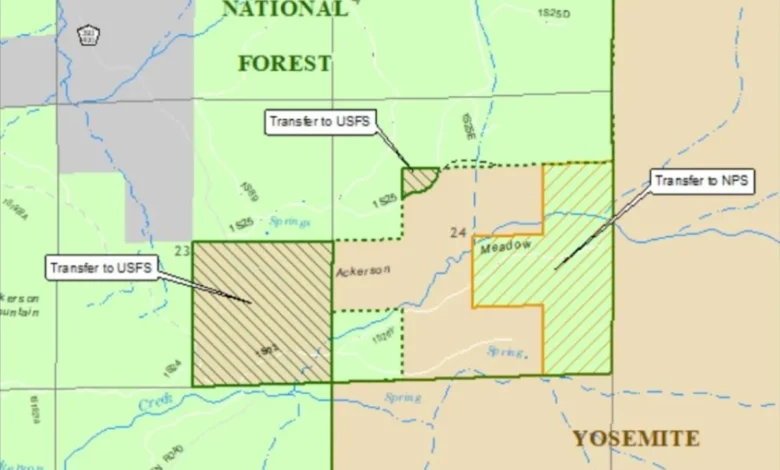
The United States Congress has successfully passed the Ackerson Meadow Land Interchange Act, a rare piece of bipartisan legislation aimed at recalibrating the eastern boundary of Yosemite National Park. The bill, which cleared both chambers with broad support, facilitates a strategic 330-acre land swap between the National Park Service (NPS) and the U.S. Forest Service (USFS). This legislative maneuver seeks to resolve long-standing jurisdictional friction in the Sierra Nevada, promising to simplify federal land management, enhance wildlife corridor protections, and provide much-needed regulatory clarity for local agricultural stakeholders. As the bill awaits executive action from President Trump, the move represents a significant adjustment to one of the most iconic landscapes in the American West.
The Mechanics of the Exchange
At the heart of the legislation is a logistical trade designed to harmonize the administrative responsibilities of two federal agencies. Under the provisions of the act, 160 acres of land currently managed by the Stanislaus National Forest will be transferred to the jurisdiction of the National Park Service, effectively incorporating the territory into the official footprint of Yosemite National Park. Simultaneously, 170 acres of land currently within the legal boundaries of Yosemite will be transferred to the U.S. Forest Service to be managed as part of the Stanislaus National Forest.
This is not a net loss or gain for federal land holdings, but rather a functional realignment. The primary objective is to eliminate the “checkerboard” pattern of land management that has historically complicated federal oversight in the region. By consolidating contiguous blocks of land under the agency best suited for their specific use, the government aims to reduce bureaucratic overlap. The National Park Service, which typically prioritizes conservation and public access over resource extraction, will gain territory essential for habitat connectivity, while the Forest Service will gain jurisdiction over land that better integrates with its existing management protocols for grazing and forestry.
A Chronology of the Ackerson Meadow Acquisition
The impetus for this legislative shift began nearly a decade ago, rooted in a significant private donation that highlighted the shortcomings of the park’s existing borders. In 2016, the Trust for Public Land acquired the 400-acre Ackerson Meadow parcel. Recognizing its ecological significance as a vital meadow system and wildlife corridor, the organization gifted the land to Yosemite National Park.
However, the acquisition created an immediate administrative paradox. While the land was technically part of the national park, it remained geographically isolated from the main body of Yosemite, wedged deep within the neighboring Stanislaus National Forest. For eight years, this created a management island, where NPS staff were tasked with overseeing property that was virtually inaccessible through the park’s established infrastructure. The Ackerson Meadow Land Interchange Act is the culmination of years of lobbying by local, state, and federal officials to rectify this geographic anomaly.
The legislative process accelerated significantly in late 2026. Following months of committee review and negotiation between Democratic Senator Alex Padilla and Republican Representative Tom McClintock, the bill gained momentum in early November. It was formally passed by Congress on November 18, 2026, marking a moment of legislative unity during a period often defined by intense political polarization.
Environmental and Economic Context
The significance of Ackerson Meadow extends beyond simple mapping. Ecologists have long identified the area as a critical habitat for high-elevation species and a primary corridor for wildlife moving between the lower foothills and the high Sierra. Because the meadow acts as a natural water filtration system and a fire-resistant buffer, its protection is considered essential for the long-term health of the region’s watershed.

The legislative focus on the “checkerboard” boundary is also deeply tied to the economic realities of the rural counties surrounding Yosemite. The Sierra Nevada foothills are home to generational ranching families who rely on grazing permits issued by the U.S. Forest Service. Because the NPS and the USFS operate under vastly different mandates—with the former generally prohibiting commercial grazing and the latter facilitating it—the historical, irregular boundary lines created significant uncertainty for local ranchers. Farmers often found themselves operating on the edge of two different sets of federal regulations, complicating their ability to maintain infrastructure or rotate livestock. By cleaning up these boundaries, proponents of the bill argue that the government is providing a more stable environment for both the environment and the local economy.
Political Climate and Legislative Scrutiny
The passage of this bill occurs within a broader, often contentious, national debate regarding the status of public lands. The year 2026 has been marked by several high-profile controversies regarding the federal government’s role as a steward of the American wilderness.
In August, reports emerged alleging that the National Park Service was engaged in negotiations to swap specific parcels of land within Yosemite to facilitate the construction of a private road for a commercial real estate developer. This sparked immediate backlash from environmental groups and lawmakers, who accused the administration of prioritizing private interests over public trust. Furthermore, in September, a proposal by Major League Baseball to host an exhibition game at Grand Teton National Park prompted a national debate over the commercialization of federal landscapes.
Against this backdrop, the Ackerson Meadow Land Interchange Act stands out as a focused, bipartisan success. Senator Alex Padilla emphasized that the legislation is a "simple and beneficial exchange" that avoids the controversies associated with privatization. By framing the bill as an effort to improve conservation and support rural livelihoods, supporters were able to insulate the legislation from the political firestorms that have surrounded other land-use proposals in the current administration.
Analytical Implications: What Lies Ahead
The implications of this act are largely administrative, yet they set an important precedent for future land management in the United States. By prioritizing logical, geography-based boundaries over historical, arbitrary lines, the federal government is signaling a shift toward more pragmatic land stewardship.
However, the transition will not be without its challenges. The transfer of 330 acres requires a comprehensive mapping and signage overhaul, as well as the reassignment of patrol duties and maintenance responsibilities. Park rangers and forest service employees will need to coordinate closely during the transition to ensure that there is no gap in coverage or enforcement during the handover.
Furthermore, while the act solves the specific issue of the Ackerson Meadow, many environmental advocates point out that much of the American West remains a "checkerboard" of federal, state, and private ownership. This mosaic of jurisdictions often complicates large-scale wildfire management and climate adaptation strategies. The success of this bipartisan effort could serve as a pilot program for similar boundary reforms in other national parks where administrative fragmentation hampers conservation efforts.
As the bill heads to President Trump’s desk, the mood among proponents is one of cautious optimism. If signed into law, the act will be implemented over the coming months, marking the first major boundary shift for Yosemite in several years. For the residents of the Sierra Nevada and the millions of visitors who flock to the park annually, the shift represents a commitment to maintaining the integrity of one of the world’s most cherished landscapes. Whether this represents a broader trend in federal land management or remains an isolated success story remains to be seen; however, the consensus among policymakers is that the Ackerson Meadow exchange is a necessary step toward modernizing the way the United States protects its most valuable natural assets.