The European Space Agency’s Hera spacecraft has officially arrived at the binary asteroid system Didymos and Dimorphos, delivering unprecedented visual data and scientific insights regarding a historic kinetic impact test conducted four years ago. In September 2022, NASA’s Double Asteroid Redirection Test (DART) mission executed a high-stakes, controlled collision with the smaller of the two space rocks, Dimorphos. The primary objective of the mission was to determine whether a human-made spacecraft could successfully alter the trajectory of an asteroid, establishing a baseline for planetary defense against potential Earth-bound threats.
Initial measurements collected by ground-based and spaceborne telescopes confirmed that the kinetic impact was a resounding success. Traveling at a velocity of more than 13,700 miles per hour, the car-sized DART probe released approximately 10 billion joules of energy upon impact. This forceful collision significantly shortened Dimorphos’s 12-hour orbital period around its larger companion, Didymos, by roughly 33 minutes—exceeding NASA’s most conservative mission expectations by a factor of 25. However, because the DART spacecraft was entirely destroyed during the collision, scientists were left with substantial gaps in their understanding of the physical mechanisms at play, relying primarily on distant telescopic observations and a fleeting flash recorded by an accompanying CubeSat.
To bridge these critical knowledge gaps, the European Space Agency launched the Hera mission. Following a meticulous two-year interplanetary cruise, Hera has finally entered the vicinity of the Didymos-Dimorphos system, positioned approximately 120 million miles from Earth. The high-resolution imagery and spectral data transmitted back to mission control over the past week have begun to solve the remaining mysteries of the DART impact, revealing a dramatic transformation of the target asteroid and an unexpected swarm of orbital debris.
A Landscape Reshaped: The Stadium-Sized Crater
The first reconnaissance images released by the ESA illustrate the profound geological consequences of the 2022 collision. Rather than merely punching a localized hole into the surface of the 500-foot-wide Dimorphos, the DART impactor carved out a colossal crater that spans nearly the entire width of the asteroid itself.
Before Hera’s arrival, planetary scientists debated whether the kinetic impact would produce a classic localized crater or fundamentally reshape the body of the asteroid. According to Patrick Michel, Hera’s principal investigator from the Côte d’Azur Observatory in Nice, France, the mission has revealed an unprecedented geological reality. "I would say we had two kinds of predictions: either we made a crater, or we reshaped the asteroid," Michel explained. "In fact, we did both because the crater is so large that the shape has changed. Therefore, we are in a sort of a transition between just cratering and global transformation, and we are still not sure how this can happen."
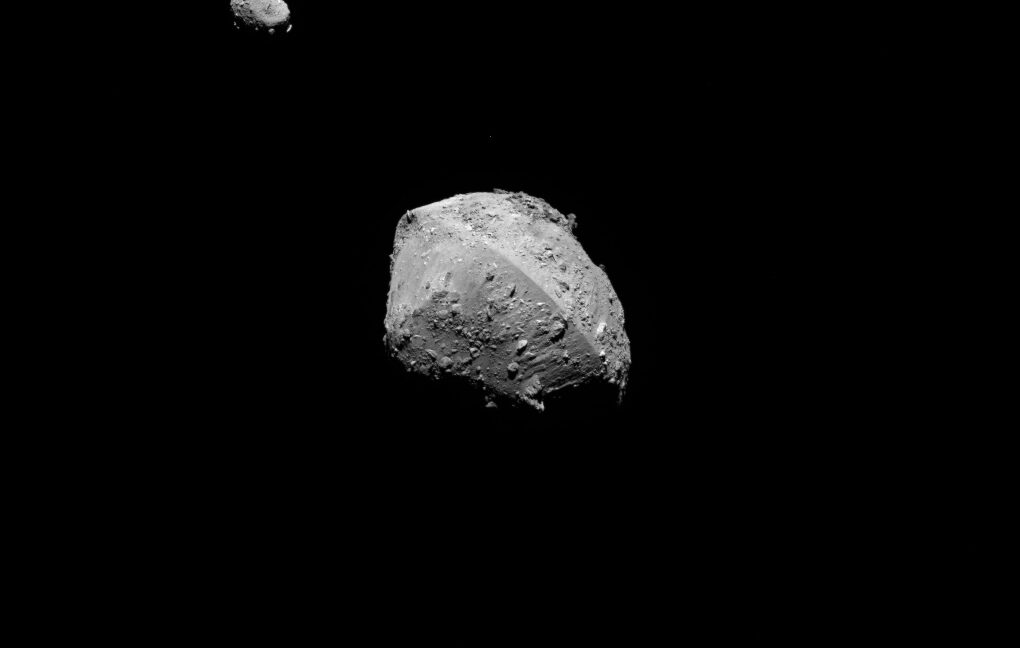
Furthermore, while the larger asteroid, Didymos, continues to rotate steadily on its axis in a predictable manner, its smaller companion has been thrown into a state of chaotic motion. Michael Kueppers, ESA’s Hera mission scientist, noted that the returned images confirm the impact left Dimorphos tumbling wildly in its orbit, underscoring the severe mechanical disruption experienced by the body.
The Accidental Debris Field: Hundreds of Bounding Boulders
Perhaps the most surprising revelation from Hera’s initial approach is the sheer volume of material ejected into the surrounding space. While the Hubble Space Telescope previously detected a faint, extended dust tail trailing behind the Didymos-Dimorphos system shortly after the 2022 impact, the close-range imagery captured by Hera reveals an extensive swarm of large rock fragments.
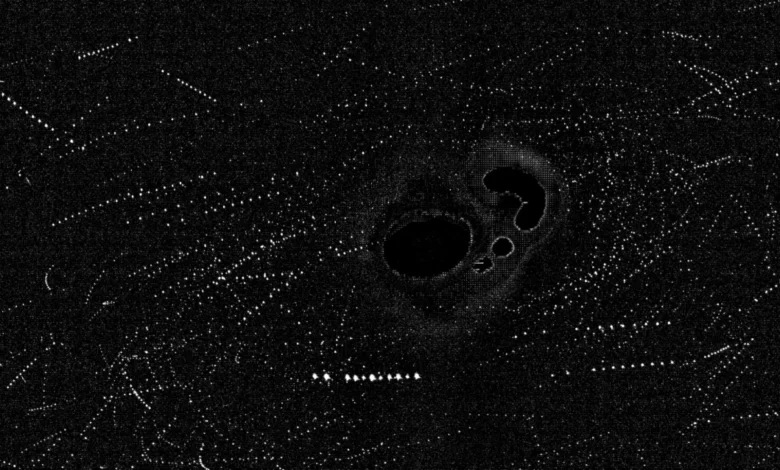
Using Hera’s Hyperscout-H instrument, mission scientists compiled a long-exposure composite image of the region surrounding Didymos. By digitally subtracting the light emissions of the two primary asteroids, researchers uncovered hundreds of distinct dot trails corresponding to moving boulders. These debris fragments range dramatically in size, with dimensions spanning from standard footballs to large washing machines.
"As we approached Didymos and Dimorphos, we quickly realized the asteroids were not alone," remarked Naomi Murdoch, a planetary scientist at the Institut Supérieur de l’Aéronautique et de l’Espace in Toulouse, France. "In fact, they had a lot of company… Hera came to visit two asteroids, and we found hundreds of companions."
While the logical assumption links this dense field of orbiting debris directly to the excavation forces unleashed by DART, scientists maintain a degree of scientific caution. Because Hera represents the first dedicated, sustained space mission to study a binary asteroid system up close, researchers cannot yet definitively rule out the possibility that a portion of these boulders may represent ancient geological relics left over from the formation of Dimorphos itself.
Chronology of the Planetary Defense Initiative
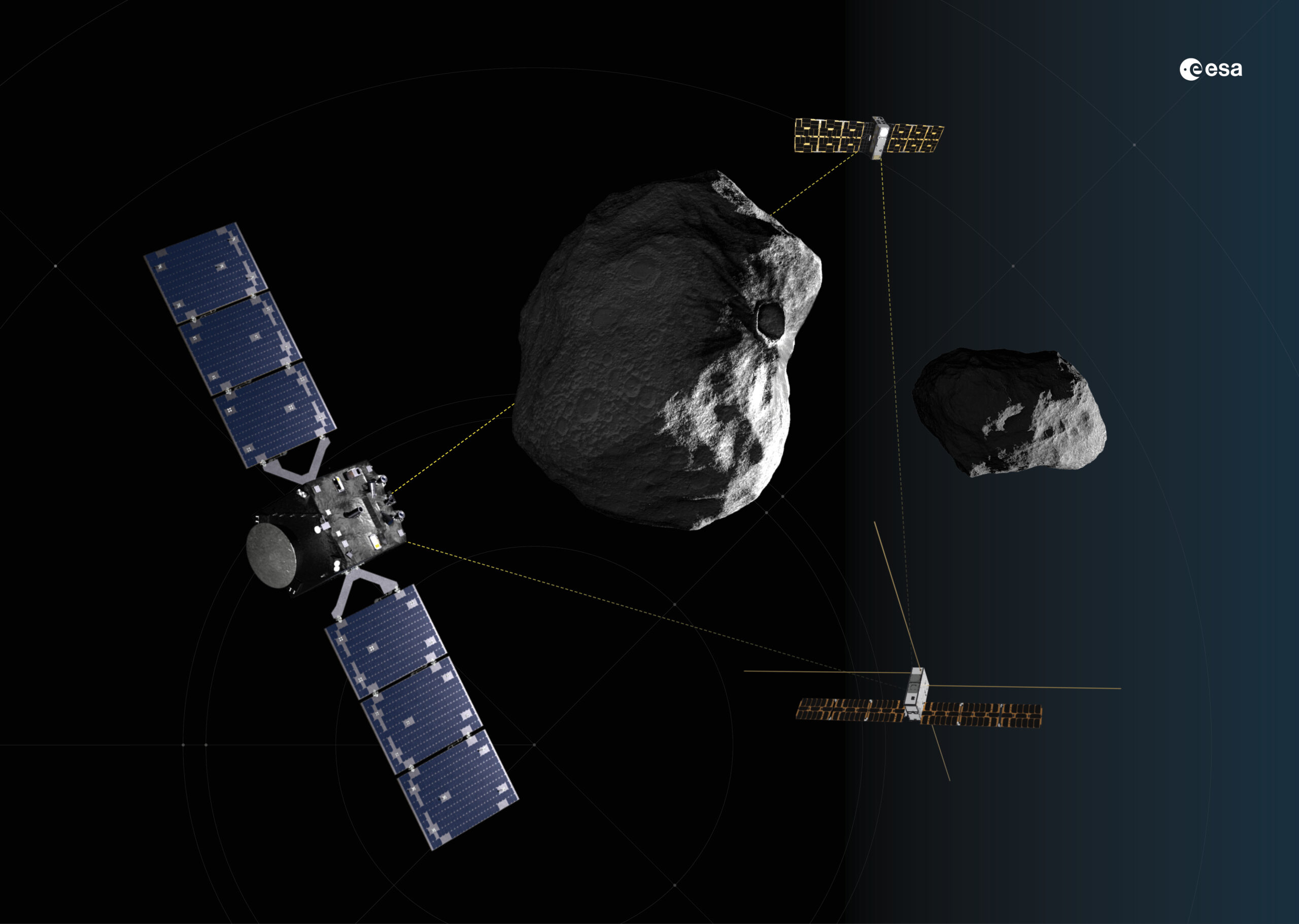
The ongoing investigation of the Didymos-Dimorphos system is the culmination of decades of theoretical orbital mechanics and international cooperation, executed through a strict timeline:
- November 2021: NASA successfully launches the DART spacecraft aboard a SpaceX Falcon 9 rocket from Vandenberg Space Force Base in California, setting a course toward the binary asteroid system.
- September 2026 (Historical): DART executes its terminal guidance sequence, successfully impacting Dimorphos at 6.14 kilometers per second, successfully shifting its orbital period.
- October 2024: The European Space Agency launches the Hera spacecraft from Cape Canaveral, Florida, initiating its two-year transit toward the impact site.
- Late 2024 to Early 2026: Ground-based telescopes, alongside the Hubble and James Webb Space Telescopes, continuously monitor the dust plume and orbital decay parameters of the target system.
- Late 2026: Hera arrives in the vicinity of Didymos and Dimorphos, initiating its primary optical and spectral reconnaissance phase and transmitting the first high-resolution images of the impact scar and surrounding boulder field.
Future Operations and the Roadmap for Planetary Defense
Hera’s arrival marks merely the beginning of an intensive, six-month orbital campaign. Over the coming months, the spacecraft will execute increasingly close flybys of both Didymos and Dimorphos to map their surfaces in microscopic detail, measure their gravitational fields, and determine their precise internal densities and mass distributions.
A cornerstone of the extended mission involves the deployment of two small sub-satellites, designated Juventas and Milani. These CubeSats will descend closer to the surface, with the ultimate objective of attempting touch-downs on Dimorphos. By utilizing radar and surface-sampling instruments, the CubeSats will gather critical data regarding the internal structural integrity of the asteroid.
This empirical data is essential for the refinement of predictive computer models. Near-Earth objects vary widely in their structural composition, ranging from solid, monolithic metallic rocks to loosely bound "rubble piles" held together solely by weak gravitational forces. By understanding precisely how Dimorphos—a rubble-pile asteroid—responded to the specific energy transfer of the DART impact, planetary scientists can generalize these physical principles to accommodate any prospective asteroid threat.
"Once we understand, we have a breakthrough, which really solves planetary defense," Michel emphasized, summarizing the ultimate stakes of the collaborative international mission. As Hera continues its detailed survey over the next half-year, humanity moves steadily closer to establishing a reliable, scientifically validated toolkit capable of safeguarding the planet from future celestial impacts.