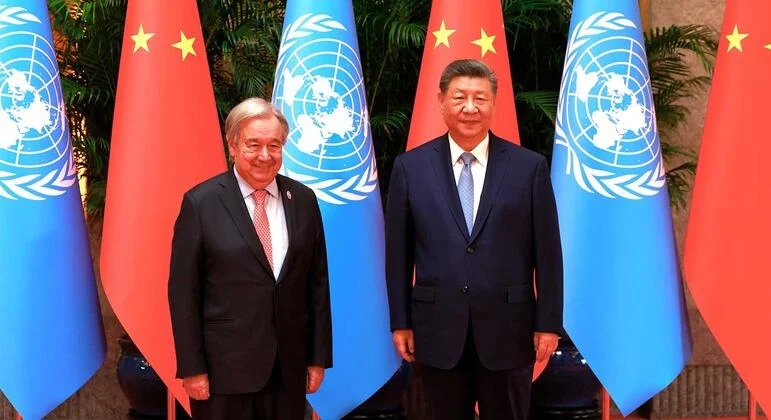
United Nations Secretary-General António Guterres issued a stark warning and a powerful call to action at the opening ceremony of the World Artificial Intelligence Conference (WAIC) in Shanghai, emphasizing that artificial intelligence, while holding immense promise as "humanity’s greatest opportunity in the 21st century," simultaneously poses "one of its greatest risks." The Secretary-General unequivocally stated that technology destined to shape the future of humanity must be shaped by all of humanity, not solely by a select group of countries or corporations. He underscored the critical need for inclusive governance, asserting that "every nation needs a seat at the table" to prevent the technology from widening global inequality rather than advancing sustainable development.
The Shanghai Platform: A Global Stage for AI Dialogue
The World Artificial Intelligence Conference (WAIC), held annually in Shanghai, China, has rapidly emerged as a preeminent global forum for leaders in technology, government, academia, and industry to discuss the latest advancements, applications, and societal implications of AI. China, a burgeoning powerhouse in AI research and development, uses WAIC to showcase its ambitions and foster international collaboration. Guterres’s presence at such a significant event highlights the United Nations’ increasing focus on global digital governance and the urgency it places on establishing a universal framework for AI development and deployment. His address in Shanghai was strategically chosen to reach a diverse audience of policymakers, innovators, and entrepreneurs, reinforcing the message that AI’s future is a shared responsibility, transcending national borders and corporate interests. The conference, typically drawing tens of thousands of participants and featuring cutting-edge demonstrations, provides a critical platform for shaping the discourse around responsible AI innovation.
AI’s Dual Nature: Opportunity and Existential Risk
The Secretary-General meticulously elaborated on the paradoxical nature of AI, presenting it as both a catalyst for unprecedented progress and a potential harbinger of profound societal disruption. On the one hand, AI offers transformative potential across numerous sectors. In medicine, it promises to accelerate breakthroughs in drug discovery, personalize treatments, and enhance diagnostic accuracy, potentially extending healthy lifespans globally. For education, AI can facilitate adaptive learning platforms, bridge knowledge gaps, and provide remote access to quality instruction, democratizing opportunities for millions. Agriculture stands to benefit from precision farming techniques, optimizing resource use and strengthening food systems against climate change and other shocks. Furthermore, the emergence of AI-driven industries could stimulate economic growth and create new categories of jobs, driving progress towards the Sustainable Development Goals (SDGs) by addressing complex global challenges like poverty, hunger, and climate change.
However, Guterres cautioned that these benefits are not guaranteed to be universally distributed. The risks, if left unaddressed, are equally profound. The rapid pace of AI development, coupled with its immense computational demands, raises concerns about job displacement in sectors susceptible to automation, potentially exacerbating economic insecurity for large segments of the workforce. Algorithmic bias, inherent in data sets reflecting societal prejudices, could perpetuate and amplify discrimination in areas such as hiring, lending, and criminal justice. The proliferation of sophisticated surveillance technologies enabled by AI threatens privacy and civil liberties. Perhaps most critically, the concentration of AI power in the hands of a few nations or corporations risks creating new geopolitical divides, consolidating power, and eroding democratic principles, potentially leading to a future where AI serves narrow interests rather than the collective good of humanity. The very real possibility of autonomous weapons systems, capable of making life-and-death decisions without human intervention, also looms large as an ethical and security nightmare.
A Call for Inclusive Governance: Beyond a Handful of Powers
Guterres’s insistence that AI governance "cannot be governed by a handful of countries or companies" directly confronts the current reality of the global AI landscape. Currently, the lion’s share of investment, research, and development in AI is concentrated in a few technological hubs, primarily in North America and East Asia. This concentration gives a disproportionate influence to a limited number of powerful states and multinational corporations in setting de facto standards, shaping technological trajectories, and defining ethical norms. The Secretary-General’s call for "every nation to have a seat at the table" is a plea for democratizing the future of AI. It acknowledges that the perspectives, values, and needs of diverse cultures and economies – particularly those in the Global South – are essential for creating AI systems that are truly beneficial, equitable, and respectful of human rights across the board. Without such inclusivity, AI risks reflecting and reinforcing the biases and priorities of its creators, rather than serving as a tool for universal advancement. The geopolitical implications are significant, as control over cutting-edge AI could translate into unprecedented economic, military, and diplomatic power, potentially destabilizing international relations and creating a new form of digital colonialism.
The United Nations’ Proactive Stance: A Timeline of Governance Efforts
Recognizing the escalating importance and complexity of AI, the United Nations has significantly stepped up its efforts on AI governance over the past year. This proactive engagement reflects a broader understanding within the international community that a fragmented, unregulated approach to AI could lead to catastrophic consequences. These initiatives aim to foster global dialogue, establish common standards, and ensure that the benefits of AI are shared equitably.
A key milestone in this chronology was the adoption of the Global Digital Compact. While not exclusively focused on AI, this compact, developed through an inclusive multi-stakeholder process, provides a foundational framework for an open, free, and secure digital future for all. It addresses issues of digital inclusion, human rights online, trust and security, and the governance of emerging technologies, laying the groundwork for more specific AI policies.
Building on this, the UN General Assembly backed the establishment of the Independent International Scientific Panel on AI. This panel marks a crucial development, being the first global scientific body dedicated specifically to the revolutionary technology. Its mandate is to provide independent, evidence-based assessments of AI’s capabilities, risks, and potential benefits, informing policymakers and ensuring that governance decisions are grounded in sound scientific understanding. This move mirrors the success of similar UN-backed scientific panels, such as the Intergovernmental Panel on Climate Change (IPCC), which provides authoritative scientific assessments on climate change.
Earlier this month, a critical step was taken with the first session of the Global Dialogue on AI Governance in Geneva. This gathering brought together governments, civil society organizations, academic experts, and private sector stakeholders for open, transparent, and inclusive discussions on the myriad challenges and opportunities presented by AI governance. The dialogue aims to create a shared understanding of best practices, identify areas for international cooperation, and build consensus around principles for responsible AI development and deployment. These recent initiatives collectively aim to facilitate the sharing of expertise among countries, promote the adoption of common standards, and amplify the voices of developing nations in shaping the technology’s future. Guterres emphasized that the next crucial phase must focus on translating these commitments into practical support, ensuring that all countries can genuinely benefit from AI’s rapid development.
Bridging the Digital Divide: A Global Imperative
The Secretary-General underscored that while AI holds enormous potential to accelerate progress towards the Sustainable Development Goals (SDGs) – from eradicating poverty and hunger to ensuring good health and quality education – many developing countries remain at severe risk of being left behind. He highlighted a stark reality: "One-third of humanity is still offline." According to recent data from the International Telecommunication Union (ITU), approximately 2.7 billion people globally remain unconnected to the internet, creating a significant barrier to accessing AI-driven tools and participating in the digital economy.
This digital divide is compounded by other disparities. Computing power, the fundamental engine of AI, remains heavily concentrated in a small number of economically advanced nations. Similarly, the technical expertise required to develop, implement, and manage sophisticated AI systems is scarce in many developing regions. Furthermore, the vast majority of investment in AI flows into a handful of countries and companies, perpetuating a cycle where those with resources innovate, while those without fall further behind. Unless these profound disparities are actively addressed, Guterres warned, AI could inadvertently lead to "greater inequalities, greater divides in income, in opportunity, in security." This would not only be a moral failing but also a significant impediment to achieving global peace and sustainable development.
To help bridge these critical gaps, Mr. Guterres announced tangible initiatives. He noted that over 20 countries, including China, have already nominated centers to participate in a UN-supported Global Network for Exchange and Cooperation on AI Capacity Building. This network is designed to facilitate knowledge transfer, share best practices, and build local expertise in AI development and application. Crucially, the Secretary-General also revealed plans to soon present recommendations for a Global Fund for AI, calling on governments and other stakeholders to support both initiatives. Such a fund would provide much-needed financial resources to developing nations, enabling them to invest in infrastructure, training, and ethical AI development tailored to their specific contexts and needs, ensuring they are not merely consumers but active participants and innovators in the AI revolution.
Guterres’s Three Pillars for a Human-Centric AI Future
To ensure that AI truly benefits everyone, Guterres outlined three overarching priorities that demand immediate and concerted global action:
1. Expanding Capacity in Developing Countries: This priority is foundational to achieving equitable AI development. It goes beyond simply providing access to technology; it encompasses empowering developing countries to build, deploy, and govern AI systems using their own data, languages, and local expertise. This means fostering robust educational programs in AI and data science, investing in digital infrastructure, promoting local innovation ecosystems, and ensuring data sovereignty. The goal is to move beyond a model where developing nations are passive recipients of AI developed elsewhere, towards one where they are active contributors, shaping AI solutions that are culturally relevant and address their unique challenges, such as optimizing agricultural yields in specific climates or improving healthcare delivery in remote areas.
2. Establishing International Safety Standards: The Secretary-General stressed the urgent need for common international approaches to AI testing and risk management, firmly grounded in international law. This includes developing globally recognized benchmarks for AI safety, reliability, and ethical performance. A critical aspect is the unwavering protection of human rights in the age of AI. This means ensuring transparency in algorithmic decision-making, establishing robust accountability mechanisms for AI systems, and safeguarding privacy. Guterres emphasized that "Humans must keep control over every life-and-death decision," directly addressing concerns around autonomous weapons and critical infrastructure control. He also highlighted the particular vulnerability of children, stating unequivocally that "no AI system should be put in a child’s hands before it has been proven safe," advocating for stringent safeguards and age-appropriate design principles.
3. Making AI More Environmentally Sustainable: The rapidly increasing computational demands of AI, particularly for training large language models and complex neural networks, carry a significant environmental footprint. Guterres called on major AI companies to transparently disclose the environmental impact of their systems, including energy consumption, carbon emissions, and water usage. Furthermore, he urged these companies to commit to powering their operations entirely with renewable energy sources by 2030, setting an ambitious but achievable target. He also called upon governments to integrate clean energy strategies for AI into their national development plans, fostering a holistic approach to sustainable technological advancement. The energy consumption of AI is substantial; training a single large AI model can consume as much energy as several homes use in a year, or even comparable to the carbon footprint of a small town. Addressing this is crucial to prevent AI from exacerbating the climate crisis it is simultaneously touted to help solve.
Broader Implications: Geopolitics, Ethics, and the Future of Humanity
Guterres’s address at WAIC serves as a powerful reminder that the development of AI is not merely a technical challenge but a profound societal and geopolitical one. The "defining question" he posed – "whether that transformation will reduce inequalities or reinforce them… Whether it will concentrate power or expand opportunity" – encapsulates the high stakes involved.
The race for AI dominance is already a significant factor in international relations, with major powers investing heavily in research and development, seeing AI as critical for future economic competitiveness and national security. Without inclusive governance, this competition could lead to an "AI arms race," diverting resources from human development and exacerbating global tensions. Ethical considerations extend beyond safety to include issues of data privacy, algorithmic bias, the potential for deepfakes and misinformation to undermine democratic processes, and the philosophical implications of increasingly intelligent machines. The UN’s initiatives, such as the Independent International Scientific Panel, are crucial in providing a neutral, fact-based assessment to guide these complex ethical debates.
Ultimately, the Secretary-General’s message is one of urgency and shared responsibility. The future trajectory of AI is not predetermined; it is a choice. A choice between a future where a revolutionary technology serves to uplift all of humanity, narrowing divides and expanding opportunities, or one where it exacerbates existing inequalities, concentrates power, and introduces new, unforeseen risks. The United Nations, through its persistent advocacy and concrete initiatives, is striving to steer this choice towards a path of global cooperation, ethical development, and inclusive access, ensuring that the promise of AI is realized for every nation and every individual. The success of this endeavor hinges on the collective commitment of governments, corporations, and civil society to heed Guterres’s call for a truly human-centric approach to AI.
Related posts: