Geomagnetic Storm Watch Issued as Fast Solar Wind Approaches Earth, Promising Potential Aurora Displays

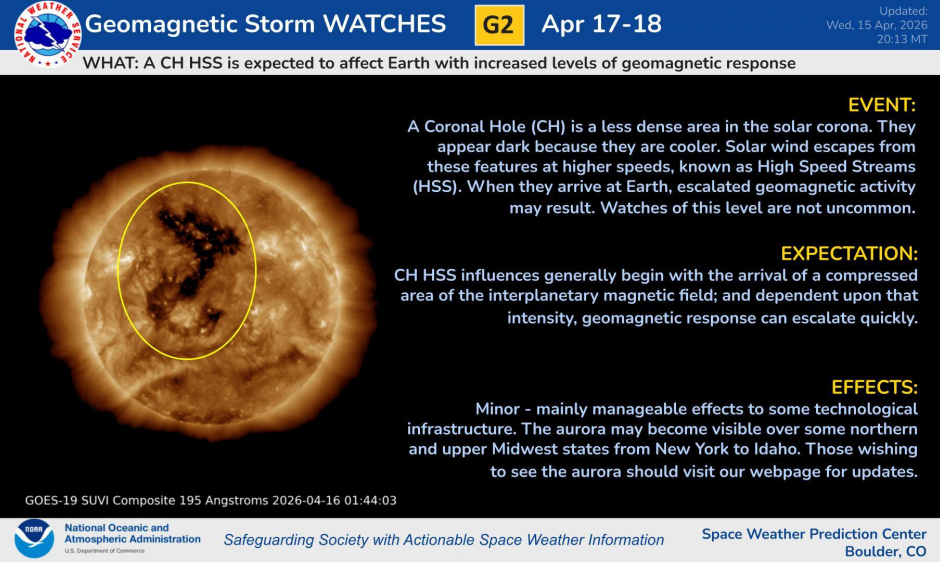
A significant surge of high-speed solar wind is currently en route to Earth, prompting a geomagnetic storm watch that could bring the captivating spectacle of the aurora borealis to mid-latitudes. The National Oceanic and Atmospheric Administration (NOAA) Space Weather Prediction Center has issued a moderate (G2) geomagnetic storm watch for April 17-18, with forecasters at the U.K. Met Office indicating a possibility of strong (G3) bursts if solar activity intensifies. This event presents an exciting opportunity for aurora enthusiasts across northern regions of the United States and potentially further south than usual.
The solar wind, a continuous stream of charged particles emanating from the Sun, is expected to reach Earth at speeds of up to 430 miles per second (700 km/s). When this energetic stream interacts with Earth’s protective magnetic field, it can trigger geomagnetic storms. These storms are categorized on a scale from G1 (minor) to G5 (extreme), with higher ratings indicating a greater potential for disruption and more widespread auroral displays. A G2 storm, currently forecast, is sufficient to push the aurora much farther from the poles, making it visible to observers at lower latitudes who typically do not witness this celestial phenomenon.
Understanding Geomagnetic Storms and Auroras
Geomagnetic storms are a natural consequence of the Sun’s dynamic activity. The Sun constantly emits a solar wind, a plasma composed of electrons and protons. When the Sun experiences events like coronal mass ejections (CMEs) or high-speed solar wind streams, these particles can be accelerated to incredible speeds and directed towards Earth.
Upon encountering Earth’s magnetosphere, the planet’s magnetic field, the charged particles from the solar wind are channeled towards the polar regions. As these particles collide with atoms and molecules in Earth’s upper atmosphere – primarily oxygen and nitrogen – they transfer energy. This energy is then released in the form of light, creating the mesmerizing, dancing colors of the aurora borealis (Northern Lights) and aurora australis (Southern Lights). The intensity and geographic reach of the aurora are directly correlated with the strength of the geomagnetic storm. More powerful storms lead to more vibrant and widespread displays.
The G-scale, developed by NOAA, provides a standardized way to communicate the potential impact of space weather events:
- G1 (Minor): Auroral displays visible from northernmost states, minor impacts on satellite operations.
- G2 (Moderate): Auroral displays visible from northern and central states, possible issues with satellite orientation and increased drag on low-Earth orbit satellites.
- G3 (Strong): Auroral displays visible from more southern areas, potential for voltage control problems on power grids, and increased satellite drag.
- G4 (Severe): Widespread voltage control issues, possible damage to transformers, and satellite orientation problems. Auroras visible from much lower latitudes.
- G5 (Extreme): Widespread voltage control problems, potential for grid collapse, and satellite orientation issues. Auroras visible across almost all of the United States.
This current event falls within the G2 to G3 range, suggesting a good chance for auroral visibility in regions that do not typically experience them.
Timeline of the Event
The current solar wind stream is a key driver of this anticipated space weather activity. While the exact timing of the solar wind’s arrival and the subsequent onset of geomagnetic storms can vary, forecasters are providing specific windows of potential peak activity.
According to NOAA’s 3-day forecast, the period of greatest geomagnetic activity is expected to occur during the following times:
- April 17, 5:00 p.m. EDT to April 18, 2:00 a.m. EDT: This window is anticipated to experience moderate (G2) geomagnetic conditions. For those in the United Kingdom and Europe, this corresponds to April 17, 9:00 p.m. GMT to April 18, 6:00 a.m. GMT.
- April 18, 2:00 a.m. EDT to 5:00 a.m. EDT: During this later period, minor (G1) conditions are possible. This translates to April 18, 6:00 a.m. to 9:00 a.m. GMT.
It is important to note that these are predictions, and the actual intensity and duration of any geomagnetic storm can fluctuate. The interaction of the solar wind with Earth’s magnetic field is a complex process, and precise forecasting remains a challenge.
Potential Visibility and Geographic Reach
The prospect of seeing the Northern Lights extends to a broader audience than usual with this predicted event. Based on the potential strength of the geomagnetic storm, here is a general forecast for visibility:
- G3 (Strong) Storm Conditions: If the storm reaches G3 intensity, auroras could be visible as far south as Illinois and Oregon in the United States.
- G2 (Moderate) Storm Conditions: Under G2 conditions, the aurora is expected to be visible in states like New York and Idaho.
- G1 (Minor) Storm Conditions: Even at G1 levels, displays could be seen in areas such as northern Michigan and Maine.
For individuals in the United Kingdom, G2 and G3 conditions would typically allow for auroral visibility across much of the country, especially away from urban light pollution.
However, it is crucial to remember that auroral displays are not guaranteed. Several factors influence whether the aurora will be visible from a specific location, including the precise angle and speed of the solar wind, the orientation of Earth’s magnetic field at the time of impact, and, critically, local observing conditions. Cloud cover and light pollution are significant impediments to aurora viewing.
Maximizing Your Chances of Aurora Viewing
For those eager to witness the aurora borealis, several steps can be taken to enhance their chances of success:
- Seek Dark Skies: The most critical factor is to escape light pollution. Areas far from cities and towns, such as rural landscapes, national parks, or designated dark sky preserves, offer the best viewing opportunities.
- Face North: Auroras are most commonly observed in the northern sky. Finding a location with a clear, unobstructed view of the northern horizon is essential.
- Check Aurora Forecasts: Utilize specialized space weather apps and websites that provide real-time aurora forecasts based on your location. Tools like NOAA’s Space Weather Prediction Center website or the "My Aurora Forecast & Alerts" app (available for both iOS and Android) can offer valuable insights into current and predicted auroral activity. These apps often provide a "KP-index" value, which is a measure of geomagnetic activity, and can alert users when conditions are favorable.
- Be Patient: Auroral displays can be intermittent. It is often necessary to wait for periods of activity. Patience and persistence are key.
- Dress Warmly: Even during milder weather, nighttime temperatures can drop significantly, especially in prime aurora viewing locations. Dressing in layers is recommended.
- Allow Eyes to Adjust: It takes approximately 20-30 minutes for human eyes to fully adapt to darkness. Avoid using bright lights, including phone screens, during this adjustment period.
Broader Implications of Geomagnetic Storms
While the visual spectacle of the aurora is a primary draw, geomagnetic storms can have broader implications for our technological infrastructure. The increased influx of charged particles can interfere with:
- Satellite Operations: Satellites can experience increased drag, affecting their orbits and requiring adjustments. Their electronic components can also be affected by radiation, potentially leading to malfunctions or data corruption.
- Power Grids: Geomagnetic storms can induce currents in long electrical conductors, such as power lines. This can lead to voltage control problems and, in severe cases, transformer damage or widespread power outages.
- Radio Communications: High-frequency radio communications, including those used for aviation and maritime navigation, can be disrupted.
- Navigation Systems: GPS signals can be affected by ionospheric disturbances caused by geomagnetic storms, leading to inaccuracies in positioning.
NOAA’s Space Weather Prediction Center plays a vital role in monitoring solar activity and issuing watches and warnings to mitigate potential impacts on these critical systems. The current G2 watch serves as an alert for operators of these systems to take necessary precautions.
Coincidental Celestial Event: The Lyrid Meteor Shower
Adding to the celestial excitement, the current period also coincides with the Lyrid meteor shower. This annual event, active from April 16 to April 25, will reach its peak in the predawn hours of April 22. While the aurora will be a nighttime spectacle, the Lyrids offer another opportunity to observe natural light shows in the sky.
The Lyrids appear to originate from a point in the constellation Lyra, near the border with Hercules. While meteors will seem to emanate from this "radiant," the most impressive shooting stars are often seen further away from this point. Observers are advised to scan a wide area of the sky around the radiant for the best chance of catching these fleeting streaks of light. The peak of the Lyrids, occurring after the predicted aurora activity, provides an excellent reason to extend stargazing efforts into the later part of the week.
This confluence of a geomagnetic storm watch and a meteor shower presents a unique opportunity for skywatchers. With careful planning and a bit of luck, many may be treated to a double dose of natural celestial wonders in the coming nights.
Related posts: