Escalating Tensions and Rights Concerns at Newark’s Delaney Hall Immigration Detention Center

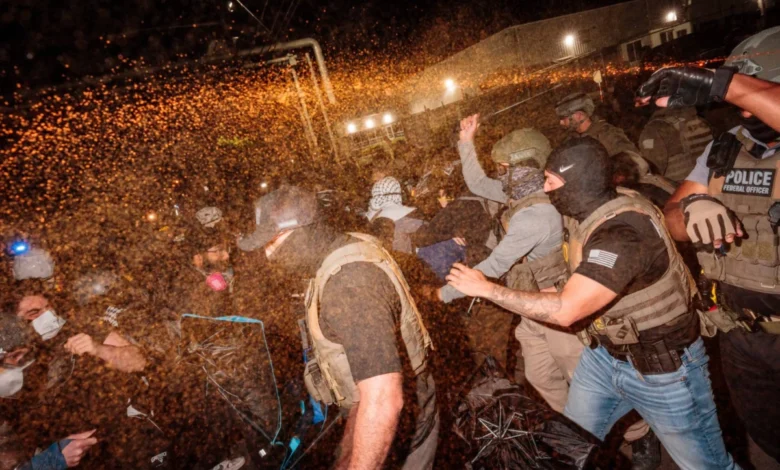
For hours, a stark tableau of resistance and authority defined the asphalt strip outside Delaney Hall, Newark’s immigration detention center. Masked protesters and equally masked U.S. Immigration and Customs Enforcement (ICE) agents engaged in a silent standoff, their gazes locked across the narrow divide. On the periphery, New Jersey state troopers stood, arms crossed, their demeanor one of detached observation. During daylight, the atmosphere around the facility often softened; crowds thinned, the officers behind the gates seemed less rigid, and families could, until recently, still access their loved ones inside. But as dusk bled into night, a palpable shift in tension occurred, signaling an impending escalation that both sides anticipated.
“When sunset happens, they’re going to push us into that cage and mace the fuck out of us,” asserted a street medic, who requested anonymity and was referred to as ‘Egg.’ His words conveyed a grim premonition of the violence that had become a recurring feature of these nightly confrontations. “When they come, they’ll come hard and fast.”
The Genesis of Conflict: Detainee Strike and Abysmal Conditions
The protests outside Delaney Hall were not spontaneous eruptions but a direct response to a harrowing situation unfolding within the facility’s walls. On May 22, a group of individuals held in Department of Homeland Security (DHS) custody initiated a hunger and labor strike, protesting what they described as inhumane and unacceptable conditions. Through a series of poignant letters smuggled out of the facility, detainees detailed a litany of grievances that painted a stark picture of neglect and suffering.
Their accounts included the rampant and unchecked spread of infectious diseases, exacerbated by inadequate hygiene protocols and a lack of preventative measures. Detainees reported alarmingly long response times from guards and medical staff in instances of accidents, injuries, or severe illness, often leading to prolonged suffering. The quality of food was a persistent complaint, with descriptions of meals containing worms and being largely inedible, contributing to health deterioration. Medical care was consistently described as insufficient, failing to address chronic conditions or acute emergencies effectively. Furthermore, the letters highlighted the dilapidated and unsanitary state of bathrooms, labeling them as being in “inhumane condition”—a significant concern for both dignity and public health.
In one letter, a collective plea for understanding and justice read: “We’d like to apologize for the way we entered the United States. Our American dream is safety and protection—with our families. Although this is a difficult situation, we trust in God and believe in American justice.” This statement underscored the detainees’ desperation, their acknowledgment of their circumstances, and their enduring hope for fair treatment under American law.
Many detainees claimed they had been held for months, even after expressing a desire to voluntarily return to their countries of origin, a right typically afforded under immigration law. One letter bore hundreds of signatures, a collective cry for release, with signatories offering to leave the country by any means necessary just to escape the dire conditions inside Delaney Hall. As these stories of hardship filtered out, families of the detainees, along with immigrant rights advocates, established aid tents and resource centers outside the facility. These makeshift hubs provided support, facilitated visits during approved hours, and served as a focal point for the growing movement. As DHS continued to disregard the detainees’ demands for more humane treatment and transparency, the protests gained momentum, intensifying pressure for a comprehensive inspection of the facility.
Political Intervention and Escalating Protests
The mounting crisis eventually drew the attention of New Jersey’s political establishment. On a Monday, Governor Mikie Sherrill, a Democrat, along with other state politicians, attempted to gain access to Delaney Hall for an inspection. While they were permitted entry, full access to all areas of the facility was explicitly denied. Sherrill subsequently issued a statement expressing her profound concern: “My request for access to Delaney Hall was formally denied this morning, raising serious questions about what they are trying to hide from public view. I will continue to hold ICE accountable… In New Jersey, we believe in the rule of law and that everyone deserves to be treated with basic dignity.” Her statement hinted at a growing rift between state-level commitment to oversight and federal agencies’ resistance to external scrutiny.
Meanwhile, the protests outside the facility took a violent turn. ICE agents reportedly engaged in aggressive crowd control tactics, deploying pepper spray against waves of demonstrators, including New Jersey Senator Andy Kim. Accounts from the scene described agents physically assaulting protesters, slamming them to the ground, and in one alarming instance, pushing an individual into oncoming traffic. The use of pepper balls and tear gas became routine, further escalating the confrontations. As the crowds outside swelled in response to these actions and the ongoing internal strike, Delaney Hall abruptly canceled all visiting hours, severing the last direct link between detainees and their families and advocates.
In a controversial move, Governor Sherrill, instead of intervening to open or inspect the facility, dispatched state police on Friday night with the explicit directive to clear the streets of protesters. This decision was met with widespread criticism from activists who viewed it as a betrayal, aligning the state government with the federal agency they were protesting against.
An Eyewitness Account: The Eve of Confrontation
The scene outside Delaney Hall on Friday evening was charged with an undercurrent of anticipated conflict. The author arrived around 6:30 p.m. to find New Jersey state troopers had already closed the main road more than half a mile in either direction, effectively stemming the constant flow of heavy truck traffic that usually characterized this desolate, industrial stretch of Newark. The facility itself is situated amidst a stark landscape of county jails, shipping depots, an asphalt plant, and fuel storage facilities. The prevailing wind carried the distinct odor of a nearby sewage treatment plant, adding to the grim ambiance.
Approaching the detention center, the reporter passed an organized array of tents and portable toilets, meticulously set up by activists to support the families of detainees. Stacks of boxes overflowed with protective gear: respirators, goggles, masks, and even knee and elbow pads—a testament to the expected intensity of the coming night. In front of Delaney Hall, a diverse but unified crowd of protesters had gathered. A front line of masked anti-fascists, described as militant, stood in defiant opposition to a phalanx of ICE agents in full combat gear, complete with body armor, helmets, and visible firearms, guarding the facility gates.
During daylight hours, a deceptive calm pervaded the protest. Elderly participants chanted and sang into megaphones, clergy members moved quietly through the crowd offering solace, and activists distributed water and snacks from carts. Governor Sherrill’s designated “protected speech zone”—a small square of orange fencing intended to contain demonstrators—was largely ignored, its empty asphalt surface serving as a canvas for chalk art. Yet, beneath this veneer of tranquility, signs of impending tension were evident. A protester, wearing a surgical mask, abruptly shouted at the loitering state troopers, “You know what’s next, just go home! You don’t have to be here! Go home to your wife and children!” The sentiment reflected a deeper frustration with the state police’s presence and their perceived role in suppressing dissent.
Conversations with protesters revealed a pervasive sense of anonymity, a growing trend in activism since the increased criminalization of protest under the previous administration. Many declined to give their real names, fearing repercussions. ‘Egg,’ the street medic, articulated a widely held sentiment: “Mikie Sherrill sold us out—now they’re here to tell us to fuck off,” he stated, gesturing towards the state police. Egg predicted a dispersal order once darkness fell, followed by aggressive enforcement against those who did not comply. Despite the anticipated crackdown, he affirmed, “We’re still here because it’s the right thing to do.” A casual shrug from a state trooper, when asked about a timeline or curfew, offered little reassurance.
Another protester, Roland, clarified the demonstrators’ core objective: “We’re not out here to be like ‘fuck ICE, fuck the state police.’ We’re here to support them,” he explained, motioning towards the detainees inside. Delaney Hall is not an expansive complex; the sounds of detainees yelling and their silhouettes in barred windows were audible and visible from the street, underscoring the immediate connection between the protest and its cause.
As dusk deepened, the calm surprisingly persisted. Protesters rested on the asphalt, sharing a moment of quiet. Brief interludes of confrontation occurred, such as when a group challenged a right-wing livestreamer who arrived to “evangelize,” as he put it. Other conservative influencers and streamers also appeared, mostly ignored. A shared dry cough afflicted many, including the reporter, attributed by one photographer to the lingering residue of pepper spray deployed throughout the week.
The Night Unfolds: A Violent Dispersal
At 9 p.m., the atmosphere shifted definitively. Some state troopers, previously in standard duty uniforms, withdrew. Street medics circulated with critical intelligence: ICE was planning a shift change. Such transitions had often been flashpoints for clashes, notably earlier in the week when a detainee involved in the internal protests was relocated, sparking outrage. As twilight fully yielded to darkness, a commotion erupted down the street. The state police returned, now organized and resolute. A sergeant’s voice boomed over a loudspeaker, issuing a formal dispersal order. The crowd responded with defiant yells, and the sergeant’s SUV retreated. In the distance, a line of riot police, ominous in their formation, appeared to the north.
This was the anticipated moment. Masks were pulled on universally. For a time, the ICE agents guarding the facility were momentarily overshadowed by the approaching state force. The riot line marched purposefully down the street, closing in on the protesters’ front line. “GET BACK. GET BACK. GET BACK,” the officers chanted, their voices muffled by gas masks. A volley of three flash-bang grenades detonated, their concussive blasts ripping through the night. Protesters recoiled, and the police line advanced. Behind them, a squad of mounted police struggled to form ranks, their massive bay horses skittering uneasily amidst the explosions. The police line, expanding to fill the entire street, momentarily trapped the reporter in a liminal space behind their rear. An officer with a grenade launcher fired a tear gas canister, which exploded with a sharp bang, its noxious fumes billowing back towards the officers before dispersing. The riot line then split, and the mounted unit charged into the gap, a tactic reminiscent of medieval warfare adapted for modern urban streets, pushing protesters back further.
On the fringes of the chaotic scene, troopers began making arrests. Several protesters were slammed to the ground. An elderly man, his eyes streaming and groaning, was led away, his hands zip-tied behind his back. A volunteer yelled, “Legal aid! Legal aid! What’s your name!” The man, summoning his remaining strength, enunciated his name clearly. Minutes later, another woman was led through the lines, moaning in pain, one leg unable to support her weight. Her name was lost in the tumult.
The protesters’ chants and yells gradually died out, replaced by gasps and coughs as they struggled against the tear gas and the shock of the grenades. The gas drifted, enveloping everyone. The state police pushed past Delaney Hall, where a group of ICE officers observed from their posts. As the street cleared, a contingent of ICE agents emerged from the facility, moving across the street to where protesters had meticulously stacked aid supplies and food. In a punitive act, they systematically trashed everything in sight. Immediately afterward, the facility gates swung open, and a stream of cars—carrying ICE and DHS officers—exited, heading home for the day.
Once the ICE vehicles had cleared, the state police fired one final volley of gas and flash-bangs, then swiftly retreated back down the street, melting into the darkness. Protesters slowly regrouped, catching their breath. “This is all about a fucking shift change,” a volunteer in an orange vest commented, coughing through the residual gas. “They did all that so they could fucking leave.”
Aftermath and Unwavering Resolve
It was around 10:45 p.m., approximately 45 minutes after the initial dispersal order. With the street now largely clear of state police, protesters turned their attention back to the ICE agents who had replaced the outgoing shift at the gate. A boombox was brought out, its music a defiant soundtrack to their resolve. For the moment, the immediate fight had subsided, and groups of protesters peeled off their masks, laughing off the adrenaline. Others sifted through the wreckage of the supply camp, collecting witness statements about the ICE agents’ destructive actions. Despite the violent dispersal, the spirit of the protest remained unbroken. “Whose streets!” someone yelled. “Our streets!” came the resounding reply.
The protests continued into Saturday. Governor Sherrill, attempting to manage the ongoing unrest, re-established designated zones for protesters, including a separate enclosure for a pro-ICE right-wing counter-protest, deploying state police to maintain separation. A small group of Proud Boys made an appearance, trading insults with the main body of protesters before a hasty retreat. The crowds grew even larger, attracting figures like left-wing livestreamer Hasan Piker, who engaged with trolls and a significant contingent of right-wing influencers attempting to provoke debates. As darkness fell once more, the state police again moved in, indicating a pattern of nightly dispersals.
For many participants, enduring nightly beatings and police aggression can be profoundly disheartening. The sight of politicians, ostensibly on their side, ordering police to suppress their demonstrations often feels like a defeat. Yet, the sustained protests at Delaney Hall have successfully elevated the plight of its detainees to a national story. The responsible politicians can no longer ignore the issue, nor can it be dismissed as another localized predation of the previous administration that goes unreported. Unlike some larger protests, these demonstrations were not sparked by political rhetoric or public relations stunts, but by a dedicated community’s response to the documented mistreatment of a few hundred individuals. The protesters chose this ground, and their unwavering determination, evident in their swift regrouping after each dispersal, suggested they intended to stay.
However, the human cost of this standoff remains high. Visiting hours at Delaney Hall remain canceled indefinitely. Many families, unaware of the change, continue to arrive, only to find a militarized compound sealed off. Instead of their loved ones, they encounter a fortress, accessible only to armed personnel, with few permitted to exit. Outside, the battle for justice and human dignity continues on the streets. As the reporter departed on Friday, a long-time activist couple, Giancarlo and his wife, watched the clashes rage on. “At least when we protested Obama it wasn’t this level of violence,” Giancarlo remarked, observing an officer spray a crowd with pepper balls. “Now it’s just a whole different beast.” The profound escalation in force, juxtaposed with the unwavering commitment of the protesters, underscores a critical juncture in the ongoing struggle for immigrant rights and civil liberties in the United States.