Congressman Takano Grills Health Secretary Kennedy Jr. on Trump’s Mental Fitness During Budget Hearing

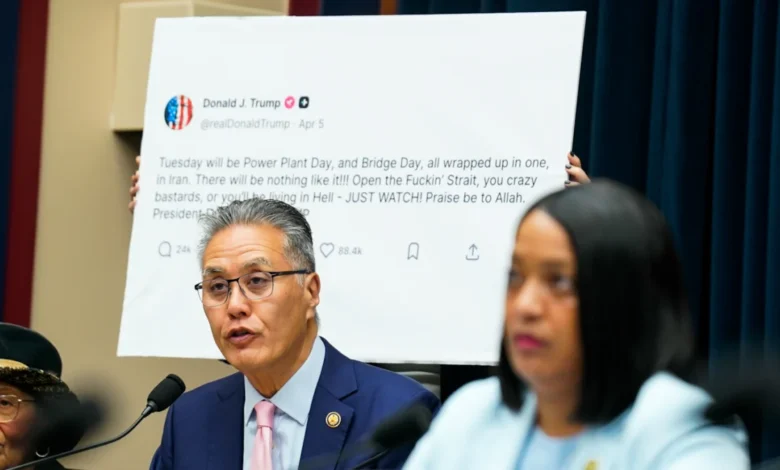
Washington D.C. – In a contentious session before the House Education and Workforce Committee on Friday, Representative Mark Takano (D-California) directly challenged Health Secretary Robert F. Kennedy Jr. regarding the mental and emotional fitness of former President Donald Trump, pressing for an assessment and even the potential invocation of the 25th Amendment. The grilling, which occurred during a hearing primarily focused on the Department of Health and Human Services (HHS) budget, quickly veered into highly charged political territory, highlighting the persistent and often weaponized debate surrounding presidential mental acuity in contemporary American politics.
The exchange unfolded as Rep. Takano presented enlarged posters of recent controversial social media posts made by former President Trump on his Truth Social platform. Among the posts highlighted were threats to obliterate the "whole civilization" of Iran, a striking comment targeting "Pope Leo XIV" – a reference that immediately drew attention given the anachronistic nature of the papacy mentioned – and an AI-generated image depicting Trump himself as Jesus Christ. These posts, Takano argued, were symptomatic of deeper concerns about Trump’s capacity to hold the nation’s highest office.
"Millions of Americans are questioning this president’s mental fitness, his emotional stability, and whether he can carry out the duties of his office," Takano stated, directing his inquiry to Secretary Kennedy Jr. "Do you share their concerns about his mental health?"
Secretary Kennedy Jr., who has served as Health Secretary under President Trump, initially paused, prompting Takano to press further. Takano emphasized the critical need for a Commander-in-Chief with "full command of his mental faculties and is emotionally stable." He then directly asked Kennedy if he would insist that former President Trump undergo an assessment of his mental fitness and emotional stability.
Kennedy’s response was swift and unequivocal: "Absolutely not," he retorted, signaling a firm rejection of the premise and the requested action.
Undeterred, Takano escalated his line of questioning, demanding to know if Kennedy would ever recommend invoking the 25th Amendment to remove Trump from office should an evaluation deem him mentally or emotionally unstable. The 25th Amendment outlines procedures for presidential disability and succession, a provision that has gained significant prominence in recent political discourse.
Kennedy again dismissed the suggestion, asserting, "there hasn’t been a president who is more sane," a statement that drew sharp criticism from Takano, who accused the Secretary of prioritizing loyalty to Trump over adherence to constitutional principles.
The tense exchange concluded with Committee Chairman Rep. Tim Walberg (R-Michigan) interjecting with a quip, suggesting Takano’s line of questioning might serve as a "fundraising video" for Democrats. Walberg also referenced past instances where the 25th Amendment was discussed concerning other presidents, stating, "I would hesitate to say something about the 25th Amendment with the last president. There was no concern there from the other side, but I won’t say that," a thinly veiled reference to Republican criticisms leveled against President Joe Biden’s mental fitness.
Background and Context of the Scrutiny
The House Education and Workforce Committee is typically responsible for legislation and oversight related to education and labor, including health and human services. While a budget hearing for HHS primarily focuses on appropriations and departmental policies, the broad scope of health, particularly mental health, can occasionally open avenues for questioning on related public health matters or, as in this case, the mental well-being of public figures, particularly those in positions of immense power. The Secretary of Health and Human Services, as the nation’s chief health officer, is seen by some as having a unique perspective or responsibility regarding public health and mental health issues. Takano’s line of questioning aimed to leverage this perceived authority to address concerns about a former president who remains a dominant figure in American politics.
The mental fitness of presidents and presidential candidates has become a recurring theme in recent election cycles, often used as a political cudgel by both major parties. During the 2020 and 2024 presidential campaigns, Republicans frequently raised questions about President Joe Biden’s age and cognitive abilities, with some even openly discussing the prospect of Vice President Kamala Harris invoking the 25th Amendment to remove him from office. This history provides crucial context for Walberg’s remark, highlighting a tit-for-tat dynamic in political accusations. Similarly, concerns about Donald Trump’s mental state, temperament, and public statements have been a consistent feature of political commentary and opposition critique since his first presidential campaign.
The 25th Amendment: A Constitutional Mechanism
The 25th Amendment to the U.S. Constitution, ratified in 1967 in the wake of President John F. Kennedy’s assassination, addresses presidential succession and disability. Section 4, specifically, outlines a process for removing a president who is "unable to discharge the powers and duties of his office." This section can be invoked if the Vice President and a majority of the Cabinet (or another body designated by Congress) declare the President unfit. If the President disputes this, Congress must then vote by a two-thirds majority in both houses to remove the President.
Historically, the 25th Amendment has been invoked only a handful of times, primarily for temporary transfers of power (e.g., when a president undergoes a medical procedure). Its Section 4, which deals with involuntary removal, has never been successfully utilized. The very high bar for its invocation underscores its extreme nature, intended for genuine incapacitation rather than political disagreement or perceived unsuitability for office. The mere discussion of invoking the 25th Amendment against a sitting or former president signifies the deep level of political polarization and the intensity of concerns expressed by certain factions of the electorate and political class.
Chronology of Controversial Statements and Political Scrutiny
The social media posts referenced by Rep. Takano are part of a broader pattern of controversial statements made by Donald Trump, particularly since leaving office and intensifying during his 2024 presidential campaign.
- Threat to Iran’s "whole civilization": This type of rhetoric aligns with Trump’s aggressive foreign policy stance and often utilizes hyperbolic language. While specific dates vary, Trump has frequently used strong language regarding adversaries, including Iran, throughout his political career, often drawing criticism for its inflammatory nature and potential implications for international relations.
- "Pope Leo XIV" comment: The mention of "Pope Leo XIV" by Takano is noteworthy. Historically, the last Pope Leo was Leo XIII, who died in 1903. Trump has not recently made a public comment attacking a Pope Leo XIV. However, he has made various controversial statements touching on religious figures, globalism, and political opponents that have been widely interpreted as attacks on established institutions or figures. It is possible Takano misidentified the specific figure, or that the reference was to a comment that was perceived as an attack on the papacy or religious leadership generally, rather than a specific Pope Leo XIV. Regardless, Takano’s intent was to highlight a religiously insensitive or provocative statement from Trump. Trump has, for instance, criticized Pope Francis in the past, and his rhetoric often includes broad criticisms of perceived "globalist" or "establishment" figures, which can be interpreted in various ways.
- AI image as Jesus Christ: The posting of an AI-generated image depicting Trump as Jesus Christ circulated on social media platforms in early 2024. This post, widely shared and discussed, was seen by critics as an example of extreme self-aggrandizement and a blurring of religious and political identity, sparking debate about his judgment and the boundaries of political communication.
These instances, taken together, form the basis for Takano’s argument that Trump’s public persona and communication style raise legitimate questions about his fitness for presidential duties.
Official Responses and Broader Political Implications
Secretary Kennedy Jr.’s staunch defense of Trump’s sanity and his outright rejection of a mental health assessment or 25th Amendment invocation are consistent with the loyalty expected from a cabinet member to their appointing president, even a former one, especially given Trump’s continued political influence. Kennedy’s assertion that Trump is among the "most sane" presidents reflects a partisan solidarity and a dismissal of the concerns raised by Democrats. His "absolutely not" response effectively shut down Takano’s line of inquiry from an administrative standpoint, emphasizing the executive branch’s prerogative in such matters.
Chairman Walberg’s intervention, while brief, served multiple purposes. His "fundraising video" remark aimed to frame Takano’s questions as a politically motivated attack rather than a genuine concern for public health or constitutional order. This narrative is common in highly polarized environments, where opponents often accuse each other of performative politics. Furthermore, Walberg’s subtle reference to past Republican criticisms of President Biden’s fitness underscores the cyclical nature of these accusations, suggesting a "whataboutism" defense where both parties engage in similar tactics. This pattern reinforces the idea that discussions of presidential mental fitness are deeply intertwined with partisan political strategies, rather than purely objective health assessments.
The implications of such public interrogations are multifaceted. Firstly, they contribute to the ongoing national conversation about the qualities required for presidential leadership, extending beyond policy positions to include temperament, judgment, and cognitive ability. Secondly, they highlight the deep partisan divide in how these qualities are perceived and evaluated. What one side views as concerning behavior, the other may dismiss as strong leadership, unconventional communication, or even strategic political maneuvering. Thirdly, these exchanges can erode public trust in political figures and institutions if they are perceived as purely political attacks rather than legitimate oversight. The politicization of mental health discussions, particularly at the highest levels of government, can also have broader societal consequences, potentially stigmatizing mental health discussions and making it harder for individuals to seek help.
In conclusion, Rep. Takano’s grilling of Secretary Kennedy Jr. was more than just a debate over a budget item; it was a potent demonstration of the enduring political battle over former President Trump’s fitness for office and the constitutional mechanisms available to address such concerns. While Kennedy Jr. firmly rejected any notion of Trump’s unfitness, the exchange underscored the deep partisan chasm that defines contemporary American political discourse and the continued weaponization of mental fitness as a tool in the ongoing struggle for power. The episode serves as a stark reminder of the intense scrutiny applied to presidential candidates and former presidents, and how even seemingly routine committee hearings can become platforms for highly charged political confrontations.