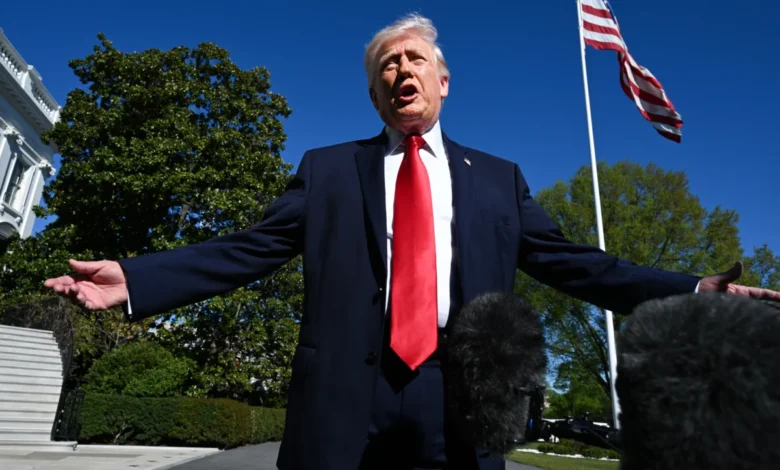
In a dramatic escalation of his controversial rhetoric, former President Donald Trump has intensified his self-portrayal as a divinely appointed figure, simultaneously launching renewed attacks on Pope Leo XIV. This latest series of pronouncements, disseminated primarily through his Truth Social platform, has ignited a firestorm of criticism from religious leaders, political analysts, and even some within his own support base, raising profound questions about the intersection of faith, politics, and the erosion of traditional norms. The former president’s unyielding commitment to his version of reality, irrespective of widespread condemnation, continues to define his public persona and political strategy.
The controversy reached a new zenith with a Truth Social post on Wednesday morning, featuring an AI-generated image of Jesus Christ embracing Trump. The accompanying caption, sourced from an X post, read: “I was never a very religious man .. but doesn’t it seem, with all these satanic, demonic, child sacrificing monsters being exposed … that God might be playing his Trump card.” Trump, in his inimitable style, added his own endorsement: “the Radical Left Lunatics might not like this, but I think it is quite nice!!! President DJT.” This act follows a pattern of increasingly bold and often blasphemous self-comparisons that have characterized his public messaging, particularly in recent weeks.
A Chronology of Contention and Blasphemous Assertions
The current wave of controversy is not an isolated incident but rather the culmination of a series of escalating rhetorical maneuvers. Trump’s history of employing religious language and imagery to galvanize his base is well-documented, often casting himself as a protector of Christian values and a bulwark against perceived secular threats. However, recent actions have pushed these appeals into unprecedented territory.
- Early Week Provocations: The week began with Trump drawing widespread condemnation for an "unholy self-comparison" to Jesus Christ. This initial provocation, which garnered significant media attention, depicted him as a Christ-like figure healing the sick.
- The "Doctor" Defense: Following the initial backlash, Trump offered a remarkably implausible explanation, claiming he believed the image depicted him as a "doctor" and that it was related to the "Red Cross." This defense was widely perceived as an attempt to deflect criticism, with some speculating it might have been a misinterpretation of an explanation that the image was "doctored" rather than a genuine belief.
- Tuesday Night Posting Spree: The former president embarked on a prolific posting spree on Truth Social, further amplifying his divine narrative. This culminated in the aforementioned AI-generated image shared on Wednesday morning, cementing his doubling down on the controversial theme.
- Escalation of the Papal Feud: Concurrently with his divine self-portrayal, Trump significantly intensified his public dispute with Pope Leo XIV. Over the weekend, he launched a scathing attack on the Pontiff, accusing him of being "WEAK on Crime, and terrible for Foreign Policy." This accusation came amid Pope Leo XIV’s vocal criticism of a hypothetical "war in Iran," a conflict which Trump has reportedly initiated or significantly exacerbated.
- Direct Challenge to Papal Authority: On Sunday, Trump issued a stark, almost imperial declaration: “If I wasn’t in the White House, Leo wouldn’t be in the Vatican.” This statement, audacious in its direct challenge to the Pope’s spiritual and temporal authority, underscored the depth of the former president’s perceived grievance and his willingness to confront even the highest religious figures.
- Renewed Attacks and Policy Critiques: On Tuesday, Trump renewed his assault on Pope Leo XIV, specifically challenging the Pontiff’s stance on the "war in Iran." He wrote: “Will someone please tell Pope Leo that Iran has killed at least 42,000 innocent, completely unarmed, protesters in the last two months, and that for Iran to have a Nuclear Bomb is absolutely unacceptable.” This statement conflates internal Iranian actions with the external conflict and implies a direct link between the Pope’s criticism and a supposed threat of Iranian nuclear proliferation, despite expert consensus that the Iranian government was "nowhere near" the creation of a nuclear weapon.
- Complaints of Under-Appreciation: In an interview with Fox Business’ Maria Bartiromo on Wednesday morning, Trump pivoted to complaining about a lack of credit for his perceived achievements, claiming he had "the greatest year, the greatest opening year" and "ended eight wars, a ninth is coming, but I ended eight wars – nobody’s ever ended one war." He lamented that despite his "greatest economy ever," presidents tend to "lose the midterms," expressing bewilderment at this phenomenon and vowing to "try turning it around."
Background and Context: The Blending of Faith and Politics
Donald Trump’s political career has been characterized by an unprecedented fusion of populist appeal and religious rhetoric. While American politicians have historically invoked divine guidance and appealed to religious voters, Trump’s approach has often veered into personal messianic claims. This strategy has resonated powerfully with a segment of his evangelical Christian base, many of whom view him as a divinely chosen leader sent to protect traditional American values.
The "cult of personality" surrounding Trump is a critical lens through which to understand these actions. For his most ardent supporters, his pronouncements, no matter how controversial or seemingly blasphemous to outsiders, are often interpreted through a lens of loyalty and unwavering belief in his leadership. This dynamic makes traditional criticism less effective, as dissent can be perceived as an attack on their shared identity and values.
The use of AI-generated imagery further complicates the landscape. In an age of rapidly advancing artificial intelligence, the line between authentic and fabricated content is increasingly blurred. AI-generated images, which can be crafted to depict highly specific and emotionally resonant scenarios, offer a powerful tool for political messaging. When such images portray religious figures interacting with political leaders, they tap into deep-seated beliefs and can reinforce narratives of divine endorsement, regardless of their artificial origins. This phenomenon raises concerns about media literacy and the potential for manipulation in political discourse.
The concept of blasphemy, while varying across religious traditions, generally refers to irreverence towards sacred things. For many Christians, particularly Catholics, comparing a political figure to Jesus Christ is considered deeply offensive and blasphemous. This is not merely a matter of taste but a violation of core theological tenets that emphasize Christ’s unique divine nature. Trump’s repeated forays into this territory underscore either a profound misunderstanding of these religious sensitivities or a deliberate provocation designed to test boundaries and energize a specific segment of his base.
The Feud with Pope Leo XIV: A Clash of Powers
The confrontation with Pope Leo XIV represents a significant departure from typical presidential-papal relations. Historically, U.S. presidents and Popes have maintained a respectful, if sometimes ideologically divergent, relationship. Direct personal attacks and challenges to papal authority are virtually unprecedented in modern American politics.
Pope Leo XIV, as depicted in the narrative, has been a vocal critic of the "war in Iran" – a conflict that has reportedly caused significant human suffering and geopolitical instability. The Pope’s stance aligns with traditional Catholic social teaching, which often advocates for peace, diplomatic solutions, and the protection of innocent lives in times of conflict. His criticism, therefore, is rooted in moral and ethical considerations rather than partisan politics.
Trump’s counter-attacks, labeling the Pope "WEAK on Crime" and "terrible for Foreign Policy," attempt to reframe the debate from a moral one to a political one, questioning the Pontiff’s judgment and competence in areas traditionally outside the Vatican’s direct purview. The claim that "If I wasn’t in the White House, Leo wouldn’t be in the Vatican" is particularly striking, suggesting an almost secular control over spiritual leadership, or at least a belief in his indispensable role in maintaining the current global order. This rhetorical move could be interpreted as an attempt to diminish the Pope’s moral authority by portraying him as politically dependent or misguided.
The former president’s invocation of Iranian casualties and the nuclear threat appears to be an effort to justify his Middle East policy and, by extension, discredit the Pope’s criticisms. However, the factual basis of his claims regarding Iran’s nuclear program has been disputed by experts, indicating a potential use of exaggerated or unsubstantiated information to bolster his argument. The complexity of the Middle East situation, as well as the sensitivity of religious leadership roles, demands a nuanced approach rarely found in Trump’s public statements.
Reactions and Condemnation: A Broad Chorus of Disapproval
The reactions to Trump’s latest actions have been swift and largely condemnatory across a wide spectrum of society.
- Catholic Leaders: Major Catholic organizations and prominent bishops in the United States have voiced strong disapproval. The United States Conference of Catholic Bishops (USCCB), while generally cautious in direct political commentary, would likely issue a statement reiterating the sanctity of religious figures and condemning the misuse of sacred imagery for political gain. Individual bishops and cardinals have been more direct, with some calling the self-comparisons "deeply blasphemous" and an affront to the faith of millions. They would likely emphasize the unique divinity of Jesus Christ and the inappropriateness of equating him with any political leader.
- Other Christian Denominations: Leaders from various Protestant denominations, including evangelicals who form a significant part of Trump’s base, have also expressed discomfort or outright condemnation. While many evangelical leaders have been supportive of Trump, the explicit self-comparison to Jesus Christ crosses a theological line for a substantial number. Some have called for repentance, while others have simply distanced themselves from the rhetoric, fearing it undermines the very faith they seek to uphold.
- Interfaith Organizations: Groups dedicated to interfaith dialogue and religious tolerance have expressed concern over the divisive nature of the rhetoric, warning that such comparisons can lead to increased religious polarization and disrespect for diverse belief systems.
- Political Analysts and Commentators: Political scientists and media commentators have largely viewed these actions as a continuation of Trump’s pattern of norm-breaking and a strategic attempt to energize his base by appealing to their deepest convictions, even if it alienates others. Many highlight the risk of further eroding the separation of church and state and the dignity of the presidential office. They point to the double-edged sword of such tactics: while they galvanize loyalists, they often solidify opposition among those who find them offensive or dangerous.
- Public Opinion: While precise polling data on these specific incidents would be required, general trends suggest that while a core segment of Trump’s supporters may rationalize or even embrace his rhetoric, a broader swath of the American public, including many religious voters, find such comparisons deeply unsettling and inappropriate for a political leader. The constant stream of controversy also contributes to voter fatigue and a sense of instability in the political landscape.
Broader Impact and Implications
The implications of Trump’s escalating rhetoric are far-reaching, touching upon religious freedom, political polarization, the role of social media, and the future of American political discourse.
- Erosion of Norms: The repeated blurring of lines between political authority and divine endorsement further erodes established norms of presidential conduct. It sets a dangerous precedent for future leaders, potentially normalizing the use of religious imagery and claims of divine mandate in political campaigns, which could undermine the secular foundations of American democracy.
- Religious Polarization: By weaponizing religious imagery and attacking a major religious leader, Trump risks deepening religious polarization within the United States. It forces religious communities to grapple with complex questions of faith and political loyalty, potentially fracturing congregations and exacerbating tensions between different denominations. For Catholic voters, who constitute a significant demographic, the direct attacks on Pope Leo XIV could force a difficult choice between their political allegiance and their religious identity.
- Impact on the 2024 Midterms (or future elections): Trump’s claim that "even when you have a great president, they tend to lose the midterms" reflects a strategic concern. His actions, while energizing his base, could alienate crucial swing voters, particularly moderate Republicans and independents who might be turned off by the extreme rhetoric and the attacks on religious figures. The advice from the article’s conclusion—that Republicans may want their leader to "stop attacking religious figures while casting himself as a divine savior"—underscores the perceived electoral risk of this strategy.
- The Role of Social Media: Platforms like Truth Social and X (formerly Twitter) serve as unmoderated echo chambers where such rhetoric can proliferate unchecked. The ability to disseminate AI-generated images and personal pronouncements without traditional editorial oversight amplifies the reach and impact of these controversial statements, making it harder for objective analysis to gain traction.
- The Future of Political Discourse: The current climate, marked by personal attacks on religious leaders and claims of divine intervention, points to a potential future where political discourse becomes increasingly performative and less tethered to verifiable facts or respectful debate. It challenges institutions, both political and religious, to adapt to new forms of communication and resist the normalization of extreme rhetoric.
In conclusion, Donald Trump’s decision to double down on his divine savior narrative while aggressively attacking Pope Leo XIV represents a profound moment in contemporary American politics. It challenges the traditional separation of church and state, strains interfaith relations, and tests the boundaries of acceptable political discourse. As the nation approaches future electoral cycles, the ongoing fallout from these provocative actions will undoubtedly continue to shape the political landscape, leaving a lasting impact on how faith, power, and public perception intersect in the American experience.