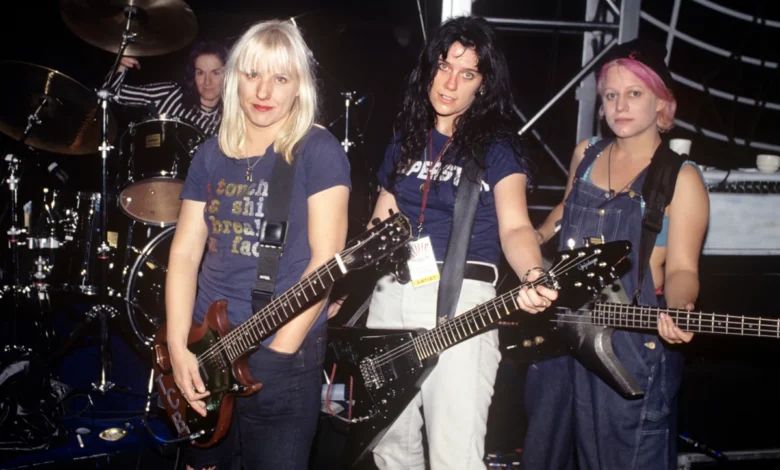
The aroma of briny seafood mingled with the salty Pacific air at Gladstone’s on the Santa Monica beachfront, a setting where L7, the formidable grunge-era band, found themselves indulging in a post-major label signing ritual: a feast fit for a nation, a platter overflowing with lobster, clams, mussels, and shrimp. This extravagant repast, served by a waitress whose attire seemed to embrace the California sun with zealous brevity, symbolized a new chapter for the quartet. "Ever since we signed to a major label, whenever we have any kind of meeting, we make them take us out for lobster," explained L7 vocalist Donita Sparks with a defiant cheerfulness that belied the apparent opulence. It was, she implied with a knowing grin, a distinctly punk gesture.
L7, comprised of Sparks, bassist Jennifer Finch, drummer Dee Plakas, and guitarist Suzi Gardner, had cultivated an image that was deliberately confrontational, a stark contrast to the polished veneer of mainstream pop. Finch, whose cropped top and pierced navel, coupled with a stocky build and numerous tattoos, projected an image that was less about allure and more about unvarnished assertion, noted the stark difference in their appearance compared to the typical clientele. Plakas sported vividly green hair, a signature hue that spoke volumes of her individuality, while Gardner embraced the resurgent trend of the 1970s with a vibrantly patched leather jacket. They were, by design, the visual outliers in any given setting, a testament to their commitment to an aesthetic rooted in rebellion and self-expression.
The band’s ascension coincided with the burgeoning popularity of grunge and the emergence of the riot grrrl movement, yet their core identity remained firmly planted in the raw, unadulterated spirit of old-school punk rock. The influence of seminal bands like the Ramones, Sex Pistols, and X was palpable in their music – a potent blend of inspired, almost insanely energetic sloppiness, characterized by mean, squealing, and subversive guitar riffs wielded by Sparks and Gardner like instruments of sonic liberation. Their lyrics, equally uncompromising, often carried a fierce, almost Thelma & Louise-esque feminist undertone, a narrative of female empowerment and defiance.
A prime example of this ethos could be found in "Shirley," a track from their 1994 album Hungry for Stink. The song samples a pivotal moment from the film Heart Like a Wheel, where drag racer Shirley Muldowney, in response to a reporter’s question about a woman’s place in a male-dominated sport, emphatically declares, "Winning." L7 loops this declaration, "Winning… Winning… Winning," transforming it into an anthemic refrain that resonated with their own journey. "It was so ironic, because in the beginning, we used to get a lot of questions like that," Finch reflected, referencing the incessant inquiries about being "women in a man’s world." L7, however, were adamant about eschewing such categorizations. They were not "foxcore," nor were they simply "riot grrrls."
Rejecting Genre Constraints: The L7 Philosophy
"To create genre out of gender is just horrible to me," Finch asserted, articulating a frustration with what she perceived as journalistic pigeonholing. "I think journalism perpetuates that. I hope the story angles for L7 will eventually be the same as for Nirvana or Cracker. There’s a uniqueness in being a woman, but not that much." This sentiment highlighted their desire to be judged on their musical merit and artistic integrity rather than solely through the lens of their gender.
Despite their aversion to being defined by their sex, L7 often reveled in provocatively challenging societal expectations. A notorious incident at England’s Reading Festival in 1992 saw Sparks remove a tampon onstage and toss it into the bewildered audience, a bold act that, while not leading to immediate endorsement deals, did elicit a significant response from Midol, a cramp-relief product that appeared on L7’s concert rider. The company later sent a substantial quantity of free merchandise, a testament to the unexpected ripple effects of their audacious gestures.
A United Front: The L7 Collective
The internal dynamic of L7 was characterized by a fierce camaraderie, a unity that rivaled any professional sports team. Cigarettes were shared, political discussions were frequent, and the concept of individual stardom was actively rejected. They operated as a cohesive unit, eschewing individual interviews and photo shoots, preferring to communicate as a collective. This unified front was evident in their interactions, where band members often finished each other’s sentences, weaving a tapestry of conversation punctuated by shared inside jokes.
"Being misquoted happens to us a lot," Finch admitted, a hint of suspicion entering her voice as she questioned the origins of the interview. "Did you pitch this story, or were you assigned to it? Did you come out from New York just for this?" This guardedness underscored their protective stance over their narrative and their commitment to controlling their own story.
Roots in the Underground: The Max Factor Heiress Connection
The origins of L7 traced back to the mid-1980s, a period of burgeoning underground music scenes in Los Angeles. They found a crucial early patron in Maxine Nazworthy, the benevolent and free-spirited Max Factor heiress, who provided a rehearsal space at her home. Nazworthy’s patronage extended to a generation of L.A. punk bands, including the Chemical People, Redd Kross, and Down by Law, effectively acting as a modern-day Medici for the city’s burgeoning alternative music landscape.
"It was funny driving to Beverly Hills to rehearse," Finch recalled with a wry smile, emphasizing the ironic juxtaposition of their punk ethos with the opulent surroundings. Finch, the sole native Angeleno in the band, was joined by Sparks and Plakas, who hailed from Chicago, and Gardner, who grew up in Sacramento. Gardner, recalling her formative years, expressed a profound sense of displacement: "All these losers that were in my hometown playing rock & roll, they didn’t have a clue. I knew I had to get out."
Echoes of Trauma and Resilience
Gardner’s past was marked by a proximity to a deeply disturbing event, a connection she alluded to with a stark candor. "Suzi was involved in the River’s Edge scandal," Sparks offered, referring to the 1986 film inspired by a real-life murder. Gardner elaborated, " River’s Edge [the film based on a real case wherein a teenager murders his girlfriend, then takes his buddies to see the body] epitomizes that whole area and the kids I hung out with." She continued with a chilling confession, "I swear to God, I came, like, this close." This brush with mortality, she suggested, was a formative experience that underscored her drive and resilience.
Fortunately, Gardner’s path led her to Sparks, and after navigating a period of less-than-ideal bandmates, they found their rhythm section in Finch and Plakas. L7’s recorded output began with Epitaph in 1988, followed by the 1990 Sub Pop EP, Smell the Magic. However, it was the 1992 release of Bricks Are Heavy and its surprisingly accessible single, "Pretend We’re Dead," that propelled them into wider commercial recognition, selling over 250,000 copies and marking a significant turning point in their career.
Hollywood Cameos and the Lollapalooza Circuit
Their burgeoning fame extended beyond the music charts, leading to a cameo appearance in John Waters’ 1994 film Serial Mom, where they portrayed the fictional band the Camel Lips. "Babes in Toyland couldn’t do it," quipped Finch, highlighting the distinction and honor they felt. "We were honored to do it, ’cause we’ve been John Waters fans for a long time."
The summer of 1994 promised to be a landmark period for L7, with their inclusion in the Lollapalooza festival and the anticipated success of Hungry for Stink. This album, a testament to stripped-down energy and a defiant rejection of fleeting trends, seemed poised for significant commercial impact. While the album featured occasional excursions into more introspective territory, such as the love-and-angst ballad "Andres," it was their deep-seated defiance that truly elevated the record. Sparks’ vocal delivery on tracks like "Fuel My Fire" – a maelstrom of squeals, growls, and soaring melodies, often within the same note – showcased her unique expressive range, akin to the avant-garde artistry of Björk. The song’s "Tilt-a-Whirl" rhythm section created an assaultive yet joyous sonic landscape, embodying their signature blend of aggression and exhilaration.
Political Activism: Rock for Choice
Beyond their musical output, L7 was deeply committed to political activism, most notably through their founding of Rock for Choice in 1991. This pro-choice organization aimed to counter the prevailing political climate, particularly the Reagan-era policies that threatened women’s reproductive rights. "When we started Rock for Choice," Sparks explained, "one of the things that concerned us the most was that Bush was in office representing a huge contingent to take away women’s rights." Their efforts evolved to focus on more grassroots initiatives, including providing crucial support to clinic workers. "Right now, Rock for Choice money is buying surveillance equipment and bulletproof vests for clinic workers, which run around $2,500 apiece."
Rock for Choice benefited from significant fundraising efforts across the country, successfully raising substantial funds for the Fund for the Feminist Majority. However, their activism was not without its challenges. A large-scale benefit show in Pensacola, Florida, featuring Pearl Jam, yielded unexpectedly low returns due to exorbitant production costs and the insistence of local law enforcement on a considerable security detail. "It’s good-old-boy territory," Sparks noted, highlighting the resistance they encountered in more conservative locales.
Despite such obstacles, L7 remained undeterred. They acknowledged that their concerts occasionally attracted hecklers, with Finch humorously mimicking the "Show us your tits" taunts in a perfect Beavis and Butt-head-esque tone. However, they countered such provocations with unwavering confidence: "But we’re the ones with a microphone. To battle us is ridiculous."
The Enduring Spirit of L7: From Leftovers to Longevity
Even amidst their growing success, L7’s financial realities remained grounded. The image of them taking home foil-wrapped leftovers from their Gladstone’s feast underscored their enduring connection to their working-class roots. Gardner spoke wistfully of her 1973 Cadillac, in need of extensive repairs, while Plakas drove a well-worn clunker adorned with bumper stickers. "My dad still drives us to the airport," Finch admitted, underscoring the continued familial support. "He’s the band dad in a way, because he’s from here. But when we go to these guys’ towns, Suzi’s mom takes us to a buffet, and Dee’s mom cooks for us. Donita’s mom cooks for us." This testament to maternal support painted a picture of a band deeply connected to their families and their past.
Their international tours in support of Bricks Are Heavy provided glimpses of their burgeoning global fanbase. In Brazil and Japan, they experienced intense fan adoration, a phenomenon that, while novel at first, presented its own set of challenges. "At first, it’s novel, and then it’s a pain in the ass," Gardner observed. "Brazilian fans are way more aggressive. In Japan, they’ll sit in front of your hotel for hours, and when you walk out, they’ll smile to see if you want to be approached." Plakas elaborated on the Brazilian experience, stating, "In Brazil, they’ll rip your hair out." Finch attempted to de-escalate the situation, noting, "You just tell them to calm down, and they usually listen." Sparks, however, offered a stark contrast: "Not in Brazil." The language barrier, Finch explained, exacerbated the situation. "They were chasing our bus down the street," Gardner recalled. "They wanted our cigarette butts," Finch added, illustrating the intense, almost obsessive nature of their admirers.
As their star status grew, L7 found themselves navigating interactions with other celebrities with increased confidence. Finch recounted a peculiar encounter with Angelyne, the iconic L.A. personality. Finch asked for an autograph and a message of good luck for Lollapalooza. Angelyne, in character, responded, "I just did an interview for a Lollapalooza." Finch, clarifying, " ’cause you know, it’s a concert series." Angelyne then inquired, "Are you in a band?" before offering a business card for video work. Finch found the interaction "really weird." Reflecting on the encounter, Finch mused, "I liked her. I saw a lot of us in her, in 20 years, with her pink Corvette…" This observation, tinged with humor and a touch of self-awareness, encapsulated L7’s enduring spirit: a blend of defiance, resilience, and an unwavering commitment to authenticity, even as they navigated the glittering, and at times, bizarre landscape of the music industry.