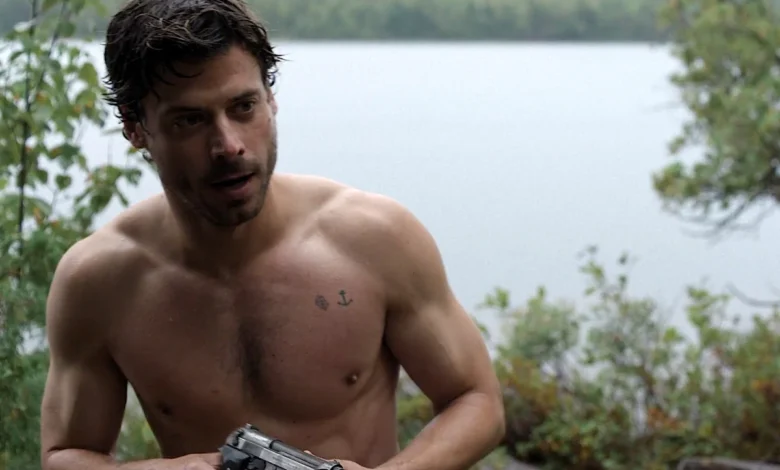
In the rugged expanse of Quebec’s Eastern Townships, a harrowing ordeal unfolds in Wiebke von Carolsfeld’s latest cinematic offering, "Someone’s Daughter." The film plunges audiences into a tense psychological thriller, centering on the unlikely and fraught relationship between Sam (Pascale Bussières), a defense attorney, and Paul (François Arnaud), her former client, who find themselves stranded in the Canadian wilderness. The narrative begins with a disquieting reassurance from Sam to Paul, who confesses a deep-seated fear of wolves: "Wolves don’t attack for no reason." This seemingly simple statement belies the complex moral and psychological terrain the film is about to explore.
While the actual Eastern Townships may not be a hotspot for wolf activity, the film masterfully utilizes the wilderness as a crucible for its characters. Sam, portrayed as a shrewd and calculating individual, dedicates much of the film to scrutinizing Paul, her hiking companion and ex-client, searching for any sign of predatory instinct or vulnerability that might mirror the very nature of the man who abducted them. This psychological warfare is set against the backdrop of a crime that has shattered lives, a crime for which Paul was, in part, exonerated thanks to Sam’s legal acumen.

The premise of "Someone’s Daughter" is undeniably high-concept, drawing parallels to Sam Raimi’s blockbuster "Send Help" from January, but filtered through a profoundly tragic and introspective lens. Instead of a corporate power struggle in a survival scenario, von Carolsfeld pairs an accused rapist with the lawyer who secured his freedom. Their forced cohabitation becomes a fight for survival, not just against the elements, but against the ghosts of their past actions and the vengeful pursuit of Mr. Borden (Peter Outerbridge). Borden, the father of a woman whose addiction and subsequent death he attributes to the defense’s conduct during Paul’s trial, is the architect of their terrifying predicament.
The Genesis of a Captivity
The film’s inciting incident is the abduction of Sam by Mr. Borden. The narrative is framed by the aftermath of this event, where Sam and Paul are left stranded. Borden, in a moment of desperate and self-destructive grief, takes his own life shortly after abducting Sam, leaving the two former adversaries to navigate their shared predicament. The immediate aftermath is marked by shock and a fleeting moment of potential solidarity. Paul, having been released from legal scrutiny 15 years prior and having had no contact with Sam since, expresses immediate concern for her well-being. This brief flicker of shared trauma suggests a possibility of alliance, a hope quickly extinguished as their forced proximity compels them to confront their interconnected histories.
The true nature of their shared trauma, however, is far from simple. As days turn into an agonizing trek through the dense Canadian wilderness, their conversations begin to unravel the events that led them to this point. The memory of the woman at the center of Paul’s trial, Lydia, surfaces. Sam reminds Paul that Lydia was the victim, prompting Paul’s detached assertion that "She ruined my life." This statement immediately casts a shadow over Paul’s character, highlighting a potential lack of remorse or self-awareness.

A Man-Child in the Wilderness
François Arnaud’s portrayal of Paul is central to the film’s unsettling dynamics. Whether he is voicing his irrational fears of wolves or reminiscing about a past as a competitive swimmer, Arnaud imbues Paul with the characteristics of a man-child, someone whose self-absorption consistently reorients every situation back to his own perceived victimhood. This tendency to make every fork in the road about himself is particularly jarring, given that he is the very reason for their current predicament. Paul’s inability to control his impulses and his persistent imposition of his own narrative make him a walking liability, even when discussing his former expertise in home security, which becomes sickeningly irrelevant in their current state.
The film’s exploration of Paul’s character is nuanced, with Arnaud skillfully oscillating between moments of apparent vulnerability and unsettling manipulation. This ambiguity is a key strength, keeping both Sam and the audience guessing about Paul’s true nature. His character’s motivations and past actions remain a constant question mark, a mystery that Sam, despite her professional experience, desperately wants to believe she has misjudged.
The Defense Attorney’s Burden
Pascale Bussières delivers a commanding performance as Sam, a character who is presented as a highly capable professional. Her initial reassurances about wolves hint at a deeper understanding of primal instincts, an understanding she now applies to assessing Paul. As the film progresses, Sam’s professional confidence begins to erode under the weight of her circumstances and her reappraisal of Paul. Bussières masterfully charts this psychological erosion, allowing Sam’s professional composure to give way to a more visceral and complex emotional performance, crucial for the narrative’s credibility.

The dialogue sometimes veers into territory that feels overtly designed to articulate the screenwriter’s ethical arguments, but this is a minor concession for a thriller so deeply invested in examining the pervasive reach of violence. Sam’s interactions with Mr. Borden, particularly his demand that she remove her makeup to reveal "someone’s daughter," are poignant moments that underscore the film’s thematic concerns. This confrontation echoes the emotional resonance of a scene in Emerald Fennell’s "Promising Young Woman," where the realization of another’s vulnerability forces a reckoning with past actions. "Someone’s Daughter" extends this concept across a vast, unforgiving landscape, stretching the psychological torment over days of harrowing survival.
Redefining the Rape-Revenge Genre
"Someone’s Daughter" eschews the conventional hallmarks of the rape-revenge genre, which often rely on graphic depictions of violence and cathartic retribution. The film, co-written by von Carolsfeld and Doug Taylor, moves beyond gratuitous gore to delve into the psychological underpinnings of sexual violence and its aftermath. Instead of elaborate physical harm, the film’s brutality lies in forcing two deeply compromised individuals into an extended period of intense proximity. This approach aligns with von Carolsfeld’s background in literary adaptations, showcasing her talent for meticulous control and subtle psychological exploration.
The film deliberately sidesteps the sensationalism that has historically defined works like "The Last House on the Left" and "I Spit on Your Grave." While these films offered visceral punishment, "Someone’s Daughter" presents a more delicate, albeit unsettling, experiment. It uses literal proximity to explore philosophical rot, questioning the nature of accountability and the ease with which predators can operate in society until circumstances strip away their veneers. The film suggests that true reckoning may lie not in overt punishment, but in forcing individuals to confront truths they have long sought to ignore.

The Wilderness as a Microcosm
The sprawling Canadian wilderness, rather than serving as a mere backdrop, becomes an active participant in the narrative. Its vastness creates a sense of isolation that amplifies the psychological pressure on Sam and Paul. This environmental contrast to the encroaching claustrophobia of their situation serves as a stark reminder that their nightmare is not an isolated incident but a manifestation of broader societal themes. The wilderness, in its indifferent grandeur, forces a confrontation with the primal instincts that lie beneath civilized behavior.
The dialogue between Sam and Mr. Borden, particularly when he discusses Lydia’s trial and its devastating impact, highlights the systemic issues at play. Sam’s measured response, "The system is tough," acknowledges her role within a complex legal framework but also suggests limitations in her ability to control outcomes. Von Carolsfeld’s film does not aim for a sweeping indictment of the criminal justice system but rather offers a nuanced and devastatingly accurate portrayal of human complicity in allowing individuals who cause immense harm to evade true accountability.
The Lingering Question of Accountability
By the time the film circles back to the motif of wolves, von Carolsfeld has shifted the narrative focus from viewing the characters as mere wildlife to understanding them as individuals grappling with their actions and their consequences. Whether Paul is guilty or innocent, and whether Sam aligns with Mr. Borden’s perspective, becomes secondary to the central question of whether the lessons learned in their ordeal will translate back into civilized society.

Von Carolsfeld, returning to filmmaking after a decade-long hiatus, masterfully demonstrates how predators can seamlessly blend into everyday life until external pressures reveal their true nature. The film suggests that the profound impact of trauma and the potential for radical transformation can be as significant as any physical act. The narrative leaves the audience with the unsettling realization that the most terrifying monsters are often those who walk among us, their true selves hidden until circumstance forces them into the light.
The film’s conclusion, while avoiding explicit resolution, underscores the complex interplay of guilt, responsibility, and the search for truth. The final grade of B+ reflects the film’s success in delivering a thought-provoking and emotionally resonant narrative that challenges conventional genre expectations. "Someone’s Daughter" premiered at Fantasia on July 21 and is slated for Canadian theaters on October 23, promising to spark conversation and critical engagement.