Russian Oligarch Umar Kremlev Bankrolled Donald Trump Jr. Wedding Events Amid Heightened Geopolitical Scrutiny

The intersection of high-profile political dynasties and foreign financial influence has once again drawn intense scrutiny following revelations that Russian oligarch and Vladimir Putin ally Umar Kremlev partially funded the post-wedding festivities for Donald Trump Jr. and socialite Bettina Anderson. While President Donald Trump notably skipped his eldest son’s marriage ceremony in May, financial records and investigative reporting indicate that a significant portion of the extravagant, multi-day, private-island celebration in the Bahamas was underwritten by figures closely tied to the Kremlin.
The disclosure, initially brought to light by ProPublica, reveals that Kremlev covered more than $100,000 in direct expenses for the couple’s weekend celebration. These expenditures included renting a second private island used to lodge guests and bankrolling a $70,000 fireworks display. The financial backing arrives at a delicate diplomatic juncture, coinciding with President Trump’s shifting foreign policy stance toward Russia and his administration’s mounting pressure on Ukrainian leadership regarding concessions in the ongoing war.
Chronology of Events and the Bahamian Celebration
The timeline of the wedding events highlights a carefully orchestrated separation between the private marital ceremony and the subsequent public festivities. According to statements and records reviewed by investigative journalists, Donald Trump Jr. and Bettina Anderson were legally and privately married on a Friday in May. This initial ceremony was described as intimate and strictly limited to immediate family members, with President Donald Trump conspicuously absent from the gathering.
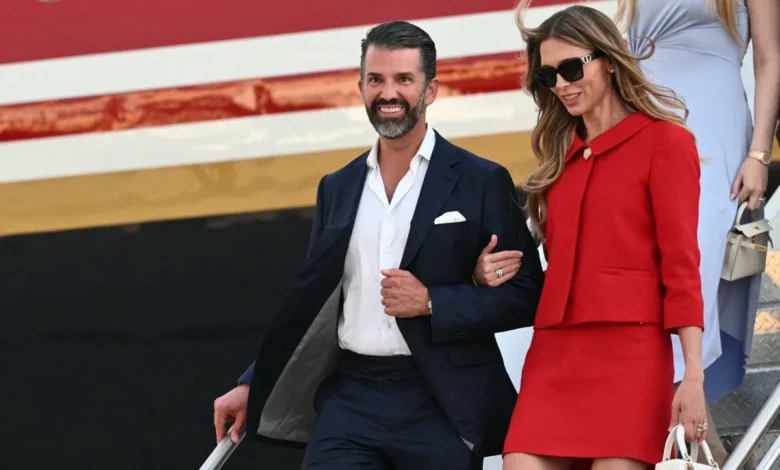
However, the conclusion of the private ceremony marked the transition to a much larger, three-day social gathering hosted across private islands in the Bahamas. While the couple maintains that the weekend getaway was planned months in advance as a casual trip with friends and was entirely distinct from the wedding itself, records show that the transition seamlessly blended into a celebratory wedding reception.
Guests arrived on the islands to find lavish accommodations, extensive entertainment, and large-scale productions. Photographic evidence from the event confirms the physical presence of Umar Kremlev among the attendees, despite his absence from official photo carousels subsequently published by the couple. Observers at the event noted the presence of several associates associated with Kremlev who maintained a distinct presence, frequently conversing in Russian away from the primary group of American guests.
Financial Disclosures and Official Responses
The revelation of foreign financial backing immediately triggered a wave of public discourse, prompting Bettina Trump to issue a formal defense via social media. Signed jointly by the couple, the Instagram statement sought to draw a sharp legal and semantic distinction between funding an actual wedding and funding a post-wedding party.
"Don and I got married privately on Friday, surrounded ONLY by our family," the statement read. "It was intimate, deeply personal and one of the most beautiful days of our lives. The weekend that followed had actually been planned well in advance as a fun weekend with friends. It was never intended to be our wedding weekend. When our original wedding plans changed, we simply decided to get married before it and arrived at an already planned weekend as newlyweds."
The statement further characterized Kremlev’s financial contribution as an act of personal camaraderie rather than a transaction with political motivations. "Our dear friend Umar very generously hosted two incredible nights of celebrations for us AFTER our wedding. It was an extraordinarily generous wedding gift from a friend, and something for which we were and remain incredibly grateful," she added, concluding with an appeal against cynicism: "Friendship doesn’t require a political motive. Generosity doesn’t automatically come with an agenda. And sometimes a wedding gift is simply a wedding gift."
Despite these assurances, financial analysts and political watchdogs have pointed out the obvious financial capacity of the Trump family itself. Given the vast wealth accumulated by members of the family through various business ventures, licensing deals, and media enterprises during and after the presidency, the coverage of a $100,000 expense by a foreign national has raised questions regarding optics and potential conflicts of interest.
Profile of Umar Kremlev and Sports Diplomacy
Umar Kremlev is a prominent figure in international sports administration, serving as the president of the International Boxing Association (IBA) and holding a position on the executive committee of the Boxing Federation of Russia. His tenure at the helm of the IBA has been marked by acute international controversy. Most notably, the International Olympic Committee (IOC) stripped the IBA of its authority to oversee international boxing competitions, pointing to systemic concerns regarding governance, financial transparency, doping control, and undue political influence.
Beyond amateur boxing, Kremlev has actively sought to expand his promotional footprint into American sports markets, focusing particularly on combat sports such as bare-knuckle fighting and underground combat leagues. The broader Trump family has historically maintained close institutional and personal ties with major combat-sport entities, including the Ultimate Fighting Championship (UFC) and World Wrestling Entertainment (WWE), creating natural avenues for overlap between Kremlev’s commercial ambitions and the family’s network.
However, Kremlev’s close alignment with Russian President Vladimir Putin remains the central point of contention for international observers. As a recognized ally of the Kremlin, Kremlev’s financial involvement with members of the immediate family of a sitting U.S. president introduces complex diplomatic and ethical dimensions.
Broader Geopolitical Implications
The financial disclosure occurs against a backdrop of significant shifts in United States foreign policy regarding Eastern Europe. During his second term, President Trump has pursued a diplomatic strategy that critics argue has severely weakened the North Atlantic Treaty Organization (NATO)—a long-standing strategic objective of the Kremlin—while actively working to reintegrate the Russian government into formal diplomatic channels despite ongoing international sanctions.
Parallel to these diplomatic realignments, the administration has intensified pressure on Ukrainian President Volodymyr Zelenskyy to alter military strategies in the war against Russian forces. In recent public statements, President Trump explicitly urged Ukrainian leadership to cease targeting Russian oil refineries and diesel production facilities.
"Mr. Zelenskyy has to do one thing. He has to stop knocking out diesel fuel in Russia," President Trump stated publicly. "Let him go after targets but not diesel fuel because he’s causing a shortage of diesel. This isn’t done by the Middle East; this is done by what’s happening with Russia and Ukraine."
Such policy directives, combined with financial gifts originating from high-ranking Russian oligarchs to members of the president’s family, have reignited debates among ethics experts, lawmakers, and foreign policy analysts regarding the boundaries of personal relationships and statecraft. While the Trump family maintains that the contributions were strictly personal gestures devoid of geopolitical maneuvering, critics argue that the blurring of private hospitality and international political alignment continues to present profound challenges to transparency and public trust in governance.