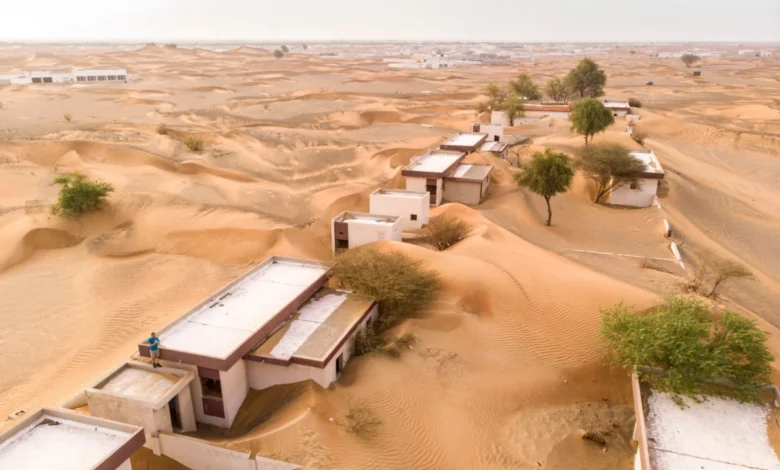
The phenomenon of urban abandonment serves as a sobering testament to the transient nature of human infrastructure. Whether caused by the collapse of local industries, environmental catastrophes, or shifting geopolitical borders, the transition from a bustling center of activity to a desolate site of ruin is often swift. As human intervention ceases, the natural world invariably initiates a process of reclamation. From the encroaching sand dunes of the Arabian Desert to the verdant overgrowth of temperate forests, abandoned locales provide a unique window into how terrestrial ecosystems integrate and dismantle artificial structures. This report examines the mechanics of abandonment, the environmental forces at play, and the broader implications of these ghost towns in the modern era.

The Chronology of Abandonment: From Industry to Silence
The lifecycle of an abandoned city generally follows a distinct pattern: a period of rapid development, a triggering event, a slow decline, and eventual total reclamation. Throughout the 20th century, the abandonment of mining towns, industrial hubs, and planned settlements became a global trend.
The process often begins with economic instability. When a primary industry—such as coal mining or textile manufacturing—fails, the tax base evaporates. In many instances, this economic collapse precedes environmental degradation. By the mid-1900s, dozens of American "company towns" were left behind as resources were depleted. The shift from an active population to a ghost town is rarely instantaneous; it is typically a gradual erosion of services, starting with the closure of schools and ending with the complete withdrawal of public utilities.

In contrast, sites like the abandoned villages near Dubai—often victims of shifting desert sands—demonstrate the speed at which geographical forces can overwhelm human engineering. These sites, once intended as permanent settlements, are now subject to the constant, fluid movement of the desert floor, proving that architecture in extreme environments requires constant, active maintenance.
Supporting Data and Environmental Dynamics
The "reclamation" process is dictated by the local climate and geological composition. In temperate regions, the primary agents of change are moisture and vegetation. Studies in structural biology indicate that root systems can exert enough force to penetrate concrete foundations, while the presence of water accelerates the oxidation of iron reinforcements within steel-frame buildings. Once a structure’s integrity is compromised, the "greenhouse effect" of encroaching ivy and invasive species accelerates the decay of the interior.

In arid regions, such as the sites frequently documented in the Middle East and the American Southwest, the primary agents are wind and heat. Sand dunes act as an abrasive, stripping paint and protective coatings, while thermal expansion and contraction cause masonry to fracture.
Selected Case Studies of Global Reclamation
- Pripyat, Ukraine: Following the 1986 Chernobyl disaster, the city was evacuated. Decades later, it serves as a primary case study for the "exclusion zone" phenomenon, where the absence of human activity has allowed wildlife populations to rebound, effectively turning the city into an unintended nature preserve.
- Hashima Island, Japan: Once a densely populated coal-mining facility, the island was abandoned in 1974. The salt air and typhoon-prone climate have rendered the concrete structures highly unstable, providing data on the long-term impact of coastal exposure on industrial architecture.
- Kolmanskop, Namibia: A former diamond mining town, it provides the clearest example of desert reclamation. The structures are currently being slowly filled with sand, offering researchers a timeline of how desertification functions in the absence of human intervention.
Official Responses and Preservation Challenges
The management of abandoned sites presents a significant challenge for local governments and international heritage organizations. There is an ongoing debate regarding whether these sites should be preserved as historical monuments or left to the natural process of decomposition.

In several instances, local governments have restricted access to abandoned cities due to safety concerns. Structures that have been overtaken by nature are frequently structurally unsound, with hidden floor collapses and potential chemical hazards. For example, the authorities in various regions of the former Soviet Union have maintained strict entry requirements for ghost towns to prevent looting and ensure public safety. Conversely, some regions have sought to monetize the "ruin porn" aesthetic, designating these areas as tourist attractions. This creates a secondary conflict: how to manage tourism without disrupting the fragile ecosystem that has evolved in the absence of humans.
Implications for Modern Urban Planning
The study of these ghost towns offers critical insights for contemporary urban planners and architects. The rapid decay observed in abandoned sites highlights the necessity of "designing for end-of-life." Modern sustainable architecture is increasingly focused on the use of materials that can be safely integrated back into the environment.

Furthermore, the vulnerability of these cities to environmental forces—whether sand, flood, or foliage—serves as a reminder of the fragility of current climate-vulnerable infrastructure. As sea levels rise and desertification expands, many currently inhabited cities face the prospect of becoming the "ghost towns" of the next century. Understanding how structures fail provides the technical data needed to build more resilient defenses.
The Aesthetic and Cultural Impact
Beyond the logistical and environmental data, the visual impact of a city being reclaimed by nature has profound cultural resonance. It challenges the anthropocentric view that human civilization is a permanent fixture. When vegetation breaks through a living room floor or a desert dune occupies a bedroom, the hierarchy between nature and culture is inverted.

This "eerie beauty" is not merely a subject for photography; it is a profound commentary on the transience of human ambition. Sociologists have noted that the fascination with these sites often peaks during periods of societal anxiety. When the future feels uncertain, the sight of a city being dismantled by natural forces offers a form of visual catharsis—a reminder that the earth has a capacity for renewal that functions independently of human presence.
Analysis of Future Trends
Looking ahead, the rate of abandonment is expected to increase in specific geographical corridors. Urbanization is leading to "hollowed-out" rural areas, where smaller towns are losing their populations to centralized metropolitan hubs. As these rural settlements are left behind, they will follow the same trajectory as the mining towns of the 20th century.

However, the technology used to document these sites is improving. Drones and LIDAR scanning now allow researchers to track the rate of decay with unprecedented accuracy. This digital preservation ensures that even if the physical structures eventually collapse into the earth, their history and the lessons learned from their construction—and their subsequent failure—remain accessible to future generations.
Conclusion
The reclamation of the built environment by nature is an inevitable physical process. Whether it occurs through the slow creep of ivy or the rapid movement of sand, the earth consistently reclaims the space occupied by human activity. By studying these abandoned locales, we gain more than just an appreciation for their haunting aesthetics; we acquire essential data on material science, environmental management, and the long-term sustainability of our own urban centers. These cities stand as silent, crumbling libraries, teaching us about the endurance of the natural world and the delicate, fleeting nature of our own contributions to the landscape. While the cities may be gone, the lessons they offer remain as vital as ever in the ongoing dialogue between humanity and the environment.
Related posts: