WHO Director-General visits Jordan to recognize strong collaboration on health system delivery, emergency relief and advancing mental health

The Director-General of the World Health Organization (WHO), Dr. Tedros Adhanom Ghebreyesus, has concluded the first phase of a pivotal two-day State visit to the Hashemite Kingdom of Jordan, a diplomatic mission that underscored the kingdom’s status as a critical nexus for regional healthcare and humanitarian relief. The visit, characterized by high-level engagements with King Abdullah II and international humanitarian stakeholders, served to highlight Jordan’s multifaceted role in providing refuge, specialized medical care, and systemic stability amidst a backdrop of escalating regional volatility.
A Strategic Alliance for Regional Stability
The centerpiece of the visit was a formal audience with His Majesty King Abdullah II, where discussions moved beyond symbolic diplomacy to address the technical and financial realities of maintaining a resilient health infrastructure. Jordan currently hosts over three million refugees—a demographic pressure that has fundamentally reshaped the nation’s health system. The dialogue focused heavily on the mechanics of Universal Health Coverage (UHC) and the operational challenges of managing a medical corridor that serves as a lifeline for the Palestinian population, particularly those evacuated from Gaza suffering from trauma, cancer, and chronic illnesses.
Dr. Tedros commended the Hashemite Kingdom for its “Medical Corridor” initiative, a logistical and humanitarian feat that allows for the safe passage and clinical treatment of vulnerable children and adults from conflict zones. This initiative is widely viewed by international observers as a model of medical diplomacy, proving that even in the most resource-constrained environments, institutional commitment to the "right to health" can mitigate the catastrophic impacts of war.
The Human Cost of Conflict: Field Observations
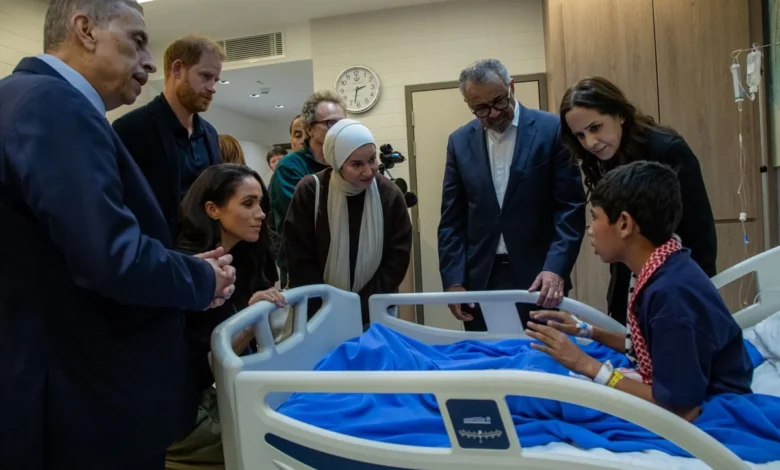
Beyond the halls of power, Dr. Tedros conducted a site visit to a WHO-supported hospital specifically equipped to treat pediatric patients evacuated from Gaza. The visit provided a stark, evidence-based look at the reality of modern medical evacuation. These patients, many of whom are suffering from complex oncology requirements or severe combat-related trauma, rely on a fragile chain of care that begins in the rubble of conflict zones and ends in the specialized wards of Jordanian facilities.
The presence of Prince Harry and Meghan, the Duke and Duchess of Sussex, during these engagements brought global visibility to the necessity of mental health support in emergency settings. Through Archewell Philanthropies, the couple has consistently championed the integration of psychosocial support into humanitarian responses. During their interactions with frontline health workers, the focus remained on the psychological toll of conflict—not only for the patients but for the medical staff who navigate the systemic stress of treating high-acuity cases under constant international pressure.
Contextualizing the Humanitarian Burden
To understand the significance of Dr. Tedros’s visit, one must analyze the data surrounding Jordan’s health sector. According to recent WHO figures, Jordan’s primary health care system has been under unprecedented strain since the onset of the Syrian crisis, which saw millions cross the border, followed by the acute medical needs emerging from the Gaza conflict.
- Refugee Integration: Jordan has successfully integrated a significant percentage of refugees into its national health network, a feat rarely achieved in other host countries.
- Mental Health Infrastructure: Supported by the Director-General’s Special Initiative for Mental Health, Jordan has moved to integrate psychological services into routine primary care, effectively reducing the historical stigma associated with mental health treatment in the region.
- Financial Requirements: The visit served as a platform for a high-level meeting with donor countries and United Nations agencies to address the funding gap. With the humanitarian response costing billions annually, the WHO is pushing for more predictable, multi-year funding cycles rather than the current reliance on short-term emergency grants.
Chronology of the Diplomatic Engagement
The visit was structured to move from policy-level discussions to grassroots implementation:
- Morning of Day 1: High-level meeting with King Abdullah II at the Royal Palace, focusing on regional health policy and the sustainability of the medical corridor.
- Afternoon of Day 1: Clinical visits to pediatric wards and high-level strategy sessions with UN partners and philanthropic entities to discuss financing for the 2024-2025 period.
- Day 2 Agenda: A transition to specialized care facilities, including the National Center for Rehabilitation of Addicts and the King Hussein Cancer Center, to review the expansion of non-communicable disease (NCD) treatment capacities.
- Concluding Sessions: Final meetings with the Jordanian Hashemite Fund for Human Development to assess community-based health initiatives and local health resilience.
Official Statements and Global Implications
The rhetoric surrounding the visit was notably focused on "resilience" and "equity." Dr. Tedros emphasized that Jordan’s experience provides a blueprint for other nations facing similar challenges. "Jordan continues to show the world what it truly means to put health and humanity first," Dr. Tedros stated during his address to the press.
Prince Harry’s contribution to the visit underscored the long-term perspective of the humanitarian mission. "Mental health is fundamental to recovery, dignity, and long-term peace," the Duke of Sussex noted. This perspective aligns with the WHO’s broader strategic shift toward viewing mental health as a prerequisite for social stability in post-conflict or long-term displacement scenarios.
The Broader Impact: Analyzing the "Jordan Model"
The implications of this visit are significant for the Middle East’s health landscape. By formalizing the partnership between the WHO and the Jordanian government, both parties are effectively signaling that health care is a non-negotiable element of national security and regional diplomacy.
There are three primary takeaways from this high-level engagement:
- Systemic Resilience: Jordan is transitioning from an emergency-response model to one that emphasizes the long-term integration of refugees into the national health framework. This reduces the reliance on separate, parallel health systems, which are often less efficient and harder to fund.
- The "Humanitarian Corridor" Standard: The success of the medical evacuation of Gazan patients into Jordan provides a case study for international humanitarian law. It demonstrates that when states prioritize medical necessity over geopolitical friction, lives are saved at a scale impossible to achieve through ad-hoc efforts.
- The Role of Philanthropy: The involvement of Archewell Philanthropies signifies a trend in modern humanitarianism where private actors provide not just funding, but advocacy and structural support to public health agencies. By bridging the gap between clinical reality and public perception, these partnerships are proving essential in securing international attention for "forgotten" crises.
Future Outlook and Policy Recommendations
As the State visit moves toward its conclusion, the focus shifts to the long-term sustainability of the programs discussed. The WHO’s collaboration with the Jordanian Ministry of Health is expected to produce a revised roadmap for the next three years, focusing on digital health records, the training of local mental health practitioners, and the expansion of oncology services to accommodate the influx of regional patients.
The visit by Dr. Tedros serves as a reminder that the WHO’s mission—"Health for All"—is frequently tested in border regions where politics and human biology intersect. Jordan, through its leadership and the logistical support provided by the WHO, remains a focal point for this mission. The coming months will likely see an increase in international donor interest in Jordan’s health sector, provided the momentum generated by this high-level visit is translated into actionable, transparent, and outcome-oriented policy.
Ultimately, the visit was not merely a ceremonial tour; it was a strategic validation of Jordan’s role as a regional health stabilizer. By aligning the interests of the Crown, the United Nations, and global philanthropic partners, the visit effectively solidified a framework intended to ensure that, regardless of regional instability, the essential components of health—care, mental support, and specialized medical intervention—remain accessible to those in the greatest need. The success of this endeavor will be measured not by the rhetoric of the visit, but by the tangible reduction in mortality rates and the increased capacity of Jordan’s healthcare system to absorb the shocks of an increasingly unstable neighborhood.