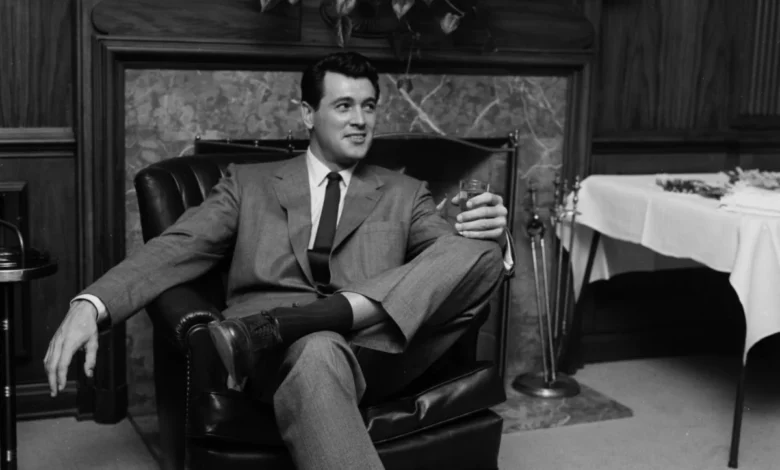
Though he is without a doubt one of the most famous faces of Tinseltown’s Golden Age, Rock Hudson came from humble beginnings. Born Roy Harold Scherer Jr. on November 17, 1925, the future movie star navigated a childhood of stark contrast to the opulence he would later inhabit. He spent his early years living with his maternal grandparents in a cramped one-bedroom bungalow on 719 Center Street in suburban Chicago. According to biographical accounts, the residence was a study in density, housing six adults and five children who shared a single bathroom. This modest upbringing, defined by necessity and limited space, perhaps catalyzed the actor’s later obsession with creating sprawling, private, and highly customized domestic environments.

As his Hollywood career ascended, marked by landmark performances in cinematic staples such as Giant, Pillow Talk, Lover Come Back, and All That Heaven Allows, Hudson sought to distance himself from the unrelenting glare of the studio system. For Hudson, his residences were not merely real estate investments; they were psychological refuges. As he noted in Sara Davidson’s definitive biography, Rock Hudson: His Story, his home was the singular location where he could experience true privacy. Beyond those gates, he was a public commodity—watched, dissected, and discussed—but within them, he was a craftsman. He took great satisfaction in the physical labor of home improvement, often spending his downtime tearing down walls and laying bricks to tailor his surroundings to his evolving needs.
A Chronology of Residence and Transformation
The trajectory of Hudson’s domestic life offers a unique window into the changing social and architectural trends of mid-century Los Angeles. His housing choices often mirrored his professional status and the personal pressures of living as a closeted gay man in a rigid, image-conscious industry.

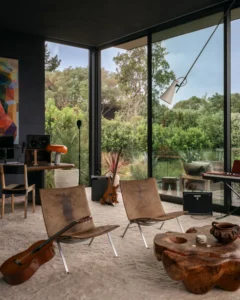
In 1952, Hudson was living with fellow actor Bob Preble in North Hollywood. Their partnership, which lasted three years across four different properties, concluded with a residence on Avenida del Sol. This home was noted for its forward-thinking architecture, featuring expansive glass fixtures and panoramic views of the valley and mountains. While the arrangement fueled contemporary speculation regarding the nature of their relationship, Preble later described the bond as an experimental period of companionship that predated his own marriage to actor Yvonne Rivero.
By 1955, the public narrative surrounding Hudson’s life shifted with his marriage to Phyllis Gates, his secretary and an aspiring interior designer. The couple settled into a two-bedroom ranch-style home at 9151 Warbler Place, which Hudson had purchased the previous year. The property featured a warm, functional kitchen—a hub for Gates, who was noted for her culinary skills—and a living room that, due to Hudson’s limited liquidity at the time, was initially furnished with simple redwood lawn chairs.

The marriage, which ended in 1958, has been widely characterized by historians and associates as an arranged union designed to shield Hudson’s private life from the scrutiny of the era’s conservative press. Following the divorce, Gates received an alimony settlement of $250 per week for a decade and ownership of the Warbler Place home, then valued at $35,000.
The Malibu Years and the Shift to Independence
Post-divorce, Hudson pivoted toward a coastal lifestyle, moving into a stilt-supported beach house in Malibu. This period, coinciding with the production of Pillow Talk in 1959, marked a transition toward a more autonomous and social existence. Living in close proximity to a circle of actors and stuntmen, Hudson embraced an outdoor-centric life that involved year-round swimming, sailing, and scuba diving. Don Burnett, a close associate from that era, recalled a period of relative freedom, noting that the group frequently engaged in physical activity in the Malibu hills before jumping into the Pacific. This brief chapter underscored Hudson’s desire for community and physical engagement, though he would soon return to the hills of Los Angeles to plant deeper roots.

The Evolution of The Castle
The most significant architectural chapter of Hudson’s life began in 1961, when he occupied 9402 Beverly Crest Drive. The property, originally owned by producer Sam Jaffe, was an expansive three-and-a-half-acre estate characterized by its Spanish-style architecture, including a red-tile roof and robust stucco walls. Hudson’s desire to own this property eventually became a point of negotiation with Universal Studios. In 1962, as his contract neared expiration, the studio agreed to purchase the residence from Jaffe for $167,000 as an incentive for Hudson to renew his commitment to the studio.
Hudson referred to the estate as "The Castle" and embarked on a multi-year renovation project. Drawing inspiration from Mexican colonial architecture and the American Southwest, he meticulously curated the interior to reflect a personal aesthetic. He utilized stone archways, hand-painted tiles, and exposed wood ceilings to ground the space. The decor was notably eclectic, incorporating African masks, zebra skins, and oversized pewter candlesticks. His dedication to the property was all-encompassing; he famously used specialized architecture books as "bibles" to guide his structural and aesthetic modifications.

The Domestic Philosophy of a Private Star
Hudson’s approach to his home was paradoxical. Despite his professional need for privacy, he maintained an open-door policy at The Castle. Associates, including actor George Nader, suggested that this lack of security was intentional—a way for Hudson to court the excitement of the unknown and facilitate unexpected social encounters. This desire for connection extended to his fan base; his household staff frequently observed that the star prioritized responding to fan mail and answering the telephone with a sense of urgency that bordered on the obsessive.
Furthermore, Hudson found a genuine creative outlet in his garden. Inheriting the estate’s gardener, Clarence Morimoto, Hudson became a hands-on horticulturalist. He grew an array of produce, from peaches and corn to herbs for cocktails, and spent hours pruning and weeding. He frequently remarked that, had he not found success in acting, he would have pursued a career as a landscape architect. This labor was not merely cosmetic; it served as a meditative practice where he could process career decisions and manage the stressors of his public life.

Legacy and Real Estate Impact
Rock Hudson remained in The Castle until his death from AIDS-related complications on October 2, 1985. The property served as the site of his final memorial service, which was attended by 300 guests, including his lifelong friend and co-star, Elizabeth Taylor. At the time of his passing, the estate was appraised at $3 million, a significant appreciation from its 1960s valuation.
The subsequent history of the property reflects the broader trend of high-end Los Angeles real estate. In 1997, Microsoft co-founder Paul Allen acquired the estate for $9 million. Under Allen’s ownership, the property was maintained for over two decades until his death in 2018. The market trajectory of the home highlights the extreme inflation of the Los Angeles luxury sector; in 2021, the estate was listed for $55.5 million.

The life of Rock Hudson, as told through the history of his homes, reveals a man perpetually negotiating the space between his carefully constructed public persona and his private, creative self. From the overcrowded bungalow of his youth to the sprawling, self-curated refuge of The Castle, Hudson’s domestic choices provide a definitive record of a star who was, above all else, deeply invested in the sanctuary of his own making. The endurance of his properties, both in their physical form and their market value, serves as a final testament to the lasting impact of a man who spent his life building walls to keep the world out, only to find the peace he sought within the very architecture he created.