Ford Reaches $6,000 Settlement with Transit Trail Owners Following Controversial Tire Downgrade and Recall

The modern automotive landscape has been profoundly shaped by an insatiable consumer appetite for rugged aesthetics. Across nearly every segment, manufacturers have capitalized on the off-road trend by injecting standard road cars, crossovers, and utility vehicles with utilitarian styling cues. Black plastic body cladding, raised suspensions, aggressive all-terrain tires, and adventurous marketing campaigns have transformed everyday commuter vehicles into symbols of untamed exploration. For vanlife enthusiasts, camper conversion companies, and commercial operators seeking extra traction, automakers have eagerly obliged, developing factory-built adventure vans designed to bridge the gap between paved highways and remote backcountry trails.
Among these specialized offerings, the Ford Transit Trail emerged as a prominent contender in the full-size van market. Launched for the 2023 model year, the Transit Trail was specifically engineered to appeal to the burgeoning community of DIY camper van builders and outdoor adventurers. However, what began as an exciting manufacturing initiative quickly unraveled into a logistical nightmare, culminating in a nationwide vehicle recall, diminished vehicle capabilities, intense consumer backlash, and a significant class-action lawsuit. Following months of legal contention, Ford has finally agreed to a financial settlement with affected owners, offering a $6,000 payout to compensate for the compromised off-road performance of their adventure-ready vans. While the settlement represents a substantial recovery compared to typical class-action payouts, it leaves impacted drivers grappling with the reality of an altered vehicle that no longer matches the specifications they paid for.
The Genesis of the Transit Trail and the Marketing of Adventure
When Ford introduced the Transit Trail variant for the 2023 model year, the vehicle was heavily promoted as a rugged, factory-engineered platform designed to conquer rough terrain straight from the dealership floor. The American automotive giant positioned the van as a dedicated tool for outdoor enthusiasts who required both the massive interior cargo volume of a full-size commercial platform and the enhanced capability to navigate unpaved forest service roads, snowy mountain passes, and muddy campsites.
To achieve this adventure-ready status, Ford equipped the Transit Trail with a series of mechanical enhancements that distinguished it from the standard, rear- or all-wheel-drive commercial Transits commonly seen serving delivery fleets across urban landscapes. The core of the Transit Trail package featured an intelligent all-wheel-drive system paired with a re-tuned chassis designed to meet rigorous durability standards. Furthermore, the vehicle boasted an increased ride height, providing approximately 6.7 inches of ground clearance—an essential metric for clearing rocks, ruts, and debris found on remote trails.
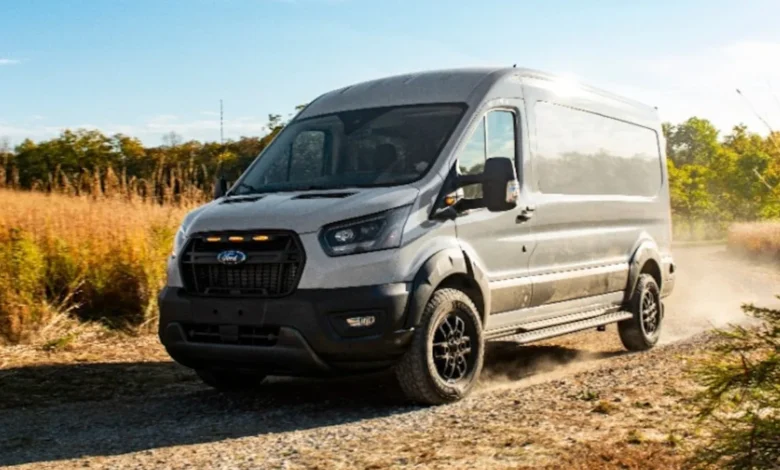
Visually and functionally, the most striking feature of the Transit Trail package was its wheel and tire setup. Ford outfitted the vans with massive 30.5-inch Goodyear Wrangler Workhorse all-terrain tires wrapped around distinct black alloy wheels. These meaty tires not only lent the van an aggressive, off-road stance but also contributed significantly to the vehicle’s functional ground clearance and traction capabilities. To complement the exterior transformation, the Transit Trail included robust underbody protection shields to safeguard vital mechanical components from impact, unique black plastic wheel arch cladding, a distinctive grille with integrated marker lights, and heavy-duty front and rear splash guards.
For buyers investing in the lifestyle, the rugged modifications came at a steep financial premium. The Trail package added roughly $12,500 to the base price of the vehicle, pushing the total cost of a well-equipped 2023 or 2024 Ford Transit Trail well into the upper tiers of the full-size van market. Consumers eagerly signed purchase agreements, confident that they were acquiring a reliable, factory-warranted foundation for their mobile dwellings, remote workstations, and weekend expedition vehicles.
The Mechanical Failure: Tire Rubbing and the 2024 Recall
The promise of factory-backed off-road capability, however, was soon undermined by an unforeseen engineering oversight. Shortly after the vehicles began populating driveways and conversion shops across North America, owners began reporting a distressing mechanical issue during normal operation. When navigating sharp turns, articulation over bumps, or uneven terrain, the generously proportioned 30.5-inch Goodyear Wrangler Workhorse tires were making unintended physical contact with the interior plastic liners of the front wheel wells.
This tire rubbing phenomenon was not merely an aesthetic annoyance or an innocuous noise; it posed tangible risks to the vehicle’s structural integrity, tire longevity, and safety. Continuous friction between the rotating tire tread and the wheel well lining could lead to premature wear of the tire sidewalls, potential punctures, damage to the inner chassis components, and localized heat buildup. Recognizing the liability and safety implications of the defect, federal regulators and corporate engineers initiated a comprehensive review of the platform.
In early 2024, Ford officially issued a safety recall affecting virtually every 2023 and 2024 Transit Trail model produced up to that point—encompassing nearly 2,000 vehicles. Rather than redesigning the suspension geometry, widening the wheel arches, or engineering a bespoke clearance solution that would preserve the vehicle’s advertised attributes, Ford opted for a simpler, standardized remediation strategy. Dealership service centers were instructed to remove the oversized 30.5-inch Goodyear all-terrain tires and replace them with smaller, standard-specification 28.5-inch tires identical to those utilized on baseline, highway-oriented Transit models.
While the tire swap successfully resolved the wheel well interference issue, it triggered immediate and profound dissatisfaction among the vehicle’s owner base. By downsizing the tires by two full inches, Ford inadvertently stripped the Transit Trail of its primary selling points. The mechanical alteration reduced the vehicle’s ground clearance from 6.7 inches down to 5.5 inches—the exact height of a standard, non-trail Transit. The visual stance of the vehicle was visibly compromised, and more importantly, its functional ability to traverse deep snow, sand, mud, and uneven terrain was severely degraded. Owners who had paid a five-figure premium for a specialized off-road machine essentially found themselves driving a standard commercial van wearing cosmetic plastic cladding.
Consumer Outrage and the Legal Battle
The unilateral decision by Ford to alter the fundamental capabilities of the Transit Trail sparked widespread indignation within the vanlife and commercial conversion communities. Online forums, social media groups, and enthusiast platforms quickly became clearinghouses for consumer grievances. Owners argued that they had bargained for a specific product—one explicitly marketed and priced for its rugged utility—and that the remedy provided by the recall constituted a substantial breach of value.
Frustrated by what they perceived as an inadequate corporate response that failed to compensate them for the loss of their vehicle’s specialized utility, affected owners took legal action. A class-action lawsuit was formally filed against Ford Motor Company, alleging that the automaker sold vehicles with a documented design defect, subsequently diminished the value and performance of those vehicles through a substandard recall remedy, and failed to provide equitable financial restitution to consumers who had paid top dollar for the Trail package.
Legal analysts following the case noted that class-action lawsuits involving automotive modifications and diminished capability are notoriously complex. Plaintiffs must prove not only that a defect existed, but that the manufacturer’s corrective action resulted in a measurable economic loss that was not adequately addressed by warranty repairs or standard recall procedures. In this instance, the quantifiable metric of economic loss was anchored directly to the $12,500 cost of the Trail package and the subsequent degradation of the vehicle’s off-road architecture.
Settlement Terms and Eligibility Criteria
After months of legal proceedings, negotiations, and evidentiary reviews, Ford Motor Company and the plaintiffs reached a formal class-action settlement agreement. Under the terms of the settlement, Ford has agreed to pay eligible Transit Trail owners a cash disbursement of $6,000 to account for the diminished off-road performance, reduced ground clearance, and loss of utility resulting from the mandatory tire replacement recall.
Legal resources, including documentation hosted by ClassAction.org, have outlined the specific criteria required for individuals seeking to claim their settlement payout. To be deemed eligible, a claimant must satisfy several strict baseline conditions:
- The individual must be the original owner or original lessee of an affected vehicle.
- The vehicle must be a model year 2023 or 2024 Ford Transit Trail.
- The purchase or lease agreement must have been executed prior to June 1, 2024.
- The vehicle must have been acquired primarily for personal, family, or household use, shielding commercial fleets from certain consumer protection provisions depending on regional jurisdiction.
- The claimant must not have previously received any separate financial compensation from Ford, including prior settlement payments, vehicle repurchases, or private arbitration awards related to the alleged tire defect or economic loss.
For qualifying owners who invested their hard-earned money into the adventure van lifestyle, the $6,000 payout represents a meaningful, albeit partial, recovery of funds. While the financial relief does not fully restore the lost off-road capabilities that initially attracted buyers to the showroom, it provides tangible compensation for the discrepancy between what was marketed and what was ultimately delivered. Notably, because the original Trail package cost $12,500, the settlement effectively refunds slightly less than half of the specialized package’s retail price, leaving the financial burden of the downgrade partially absorbed by the consumer.
Broader Industry Implications and the Future of Niche Vehicles
Beyond the immediate legal and financial ramifications for Ford and the individual plaintiffs, the Transit Trail controversy highlights a broader, systemic challenge facing the contemporary automotive industry. As manufacturers increasingly leverage "lifestyle" branding to market specialized trim levels, the pressure to rush rugged, off-road-oriented variants to market has never been higher. The race to capture consumer segments interested in overlanding, vanlife, and outdoor recreation frequently introduces engineering compromises, particularly when heavy-duty components are retrofitted onto existing commercial platforms designed primarily for paved highway use.
The Ford Transit Trail incident serves as a cautionary tale for both automakers and consumers regarding the perils of platform adaptation. When engineers push physical tolerances to their absolute limits—such as squeezing oversized tires into wheel wells designed for smaller highway profiles—the margin for error narrows significantly. If manufacturing defects or safety hazards subsequently force a rollback of those capabilities, the resulting consumer alienation can inflict lasting damage on brand loyalty and corporate reputation.
Furthermore, the settlement establishes an interesting precedent for automotive class-action litigation involving diminished utility rather than catastrophic mechanical failure or physical injury. Historically, major automotive recalls focus heavily on mitigating safety risks, such as faulty airbags, braking system failures, or engine fires, where remedies are evaluated purely on the restoration of baseline safety. In contrast, the Transit Trail lawsuit places commercial and experiential value on trial—asserting that when a manufacturer charges a significant financial premium for specialized recreational capabilities, stripping away those capabilities via a mandatory recall constitutes a compensable financial injury.
As automakers continue to develop and market heavily accessorized soft-roaders, rugged crossovers, and factory-built adventure vehicles, industry observers expect that quality control standards and pre-production testing protocols will face heightened scrutiny. Consumers investing thousands of dollars in specialized packages expect uncompromising durability and performance that align precisely with promotional materials. Whether the Ford Transit Trail settlement will deter manufacturers from cutting corners on future niche variants remains to be seen, but it undoubtedly serves as a stark reminder that modern adventurers and vanlife enthusiasts will hold automotive giants accountable when their vehicles fall short of the promised journey.