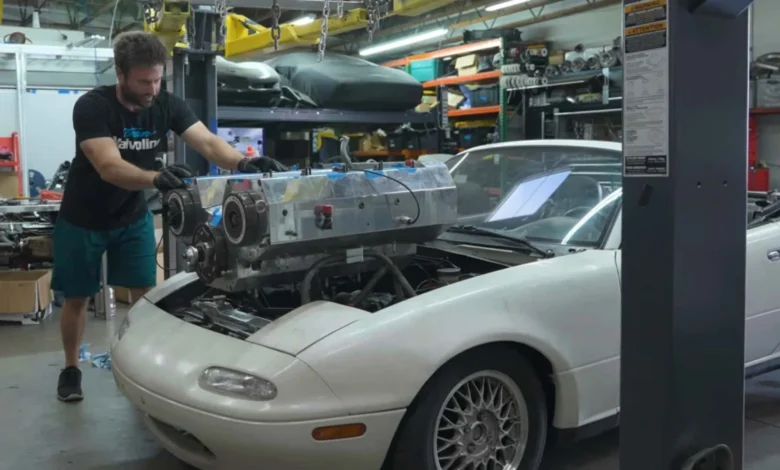
The 2026 Specialty Equipment Market Association (SEMA) Show in Las Vegas serves as the premier global stage for automotive innovation, and this year’s event was defined by a project that defies traditional mechanical logic. YouTube personality and rotary engine enthusiast Rob Dahm unveiled a first-generation Mazda MX-5 Miata that features a staggering 13-rotor engine configuration. While the spectacle of such an oversized powerplant shoehorned into a compact chassis captured the attention of thousands of attendees, the project is a masterclass in creative engineering, psychological misdirection, and the extreme lengths builders go to for the sake of the SEMA spotlight.
The Engineering Duality of the 13-Rotor Build
At first glance, the build appears to be a monstrously overpowered track machine. The engine bay of the modest Miata is completely dominated by a massive, custom-fabricated 12-rotor engine assembly. However, the reality of the vehicle’s propulsion is far more nuanced. The 12-rotor unit, which commands the entirety of the engine bay, is a non-functional display piece designed to mimic the appearance of a high-output, race-ready engine. To move the vehicle, Dahm’s team integrated a separate, single-rotor engine equipped with a Garrett GBC22 turbocharger.
This separation of form and function was a strategic choice. By retaining the wiring, complex fuel lines, and peripheral accessories on the 12-rotor assembly, the team successfully created a visual masterpiece that invites scrutiny. The 12-rotor engine, a conceptual beast that claims a theoretical output of 4,500 horsepower, remains disconnected from the drivetrain. The single-rotor unit, meanwhile, provides enough torque to allow the Miata to maneuver under its own power, a prerequisite for the SEMA booth requirements which mandate that display vehicles be capable of movement.
Chronology and Development Challenges
The development of this project was defined by an aggressive, high-pressure timeline. Transforming an MX-5—a platform famously optimized for a lightweight, four-cylinder engine—into a host for a 13-rotor system required an unprecedented level of chassis modification. The process began months before the November 2026 show, with the team focusing on structural integrity. Because the combined weight of the two engines, four turbochargers, and the intricate manifold systems would drastically alter the vehicle’s center of gravity and front-end bias, the team had to build custom, triangulated mounts.
These mounts were designed to mitigate the inherent vibrations of the rotary engines and prevent the chassis from succumbing to the weight distribution shift. The installation of the components was a linear, high-stakes puzzle; the team had to install the turbochargers, intake manifolds, and fuel rails in a specific, rigid sequence, as many of these parts served as secondary bracing against the chassis walls.
In the final weeks leading up to the SEMA debut, the team faced a "rolling" milestone. Because they were unable to start from scratch, they salvaged and adapted wiring harnesses and peripheral components from previous Dahm builds. This decision proved critical in meeting the deadline, as the complexity of the custom fuel injection and engine management systems would have otherwise required months of additional electrical engineering.
Logistics and the Road to Las Vegas
The physical transport of the vehicle presented a significant logistical challenge. During the final preparation phase, the team struggled to load the car into its transport trailer. The added weight of the front-end components, combined with the low ground clearance necessitated by the chassis modifications, turned a standard loading procedure into a high-risk operation. The rear end of the car frequently lost traction and shifted under the uneven weight distribution as the vehicle traversed the steep loading ramp.
Success was achieved only through precision measurement and a calculated willingness to accept minor cosmetic damage to the vehicle’s undercarriage. Once the vehicle arrived in Las Vegas and was positioned within the Haltech booth in the Central Hall, it became an immediate focal point of the show. Haltech, as the primary engine management sponsor, leaned into the absurdity of the build, leveraging the attention to highlight the capabilities of their standalone ECU systems, which govern the operational single-rotor engine.
Supporting Data and Technical Context
To understand the scale of the build, one must look at the constraints of the first-generation Miata engine bay. The original Mazda B-series engine weighed approximately 250 to 300 pounds. By contrast, the 12-rotor display unit, when combined with the secondary single-rotor engine and the associated triple-turbocharger array, adds several hundred pounds of weight to the front axle. Each of the three turbochargers contributes roughly 70 pounds to the load.
The decision to use a single-rotor engine for actual propulsion is also a technical nod to the versatility of rotary technology. While the 12-rotor engine serves as a conceptual monument to "rotary excess," the single-rotor engine represents a minimalist approach to engine management, requiring precise ignition timing and fuel delivery—tasks at which the Haltech management systems excel. The project effectively demonstrates that even the most extreme, "impossible" engine configurations can be controlled if the management electronics are sophisticated enough to handle the specific harmonic and firing requirements of rotary architecture.
Official and Industry Reactions
While official press releases from the show focused on the technical prowess of the builders, the industry reaction has been one of fascination with the "theater" of the build. Critics and automotive engineers alike have noted that while the 12-rotor engine is essentially a "prop," it represents a significant achievement in custom fabrication. Building an engine block of that size—regardless of its function—requires aerospace-level machining and a profound understanding of engine harmonics.
The consensus among show attendees is that Dahm has pushed the boundaries of what is considered "SEMA-worthy." By prioritizing the spectacle, the builder has managed to turn a standard tuning show into a platform for debate on the limits of engine modification. The project highlights a shift in the custom car culture: as electric vehicles become more prevalent, traditional internal combustion builds are becoming increasingly theatrical to maintain relevance and intrigue in the enthusiast space.
Broader Impact and Future Implications
The 13-rotor Miata stands as a case study in the evolution of automotive content creation. Rob Dahm has demonstrated that the value of a project is no longer tied strictly to its performance statistics, but to its ability to capture audience interest and tell a compelling story of engineering struggle. This project serves as a reminder that the aftermarket industry is as much about art and engineering as it is about racing.
Furthermore, the implications for engine management companies are clear. By sponsoring such an extreme build, Haltech has demonstrated the scalability of its products. Whether managing a standard street engine or a complex, multi-layered rotary configuration, the company’s ability to support such a high-profile, non-traditional build reinforces its position in the performance market.
As the 2026 SEMA Show concludes, the legacy of the 13-rotor Miata remains one of technical ambition. It serves as a bridge between the analog, mechanical passion of the past and the modern era of high-visibility, digitally-driven automotive content. Whether or not such a vehicle could ever be made to function as a unified, high-performance unit remains a question for future builders, but for now, the display stands as a testament to the fact that in the world of high-end automotive customization, if it can be imagined, it can be built—even if it defies common sense.