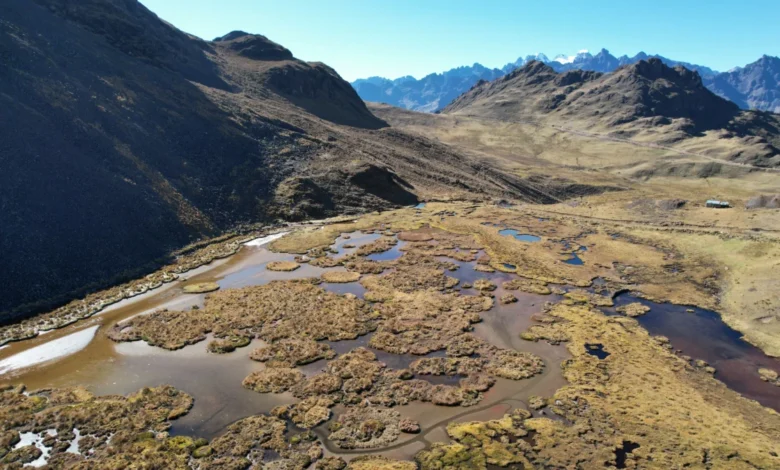
For the residents of Phinaya in southeastern Peru, the Quelccaya ice cap is not merely a geographic feature; it is the fundamental source of their livelihood and spiritual existence. Donato Bermúdez, a lifelong resident and former president of the community, describes the glacier as a living entity—a provider of the "lifeblood" water that sustains his flock of 500 alpacas. Towering at 5,600 meters (18,400 feet), Quelccaya holds the distinction of being the second-largest tropical ice cap in the world. However, as the Peruvian government under President Keiko Fujimori shifts its economic strategy toward the aggressive promotion of "transition minerals," the shadow of the mountain has become a site of intensifying conflict between industrial ambition and environmental preservation.
The tension centers on the vast lithium and uranium deposits located beneath the glacier. Canadian-based American Lithium, through its local subsidiary Macusani Yellowcake, currently controls at least 174 mining concessions covering more than 1,090 square kilometers (421 square miles) in the department of Puno. These concessions include the Falchani lithium project and the Macusani uranium deposit, which the government has designated as critical to its participation in the global green energy transition. As construction on the Falchani open-pit mine nears a 2028 start date, local communities, scientists, and environmental activists are sounding alarms over the potential for irreversible ecological damage.

A Chronology of Contention
The path to the current confrontation has been marked by a decade of legal and administrative volatility. The region’s potential as a mineral hub gained international attention in 2017, when significant lithium deposits were confirmed alongside long-known uranium reserves. The subsequent history of the project has been anything but smooth:
- 2019: The Peruvian government declared 32 of the company’s 149 concessions invalid due to missed payments, triggering a multi-year legal battle.
- 2020: The Agency for Environmental Assessment and Enforcement (OEFA) sanctioned Macusani Yellowcake for conducting unauthorized exploration activities.
- 2021: American Lithium acquired the concessions, inheriting a project mired in regulatory and social disputes.
- August 2025: A pivotal moment occurred when the Supreme Court of Peru ruled in favor of American Lithium, confirming its full ownership of the previously disputed concessions and effectively clearing the path for development.
- June–August 2026: The federal government formalized its commitment to the sector by declaring lithium and uranium "minerals of national importance" and signing a strategic pact with Argentina, Chile, and Bolivia to foster regional mineral cooperation.
The Science of the Risk: Dust, Radioactivity, and Water
The environmental concerns are rooted in the specific nature of open-pit mining in a high-altitude, glacial environment. Environmental engineer Bladimir Martínez, who monitors the site for the organization Red Muqui, warns that the extraction process is inherently incompatible with the stability of the glacier.
"We are convinced that the dust generated by these operations will settle on the glacier," Martínez explained. "This accumulation of dark, metal-rich particulate matter reduces the ice’s albedo—its ability to reflect sunlight—which leads to an increase in localized temperature and, consequently, accelerated deglaciation."

Beyond the physical retreat of the ice, there is the issue of radioactivity. While the company has sought to categorize its projects as distinct "lithium" and "uranium" operations, independent research from the Pontifical Catholic University of Peru in 2024 identified uranium as a trace element within the Falchani lithium rock. Critics argue that the two minerals are geologically intertwined, making it impossible to extract one without disturbing the other. The potential for radioactive dust to contaminate the surrounding ecosystem—including the 56 plant species and 76 bird species that inhabit the area—remains a primary concern for local stakeholders.
Furthermore, the glacier serves as a critical water tower for the Amazon basin and the departments of Cusco and Puno. The National Research Institute for Glaciers and Mountain Ecosystems (INAIGEM) estimates that the ice cap holds 2.43 billion cubic meters of water, a supply deemed sufficient to sustain the city of Cusco for a century. With data indicating that Quelccaya has already lost 58% of its mass over the last four decades due to climate change, activists argue that the introduction of industrial mining is an ecological gamble that the region cannot afford.
Economic Hopes and Social Fragmentation
While opposition is vocal, it is not monolithic. In the province of Carabaya, where poverty rates are among the highest in the country, the prospect of mining is viewed by many as a rare opportunity for development. Supporters point to projections that the Falchani project could generate up to 5,000 jobs and produce 25,000 tonnes of lithium carbonate annually, potentially injecting over $6 billion into the local economy over its lifespan.

"The community is divided," says Roger Merino, an expert in environmental governance. "In areas where the state has historically failed to provide basic services, the mine is seen as the only pathway to a better standard of living. For some, the promise of jobs outweighs the abstract, long-term risks to the glacier."
This social fragmentation is a strategic advantage for mining firms and the government. By engaging with communities that are desperate for economic relief, proponents of the project have successfully framed the mining industry as the engine of Peru’s future prosperity. However, critics like Yolanda Quispe, a park ranger and community leader, urge a more cautious approach. "You cannot simply sell your future so easily," she argues, emphasizing that once the water source is gone, the temporary economic gains of mining will be insufficient to sustain the region.
Regulatory Ambiguity and Future Outlook
A significant point of concern among legal and environmental experts is the lack of a comprehensive regulatory framework for uranium mining in Peru. Despite the government’s push for "strategic mineral development," specific technical regulations regarding the handling of radioactive materials remain vague. Professor Roger Merino notes that the current administrative approach appears to prioritize speed over safety, potentially bypassing the rigorous environmental impact assessments that such sensitive projects require.

"The approach is clearly one of lowering social and environmental standards to accelerate investment," Merino stated. "We are seeing projects being fast-tracked without the necessary legal maturity to ensure that uranium, in particular, is handled with the appropriate safety protocols."
American Lithium maintains that it adheres to the "highest standards" of environmental stewardship and asserts that its baseline studies have found no endangered habitats within the project zones. However, the company’s refusal to engage directly with certain media inquiries regarding the overlap of uranium and lithium in their extraction zones has done little to assuage the fears of the scientific community.
A "Terminal" Diagnosis
For those who have studied the glacier for decades, the situation is dire. Lonnie Thompson, a world-renowned paleoclimatologist who has been conducting research on Quelccaya since 1974, likens the current state of the glacier to that of a terminal patient.

"If these mining concessions are allowed to develop fully, the entire ice cap is at risk," Thompson warned. He suggests that the only viable path to protecting what remains of the glacier is to designate the area as a protected national park, thereby creating a legal barrier against industrial encroachment.
However, Thompson remains a realist. Even with the highest level of legal protection, the glacier is already retreating due to global climatic shifts. "I document the change taking place, but I cannot stop it," he said. "Our goal now must be to preserve it for as long as possible to buy time for the communities that rely on it to adapt."
As Peru positions itself as a global player in the energy transition, the fate of the Quelccaya glacier serves as a microcosm of a larger, global dilemma: the conflict between the need for raw materials to fight climate change and the local necessity of protecting the ecosystems that sustain human life. For the residents of Phinaya, the decision is not about abstract policy, but about the survival of the water that has defined their culture for centuries. Whether the government can balance these competing interests—or if it will choose to sacrifice the mountain for the sake of the market—remains the central question for the future of the Peruvian Andes.