EPA to Decommission Online Public Web Archive by End of Year, Threatening Decades of Environmental Records

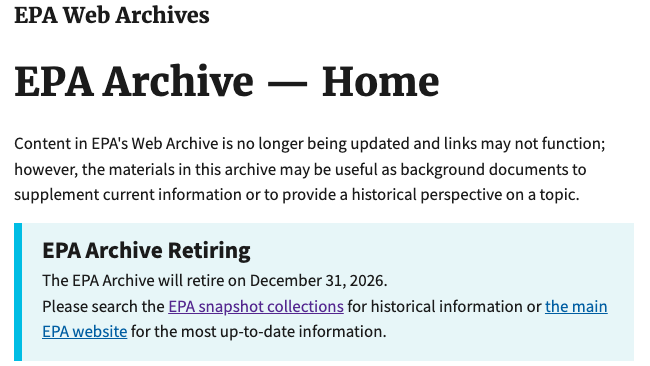
Environmental Protection Agency Administrator Lee Zeldin’s leadership has entered a new phase of administrative contraction as the agency quietly moves to dismantle its historical digital repository. Through a discreetly updated banner notice on its website, the EPA has announced plans to officially decommission its online web archive by December 31. This impending shutdown places tens of thousands of publicly accessible environmental reports, datasets, policy changes, and historical guidelines on the chopping block, threatening to sever public access to crucial documentation of federal environmental oversight spanning more than twenty years.
The scheduled closure stands in sharp contrast to the high-profile regulatory rollbacks pursued by Zeldin since taking the helm of the agency. While Zeldin has utilized public platforms and formal announcements to dismantle power plant pollution standards and overhaul federal methane regulatory frameworks under the second Trump administration, the elimination of the archive targets the very historical record that tracks how these policies evolved. Watchdog organizations, researchers, librarians, and legal experts warn that the disappearance of these records will create an irreversible gap in government transparency, crippling independent academic research, legislative oversight, and public access to vital environmental safety data.
The Irreplaceable Value of Decades of Digital Governance
The EPA’s online archive serves as an unmatched repository for historical environmental policies, dating back to the late 1990s and early 2000s. It houses a diverse collection of technical reports, regulatory notices, public fact sheets, and enforcement actions that are not systematically mirrored elsewhere on the web. For environmental scientists, policy analysts, and journalists, the database has long functioned as an indispensable digital library for tracing the trajectory of American environmental law.
Gretchen Gehrke, co-founder of the Environmental Data and Governance Initiative (EDGI), emphasized the profound loss the closure represents. Gehrke, who has spent a decade tracking federal environmental data alterations, noted that the information stored within the repository is irreplaceable. According to EDGI and various scientific coalitions, the archive has served as a foundational instrument of democratic oversight, allowing the public and lawmakers to hold regulatory bodies accountable by examining past administrative decisions, scientific assessments, and enforcement precedents.
Major political and environmental milestones are inextricably linked to the documents preserved within the database. The platform has provided researchers with direct access to primary source materials detailing sweeping regulatory shifts, such as President George W. Bush’s 2003 Clear Skies Initiative and President Barack Obama’s 2015 Clean Power Plan. Furthermore, during the first Trump administration—when sweeping modifications and deletions of federal climate change web pages occurred—the independent archive acted as a crucial safety net, preserving defunct federal pages and preventing environmental data from vanishing entirely from the public eye.
The Chronology of an Archival Tug-of-War
The impending December closure is not the first time the EPA has attempted to shutter its web archive. The effort to dismantle the repository has a multi-year history defined by administrative pushback, public resistance, and shifting justifications.
In late January 2022, during the Biden administration, the EPA initially announced its intention to discontinue the online repository. At the time, the agency cited the burdensome financial upkeep required to maintain the digital infrastructure. Subsequent Freedom of Information Act (FOIA) requests filed by Gehrke revealed that the agency spent approximately $2 million annually to sustain the archive.
The initial 2022 announcement provoked immediate and widespread condemnation from an influential coalition of environmentalists, historians, librarians, and Good Government organizations, including EDGI and the American Society for Environmental History. Critics characterized the move as an alarming threat to the historical record that would create a tremendous gap in public accountability. Facing five months of intense public backlash and scrutiny, the EPA partially relented in July 2022, postponing the archive’s retirement by one year.
Despite the reprieve, uncertainty persisted. In March 2023, the agency modified its warning banner, softening the language to state that the archive was merely retiring without specifying a final operational deadline. For the subsequent three and a half years, the digital repository operated in a static state—frozen in time, receiving no new updates, but remaining accessible to anyone seeking historical federal documents. That quiet period ended recently when the agency updated its notification banners to establish a definitive termination date of December 31.
Enforcement, Public Health, and Accountability
Beyond academic research and high-level policy tracking, the EPA’s archive has historically played a critical role in local environmental enforcement and community advocacy. A prominent example involves Marine Corps Base Camp Lejeune and the Marine Corps Air Station in North Carolina. In 1989, following exhaustive investigations that uncovered widespread contamination of soil, sediment, surface water, and groundwater due to historic military operations, the EPA placed the base on its Superfund National Priorities List.
The decades-long paper trail of EPA investigations, risk assessments, and cleanup directives was meticulously preserved within the agency’s web archive. These documents have empowered nearby residents, veterans, and military families to verify federal findings, understand the scope of chemical exposures, and evaluate the agency’s historical mitigation efforts. This local oversight intersects with contemporary political friction; recent statements from political figures regarding the potential withholding of compensation for service members exposed to toxic water at Camp Lejeune underscore the volatile intersection of federal accountability, public health, and governmental transparency.
The closure of the archive arrives at a precarious moment, coinciding with historic lows in public trust in government institutions. Critics argue that willfully restricting access to foundational environmental records will only accelerate this erosion of confidence.
Lauren Harper, the inaugural Daniel Ellsberg chair on government secrecy for the Freedom of the Press Foundation, warned of the administrative bottlenecks the shutdown will create. Harper noted that eliminating easy digital access to public records forces researchers, journalists, and lawmakers to flood already overburdened FOIA offices with requests just to view documents that were previously available with a simple click.
Official Responses and the Threat to Snapshot Collections
In its updated notices, the EPA has maintained that historical information will not be entirely lost, directing users toward the agency’s internal snapshot collections as an alternative reference point. However, independent watchdogs and data preservation experts remain deeply skeptical. Given the broader regulatory landscape of the second Trump administration—characterized by aggressive reductions in federal data availability and severe budgetary and personnel cuts across environmental programs—experts question whether these snapshot collections will preserve the nuance, breadth, and completeness of the original repository.
Gehrke and other data protection advocates argue that placing reliance on a handful of static snapshots is entirely insufficient for maintaining government transparency. EDGI maintains that the EPA should be expanding and systematically modernizing its digital archives rather than dismantling them under the guise of administrative efficiency or cost-saving measures.
As the December 31 deadline approaches, requests for comment sent to the Environmental Protection Agency regarding the definitive decommissioning plan and the fate of the underlying data have gone unanswered. With time running out, independent digital archivists and academic coalitions are racing against the clock to back up and preserve as much of the endangered EPA web archive as possible before the digital doors close permanently.
Related posts: