The Hidden Cost of Innovation: Why Tesla Cybertruck Owners Face Eye-Watering Tire Replacement Bills

The Tesla Cybertruck has established itself as one of the most polarizing and scrutinized vehicles of the modern automotive era. With its distinctive, angular stainless steel exoskeleton, absence of conventional curves, and unmissable presence on public roads, the all-electric pickup truck consistently commands attention wherever it goes. However, beyond the initial purchase price, the futuristic exterior design and the advanced engineering beneath the surface have introduced a secondary financial reality that many early adopters are only beginning to appreciate: the exceptionally high cost of tire maintenance.
Replacing the rubber on a Tesla Cybertruck requires a significantly larger financial commitment than servicing an average internal combustion engine (ICE) full-size truck. Depending on the chosen trim level, wheel size, and manufacturer specifications, a single set of replacement tires can easily eclipse the $2,000 threshold. Compounding this issue is the reality that Cybertruck tires frequently wear out at an accelerated rate—with some owners reporting significant tread degradation in under 7,000 miles. This premature wear is primarily driven by the vehicle’s immense curb weight, distributed battery mass, and instantaneous torque delivery, characteristics that fundamentally alter how heavy electric vehicles interact with the road surface.
The Genesis of the Cybertruck Tire Dilemma
To understand the scope of the Cybertruck’s tire consumption, it is necessary to examine the vehicle’s development and market rollout timeline. Unveiled as a concept in November 2019, the Cybertruck promised revolutionary utility, performance, and durability. However, manufacturing complexities, supply chain disruptions, and engineering refinements delayed the start of production. Initial customer deliveries finally commenced in late November 2023 during a special delivery event at Tesla’s Gigafactory in Austin, Texas.
As early reservation holders took delivery of their Foundation Series vehicles throughout 2024, real-world driving data began to emerge. Automotive forums and social media platforms quickly filled with discussions regarding the vehicle’s maintenance profile. While owners praised the pickup’s acceleration, towing capability, and steer-by-wire system, early reports of rapid tire wear began raising eyebrows across the automotive community.
Unlike traditional light-duty trucks, which typically feature lighter gross vehicle weight ratings (GVWR) and more gradual power application, the Cybertruck weighs approximately 6,600 to 6,900 pounds depending on the configuration. When combined with dual- or tri-motor setups capable of delivering massive torque instantaneously to all four contact patches, the resulting friction during acceleration, cornering, and regenerative braking places unprecedented stress on the rubber. Consequently, the rubber compound designed to support the vehicle’s weight while maintaining efficiency must contend with severe lateral and longitudinal forces.
Factory Specifications and Specialized Options
Tesla engineered the Cybertruck with specific wheel and tire configurations to balance range, load capacity, and aesthetic appeal. According to official Tesla documentation, the entry-level rear-wheel-drive and dual-motor variants equipped with standard 18-inch wheels utilize all-season Goodyear Wrangler Territory HT tires, specifically sized at 285/70R18.
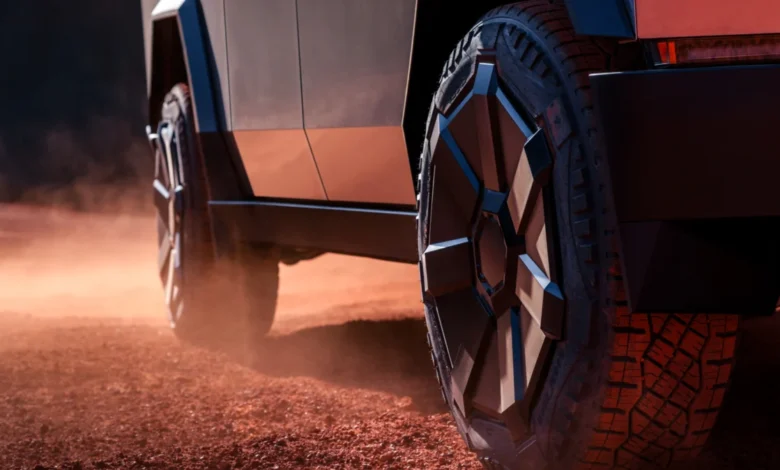
For buyers opting for the 20-inch wheel upgrade, the factory choices expand. Owners can select either all-season Pirelli Scorpion ATR tires in a 285/65R20 dimension or heavy-duty Goodyear Wrangler Territory R/T tires sized at LT285/65R20. The latter option features a distinct, bespoke sidewall design meticulously tailored to accommodate the Cybertruck’s specialized aerodynamic wheel covers. Early in the vehicle’s production cycle, Tesla briefly paused deliveries to address an issue where poorly fitting aero covers could come into contact with the tire sidewall, causing localized friction and premature wear—a design flaw that necessitated a swift engineering remedy. Additionally, for owners operating in colder climates or regions prone to severe winter weather, Tesla and its partners support 20-inch Goodyear Wrangler DuraTrac R/T winter-capable configurations.
A Breakdown of Replacement Costs
When the time arrives for a tire change, the financial impact becomes immediately apparent. Sourcing replacement rubber through factory channels or independent distributors reveals a wide spectrum of pricing structures.
For owners of the base 18-inch configuration seeking budget-friendly independent retailer alternatives, a complete set of replacement tires can be acquired starting at approximately $1,474. However, moving up to the factory-recommended heavy-duty 20-inch tires with specialized sidewall architecture elevates the price significantly. Purchasing these specific Goodyear or Pirelli compounds directly from Tesla or authorized distributors can easily push the bill past the $2,120 mark for the tires alone.
For those requiring comprehensive seasonal transitions, the official OEM 20-inch Core Wheel and Pirelli Winter Tire Package is listed at $3,650. Notably, this package excludes the specialized wheel covers, which require an additional $320 investment if the owner wishes to maintain the vehicle’s signature aerodynamic aesthetic.
The aftermarket ecosystem has similarly mobilized to support the growing Cybertruck population, offering alternatives that range from economical utility options to ultra-high-end bespoke modifications. Independent digital retailers such as Tire Rack list Cybertruck-compatible options starting near $996 for an Advanta ATX 20-inch set, while premium factory-matched Goodyear Wrangler Territory R/T sets hover around $2,149.
Meanwhile, specialized Tesla tuners have introduced performance-oriented wheel and tire packages. Unplugged Performance, a prominent aftermarket developer, offers tire sets starting at $1,728 for 18-inch BFGoodrich All-Terrain T/A KO3 tires, scaling up to $3,164 for massive 24-inch Nitto Recon Grappler tires sized at 295/45R24. For customers seeking an entire turnkey transformation, Unplugged Performance sells complete forged wheel-and-tire assemblies ranging from $3,957 to a staggering $11,195 per set of four, catering to luxury-oriented buyers looking to customize their vehicles beyond factory specifications.
Comparative Cost Analysis: Cybertruck Versus Traditional and Electric Competitors
To contextualize the financial burden of Cybertruck tire maintenance, it is helpful to compare these figures against the broader full-size truck market. The contrast between electric vehicles and traditional internal combustion engine (ICE) trucks is stark.
Traditional, gas-powered full-size pickup trucks generally operate on smaller, less complex tire constructions that benefit from decades of mass manufacturing efficiencies. For instance, a standard set of 17-inch Yokohama Geolandar M/T G003 tires suitable for traditional work trucks can be purchased for roughly $480. Similarly, an 18-inch set of Bridgestone Dueler H/P Sport tires typically costs around $574. Comparable 18-inch replacement options for the Chevrolet Silverado start around $621, the Ram 1500 near $688, and the Toyota Tundra around $492.
Even when examining heavy-duty or aggressive off-road tire options for ICE trucks—such as the Toyo Tires Open Country M/T (LT275/70R18), priced at $1,715 per set—the costs remain noticeably lower than the upper tier of electric truck requirements, while simultaneously offering significantly longer tread life due to the lower vehicle mass.
However, the Cybertruck is not alone in facing these inflated operational costs. Other luxury all-electric pickup trucks encounter comparable market dynamics. The Rivian R1T, a primary competitor in the lifestyle EV truck segment, faces similar economic realities. Equipping an R1T with 22-inch Nokian Hakkapeliitta R5 SUV winter tires requires an investment of approximately $2,216 per set. Furthermore, opting for comprehensive wheel-and-tire assemblies directly through Rivian’s official online configurator can drive costs up to $5,981.
Broader Implications for Electric Vehicle Ownership
The high cost and rapid consumption rate of Cybertruck tires highlight a broader, often overlooked implication of the ongoing transition toward heavy electric vehicles. As automotive manufacturers push to deliver long-range capability, high towing capacities, and robust performance figures, the physical weight of these vehicles has increased substantially. Batteries inherently add thousands of pounds to a vehicle’s architecture, and managing that mass requires wider, heavier, and more structurally reinforced tires.
For prospective buyers and current owners alike, these maintenance realities necessitate a shift in total cost of ownership (TCO) calculations. While electric vehicles offer well-documented savings on routine services such as oil changes, spark plug replacements, and exhaust repairs, consumables like tires and brake components represent significant countervailing expenses. In the case of the Cybertruck, the frequency of replacement combined with specialized sizing creates an ongoing financial obligation that extends far beyond the initial window sticker price.
Ultimately, as EV adoption matures, tire manufacturers are actively investing in heavier-duty rubber compounds specifically engineered to resist the unique wear patterns induced by high-torque electric powertrains. Until those technological advancements become universally accessible and affordable, maintaining a Tesla Cybertruck will remain an expensive proposition, underscoring the reality that driving the future of automotive design comes with a uniquely heavy price tag.