Amidst the relentless conflict and the devastating humanitarian crisis unfolding across the Gaza Strip, stories of remarkable resilience occasionally pierce through the gloom. For three siblings—Anas, Sujood, and Mohammad—living with severe physical disabilities in an active warzone has presented unimaginable daily hurdles. Born without legs and with severely limited hand dexterity, navigating the rubble, displacement camps, and makeshift living quarters required grueling physical exertion, with the siblings historically relying on crawling or being carried by their mother.
However, a recent humanitarian initiative spearheaded by the international non-governmental organization EducAid, with vital funding from the United Nations Office for the Coordination of Humanitarian Affairs (OCHA), has fundamentally transformed their daily existence. By designing and manufacturing customized assistive devices tailored to each child’s precise anatomical needs, the initiative has delivered a newfound sense of autonomy, dignity, and hope to the family. This comprehensive support intervention highlights not only the critical importance of specialized humanitarian aid in conflict zones but also the profound, life-altering impact that targeted accessibility tools can have on vulnerable populations.
Background Context and the Humanitarian Landscape in Gaza
The ongoing hostilities in the Gaza Strip have severely fractured the local infrastructure, creating catastrophic conditions for millions of civilians. Within this volatile environment, marginalized groups—particularly individuals with disabilities—face exponentially compounded challenges. Essential services, including specialized medical care, rehabilitation facilities, and accessible educational infrastructure, have been largely crippled or destroyed by continuous military operations and blockades.
Displacement has become a way of life for the vast majority of Gazans, forcing families into overcrowded tents and makeshift shelters that are inherently hostile to individuals with mobility impairments. Uneven terrain, lack of sanitation facilities, and the absence of paved pathways turn routine movements into perilous obstacles. For children born with congenital limb differences, these systemic failures threaten to rob them not only of their physical safety but also of their fundamental right to education, socialization, and personal development.
Recognizing these acute vulnerabilities, international bodies and local aid groups have increasingly prioritized disability-inclusive humanitarian responses. Organizations like EducAid operate under extraordinarily difficult circumstances, utilizing local workshops and laboratories to fabricate bespoke mobility solutions when commercial imports are restricted or unavailable. Funding from OCHA acts as a critical lifeline, enabling these organizations to source necessary raw materials, deploy technical experts, and reach remote or displaced populations who would otherwise remain entirely isolated.
Tailored Innovations for Individual Needs
The intervention undertaken by EducAid was far from a one-size-fits-all approach. Recognizing that each sibling faced unique ergonomic challenges within both domestic and educational settings, the technical team conducted comprehensive assessments to engineer customized devices.
For 15-year-old Mohammad, whose daily routine involves navigating cramped living spaces and makeshift classrooms, the physical toll of his disability was immense. Previously forced to crawl across rough surfaces, Mohammad suffered from constant hand injuries, skin abrasions, and the indignity of soiled clothing. EducAid’s workshop designed a specialized wheelchair integrated with a small skateboard mechanism, optimizing his propulsion and maneuverability. Additionally, they provided specialized hand grips to protect his fingers from wounds and slippage, a functional dining table attachment, and a dedicated commode chair that drastically improved his household hygiene and independence.
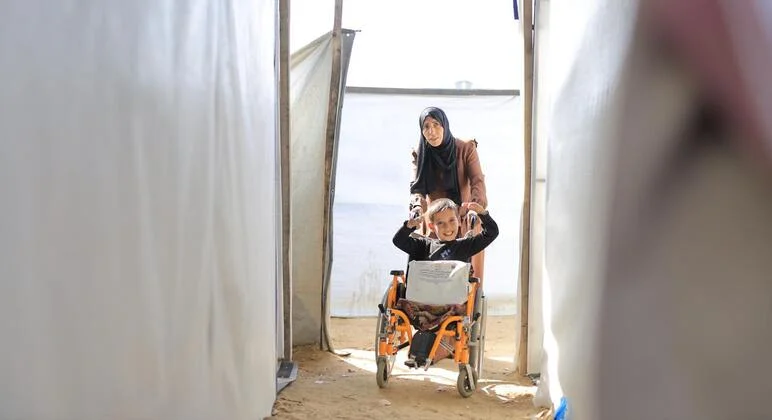
His older sister, 17-year-old Sujood, faced parallel struggles. Born without legs and with only two fingers on each hand, Sujood’s mobility was severely restricted. Prior to receiving assistance, academic tasks such as writing were physically exhausting, requiring her to lie prone on the ground. EducAid provided a tailored size-40 wheelchair equipped with a detachable dining surface and an adjustable slant table designed to facilitate reading and writing. Furthermore, she received an adaptive lower-body waterproof protector shield and hand-support walking aids, allowing her to traverse the muddy and dusty environments outside her family’s tent without damaging her clothing or injuring her hands.
Anas, the youngest of the three siblings, experienced similar transformations. Heavily reliant on his mother for basic transport and physical support, Anas struggled with core balance and hand grip, making academic engagement exceptionally difficult. EducAid upgraded his mobility apparatus by integrating a detachable wheelchair table, a lower-body waterproof shield, a customized pen grip, an adjustable slant table, and specialized hand-walking aids. These modifications collectively dismantled the physical barriers that had previously hindered his educational progress and social integration.
Personal Testimonies and Psychological Impact
The delivery of these assistive devices generated profound emotional responses, underscoring that the intervention addressed far more than mere physical logistics—it restored a sense of human dignity and psychological well-being.
Sujood captured the emotional weight of the transformation when reflecting on her new wheelchair. "For the first time I have my own chair. I slept in it so that none of my siblings would take it from me," she shared, highlighting the deep psychological comfort of ownership and personal space in an environment otherwise defined by loss and displacement. "I feel that someone cares about me."
Looking toward the future, Sujood expressed renewed optimism regarding her educational aspirations. "This chair will help me achieve my dreams and study the field I love—which is media. Now I can move outside the tent without messing up my clothes," she noted.
Her brother Anas echoed these sentiments of joy and connection, expressing simple gratitude to the support team: "I am very happy and I love you so much." Their mother also emphasized the tangible shift in their daily routines, noting that the tools have successfully bridged the gap toward self-reliance, particularly regarding fundamental activities like nutrition and literacy.
Mohammad similarly celebrated the practical benefits of his new equipment. "I am very happy with the table—my clothes no longer get dirty," he remarked, reflecting the restoration of personal pride. His mother praised the holistic nature of the support, pointing out that the protective hand grips and specialized seating arrangements effectively mitigated the chronic physical pain and vulnerability associated with crawling.
Educators working with the siblings have also observed a striking upturn in their academic engagement. According to their teacher, the children possess a natural eagerness to learn and are academically distinguished. With the structural hurdles of writing and seating alleviated, the teacher noted that the siblings have "started writing more effectively," proving that given the right accommodations, their intellectual potential can flourish despite the surrounding adversity.
Broader Implications and Future Humanitarian Outlook
The success of the EducAid intervention, backed by OCHA, offers valuable insights into the broader mechanics of crisis response. While emergency interventions understandably prioritize immediate life-saving provisions such as food, clean water, and emergency medical care, protracted conflicts demand a simultaneous investment in long-term rehabilitation and inclusion. When humanitarian frameworks overlook individuals with disabilities, a significant segment of the population is effectively abandoned to secondary victimization by their environment.
Data from global humanitarian agencies consistently demonstrates that persons with disabilities are disproportionately affected during emergencies, facing heightened risks of violence, abandonment, and exclusion from vital relief distributions. Initiatives like the one in Gaza establish a critical precedent, proving that inclusive programming is both feasible and transformative, even amidst active hostilities. By manufacturing adaptive technologies locally, organizations can bypass severe supply chain bottlenecks while simultaneously supporting local economic resilience and technical expertise.
However, the scale of the need vastly outstrips current available resources. Thousands of other children and adults across the Gaza Strip remain in urgent need of specialized assistive devices, prosthetic care, and psychological support. The sustainability of such programs hinges entirely on predictable, unhindered humanitarian access and sustained international donor contributions. Without robust financial backing, humanitarian groups face severe limitations in scaling up their operations to meet the exponential rise in disabilities caused by ongoing conflict injuries.
As the international community grapples with the multifaceted dimensions of the Gaza crisis, the poignant experiences of Anas, Sujood, and Mohammad serve as a powerful reminder of what is at stake. Their renewed mobility and educational engagement demonstrate that resilience, when met with targeted compassion and structural support, can transcend even the most dire circumstances. Ensuring that other children with disabilities receive comparable opportunities remains a critical imperative for humanitarian agencies operating in the region—an endeavor that requires ongoing global solidarity and financial commitment to restore dignity and agency to the most vulnerable.