BYD Unveils the Worlds First Integrated Solar Energy Storage Flash Charging and Robotic Charging System in Abu Dhabi

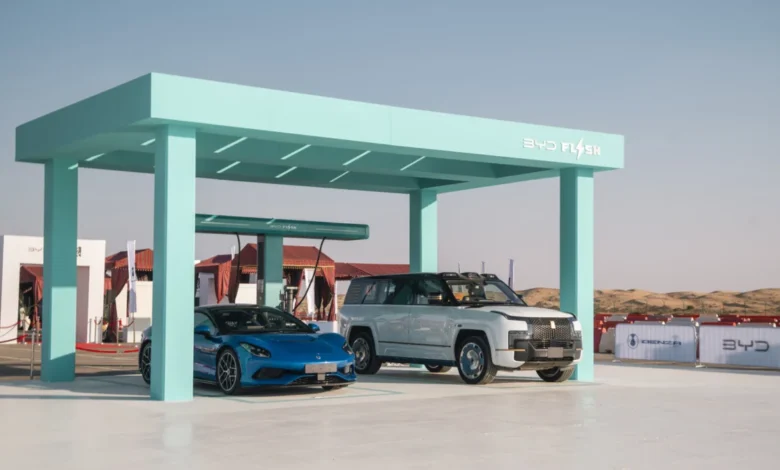
Chinese automotive giant BYD has officially unveiled a groundbreaking electric vehicle charging infrastructure that merges clean solar energy, high-capacity local battery storage, proprietary ultra-fast flash charging, and automated robotic plug-in technology. Debuting in the harsh environment of the Abu Dhabi desert in the United Arab Emirates, this comprehensive ecosystem represents a significant milestone in the global transition toward sustainable mobility. Despite not currently retailing passenger vehicles in the United States, BYD has steadily expanded its global footprint, overtaking traditional rivals to become the world’s leading manufacturer of electric vehicles by sales volume. The company’s latest technological leap aims to challenge existing paradigms of range anxiety, grid dependency, and charging speeds, positioning the firm at the forefront of the global infrastructure race.
The architecture of this newly introduced system addresses several historical bottlenecks associated with electric vehicle refueling. Traditional charging infrastructure often places immense strain on local electrical grids, particularly when multiple high-capacity vehicles demand power simultaneously. BYD’s innovative approach mitigates this issue by incorporating a localized energy storage buffer.
Core Mechanics of the Flash Charging System
At the heart of the newly deployed system is BYD’s proprietary Flash Charging technology. While conventional charging stations draw electricity directly and exclusively from municipal or regional power grids, BYD’s infrastructure routes power through two on-site, high-capacity 185-kilowatt battery storage units. This localized energy reservoir allows the station to accumulate power steadily during periods of low demand and discharge it rapidly when an electric vehicle connects to the terminal.
The performance metrics associated with this technology significantly outpace current industry standards. Each individual Flash Charger is equipped with dual connectors. When a single vehicle utilizes the station, the system is capable of delivering an unprecedented charging output of up to 1,500 kilowatts. If two vehicles are actively charging simultaneously, the power splits to deliver up to 1,000 kilowatts to each car.
To contextualize these figures, prevailing high-speed infrastructure offers substantially
lower maximum outputs. Tesla’s newly rolled-out V4 Superchargers generally top out at 500 kilowatts, while standard Tesla Superchargers operate at 250 kilowatts. Similarly, the fastest direct current fast-charging stations deployed by networks such as Electrify America typically peak at 350 kilowatts.
By leveraging its advanced high-voltage battery architecture and local energy storage, BYD reports remarkable replenishment times. According to the company’s official specifications, the system can charge a compatible vehicle from 10% to 70% capacity in approximately five minutes. Expanding that window from 10% to 97% takes roughly nine minutes. Furthermore, the company has addressed cold-weather degradation—a notorious challenge for lithium-ion batteries—stating that under extreme ambient temperatures as low as minus 30 degrees Fahrenheit, a vehicle can replenish its battery from 20% to 97% in just 12 minutes.
Integrating Solar Power and Autonomous Robotics
The Abu Dhabi installation goes beyond mere energy storage by introducing an integrated solar generation component. Photovoltaic panels, typically installed atop protective canopies shading the charging bays, harvest solar radiation and route the generated clean energy directly into the on-site 185-kilowatt storage batteries.
This localized generation model drastically reduces the station’s reliance on external utility grids. Such independence is critically valuable in remote, sun-drenched environments like the Arabian Desert, where extending heavy-duty transmission lines can be economically prohibitive and logistically complex. By harnessing abundant solar power and pairing it with robust stationary storage, the installation operates with a high degree of energy autonomy.
Complementing the power delivery system is the integration of automated robotic charging arms. While the concept of automated plug-in robotics is not entirely novel—Tesla initially conceptualized robotic charging cables nearly a decade ago, and competitors such as Volkswagen, Hyundai, and China’s Xiaomi have since developed proprietary iterations—BYD’s commercial deployment brings the concept closer to mainstream reality.
The operational premise of the robotic arm is designed to maximize user convenience. Upon parking a compatible electric vehicle within the designated bay, an integrated robotic mechanism utilizes advanced sensors and optical recognition to locate the vehicle’s charging port. The arm automatically opens the protective cover, aligns the connector, and securely inserts it into the vehicle without requiring any physical intervention from the driver. This hands-free operation enhances accessibility, particularly for drivers with physical limitations or in adverse weather conditions where handling heavy cables manually is undesirable.
Chronology and Strategic Expansion
The unveiling of the Abu Dhabi desert charging hub marks the culmination of years of targeted research and development by BYD in energy storage and high-voltage electrical architectures. The timeline of the company’s infrastructure ascent aligns with its rapid manufacturing dominance. Having surpassed Tesla in global pure-electric and plug-in hybrid vehicle sales, BYD has systematically shifted strategic emphasis toward securing the supporting ecosystem.
The initial conceptualization of ultra-fast flash charging began as an engineering initiative to solve thermal management and battery longevity issues associated with rapid energy transfer. Over the preceding three years, BYD integrated these findings into commercial heavy-duty transit solutions before scaling the technology down for consumer-grade passenger vehicles.
The selection of the United Arab Emirates as the launchpad for this multi-technology system was deliberate. The extreme climate of the desert provides an optimal stress-testing environment for both photovoltaic generation efficiency and thermal management systems under intense heat. Following this initial deployment, BYD has outlined an aggressive global rollout schedule. The firm plans to install approximately 6,000 Flash Charging stations worldwide by the end of next year.
Industry analysts note that while not all initial installations will feature the complete suite of solar canopies and robotic arms immediately, the modular nature of the architecture allows for scalable upgrades as local demand and capital deployment permit.
Industry Implications and Global Market Reaction
The introduction of BYD’s integrated solar, storage, flash charging, and robotic system carries profound implications for the global automotive and energy sectors. As electric vehicle adoption accelerates worldwide, the limitations of existing electrical grids have emerged as a primary bottleneck for infrastructural expansion. Utility companies often struggle to manage the localized surge demands imposed by traditional DC fast chargers, leading to expensive grid upgrades and permitting delays.
By decoupling charging stations from immediate grid constraints through local battery buffering and direct solar integration, BYD offers a blueprint for decentralized, resilient energy infrastructure. Competitors in both the automotive and energy sectors are closely monitoring the rollout. Established charging network operators in North America and Europe are under increasing pressure to match the ultra-high charging speeds demonstrated by BYD’s 1,500-kW architecture, though existing vehicle electrical architectures in many Western markets currently lack the capacity to accept such high sustained currents without specialized modifications.
Furthermore, the mainstreaming of robotic charging arms points toward a future where autonomous vehicles could theoretically manage their own refueling schedules without human intervention. Fleet operators, robotaxi services, and commercial delivery companies stand to benefit immensely from automated plug-in systems that eliminate human error and streamline depot management.
Economic and geopolitical analysts observe that BYD’s technological advancements underscore the shifting epicenter of automotive innovation. While regulatory barriers and geopolitical tensions currently restrict the import of Chinese-built passenger vehicles into the United States, the underlying intellectual property, charging standards, and energy storage solutions developed by firms like BYD exert global influence. As standards evolve, international automakers and infrastructure developers may find themselves compelled to adopt or adapt similar technological frameworks to remain competitive in international markets.
Future Outlook and Next Steps
As BYD moves forward with its target of deploying thousands of Flash Charging stations globally over the next 12 to 18 months, the company will face logistical, regulatory, and maintenance challenges inherent in managing large-scale infrastructure across diverse international jurisdictions. The success of the Abu Dhabi pilot will serve as a critical operational benchmark, demonstrating whether high-frequency, ultra-fast robotic charging can maintain commercial viability and reliability in extreme operating environments.
The convergence of solar generation, localized stationary battery storage, ultra-high-power output, and automated robotics signals a maturation phase for electric vehicle infrastructure. No longer viewed merely as an extension of traditional gas stations or standard electrical outlets, the modern EV charging hub is increasingly recognized as an intelligent, interconnected node within a broader smart-grid ecosystem. Whether BYD can successfully translate its manufacturing dominance into infrastructure supremacy will depend on execution, regulatory acceptance, and the broader industry’s ability to keep pace with a five-minute charging standard.