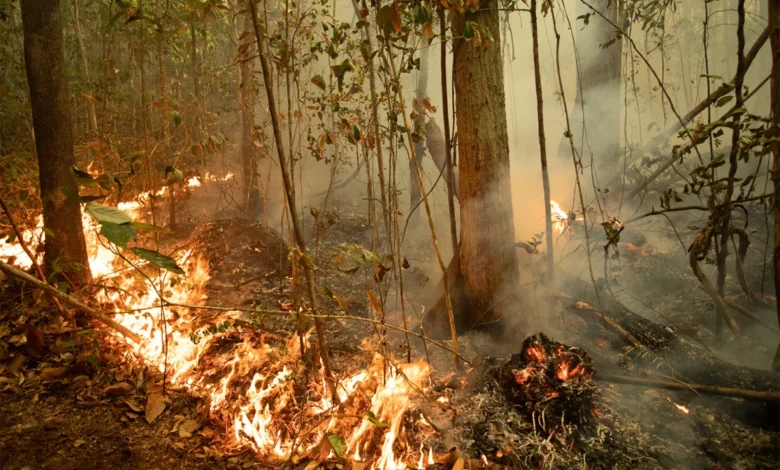
As wildfires exacerbated by El Niño climate patterns tear through the Indonesian archipelago, the immediate race to rescue endangered orangutans and other displaced wildlife has captured global attention. However, beyond the visible flames and the urgent evacuation efforts, a profound and largely silent ecological crisis is unfolding. A recent systematic review published in the scientific journal Oryx has highlighted that while individual primates may survive the initial onslaught of fire and smoke, the long-term viability of these populations remains precarious due to cascading environmental shifts, habitat fragmentation, and diminished reproductive success.
The study, led by Elizabeth Barrow, conservation research director at the Gunung Palung Orangutan Conservation Program (GPOCP), underscores a critical gap in our understanding of climate-driven threats. With approximately 94% of Southeast Asian primate species currently classified as threatened with extinction, the intersection of drought, fire, and human-induced climate variability represents an existential challenge that has yet to be fully integrated into regional conservation policy.
A Pattern of Cumulative Destruction
To understand the severity of the threat, it is necessary to examine the recurring nature of these climate events. El Niño, a phenomenon characterized by the warming of sea surface temperatures in the central and eastern Pacific, consistently triggers severe drought across Indonesia and neighboring Southeast Asian nations. The history of this interaction is well-documented, with major fire events during the 1997-98, 2015-16, and 2026 cycles serving as painful milestones.

During the 1997-98 El Niño, massive fires swept through the region, providing researchers with an initial, albeit harrowing, look at how primates respond to landscape-level destruction. Susan Lappan, a professor at Appalachian State University who tracked siamang gibbons following those fires, observed that the impacts were not merely temporary. While some species displayed the capacity to return to recovering forests after nearly two decades, the quality of their habitat had been fundamentally altered. The forest composition had changed, and the ranging behaviors of the primates were permanently adjusted to account for the loss of primary food sources and safe canopy corridors.
This longitudinal perspective is essential. The 2026 fires, currently active in regions such as West Kalimantan, are not isolated anomalies but part of a multi-decadal pattern. Conservationists are now asking whether the forests—and the primates that inhabit them—possess the resilience to withstand these increasingly frequent fire cycles.
The Hidden Data Deficit
Despite the scale of the threat, the Oryx review identified a startling lack of comprehensive data. Of the 105 primate species inhabiting the region, researchers found only 15 peer-reviewed papers that specifically addressed the impacts of El Niño-linked drought, fire, and smoke. This research was further restricted to just seven species, with a heavy geographic bias toward Indonesia.
This knowledge gap is dangerous. When researchers cannot account for the survival rates, reproductive output, or dietary shifts of the vast majority of Southeast Asian primates, the ability to implement effective mitigation strategies is severely hampered. For species like the Miller’s grizzled langur (Presbytis canicrus), which was notably absent from surveys in East Kalimantan a decade after the 1997 fires, the silence in the data may reflect a localized extinction. In other instances, such as the Mega Rice Project area in Central Kalimantan, fires have forced orangutans into shrinking, fragmented forest patches. This unnatural crowding increases competition for resources, heightens the risk of disease transmission, and places immense pressure on the social structure of the groups.

Reproductive Failure and Physiological Stress
One of the most concerning findings from the review is the impact on infant survival and reproductive health. Observations of siamangs living adjacent to burned areas have shown significantly higher infant mortality rates. This suggests that the indirect effects of fire—such as the depletion of high-quality fruit trees and the chronic inhalation of toxic haze—exert a physiological toll that persists long after the smoke has cleared.
"Primates might survive a fire, but that doesn’t necessarily tell us whether they’re going to have enough food or suitable habitat, or what’s happening with their health and ability to reproduce in the months and years ahead," Barrow noted.
The physiological stress induced by poor air quality is a burgeoning field of study. Exposure to fine particulate matter from peat fires can lead to behavioral changes, including lethargy and reduced foraging efficiency. In a state of chronic malnutrition, the metabolic cost of reproduction becomes too high for many females, leading to a "reproductive gap" that can suppress population growth for years. If a population is already isolated due to habitat loss, this decline in birth rates can push them past the threshold of long-term survival.
Perspectives from the Field
Conservationists on the ground, such as Susan Cheyne, co-director of the Borneo Nature Foundation, argue that the current evidence base serves as an urgent call to action. Cheyne points out that some gibbon populations are now facing their second or third major El Niño cycle within their lifetimes. The question is no longer just about survival through a single season, but about life expectancy and the cumulative "wear and tear" on populations that are never given sufficient time to recover.

The reaction from the broader scientific community has been one of concern. While the immediate focus remains on rescue and rehabilitation, there is a growing consensus that the "subtle effects" of climate change—the slow degradation of habitat quality and the silent decline in fertility—are arguably more damaging to the ecosystem than the fires themselves.
Toward A Strategy of Resilience
Addressing this crisis requires a transition from reactive emergency response to proactive landscape management. Experts suggest that the primary focus must be on increasing the intrinsic resilience of the forests themselves.
- Hydrological Restoration: The rewetting of drained peatlands is widely considered the most effective way to prevent the catastrophic, deep-burning fires that characterize Indonesian droughts. By restoring the natural water table, the forest becomes less susceptible to ignition.
- Halting Fragmentation: Maintaining continuous forest corridors is essential for allowing primates to escape, forage, and migrate in response to localized environmental stress. Fragmentation prevents natural recovery processes.
- Enhanced Long-term Monitoring: There is an urgent need for multi-decade studies that track individual health, reproductive status, and population dynamics post-fire. Without this data, conservation interventions remain speculative.
As the 2026 fire season continues to evolve, the plight of Southeast Asia’s primates remains a barometer for the health of the entire tropical ecosystem. These animals are the "gardeners" of the forest, responsible for seed dispersal and the maintenance of biodiversity. If they continue to disappear, the forests’ ability to recover from climate shocks will further diminish, creating a negative feedback loop that will impact the entire region.
The findings presented by Barrow and her colleagues in Oryx are a sober reminder that environmental change is not always sudden and spectacular. Often, the most significant losses occur in the quiet aftermath of a disaster, within the populations that initially seemed to survive. For the orangutans, gibbons, and langurs of Southeast Asia, the future will depend on whether humanity can move beyond the "rescue mentality" and address the systemic drivers of a landscape in crisis. The challenge is immense, but as the evidence suggests, the window for effective, proactive intervention is closing.