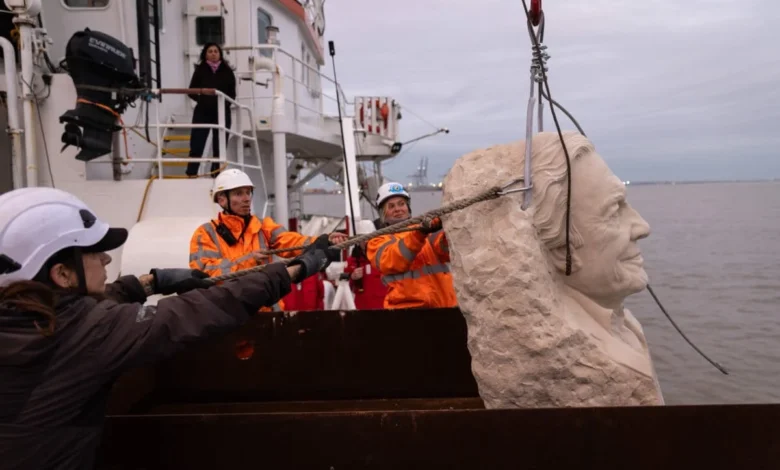
The recent operation, which saw ten two-tonne granite boulders lowered onto the seabed, represents a significant escalation in the ongoing conflict between environmental advocacy groups and the industrial fishing sector in the United Kingdom. This intervention is designed to physically prevent bottom trawlers—commercial vessels that drag heavy, weighted nets across the seafloor—from operating in a zone designated for conservation. The site in question, a vast 37,000-square-kilometer stretch of the Southern North Sea, is technically protected under U.K. law. However, because bottom trawling remains legally permissible within its boundaries, activists argue the designation is effectively meaningless.
The Conflict of the Paper Park
The term "paper park" has become a central rallying cry for marine conservationists. It refers to marine protected areas (MPAs) that exist as administrative entities on government maps but lack the enforcement or regulatory teeth to actually preserve biodiversity. According to Elena Polisano, head of oceans at Greenpeace U.K., these areas currently function as a form of "false advertising."
Bottom trawling is widely criticized by marine biologists for its indiscriminate nature. The heavy gear is designed to catch target species, such as cod or plaice, but in the process, it often pulverizes delicate benthic ecosystems, including coral reefs, sponges, and seagrass beds. By stripping the seafloor of its structural complexity, the practice removes the habitats necessary for juvenile fish to survive and mature, ultimately depleting the very stocks that the fishing industry relies upon. Furthermore, the nets often become lethal traps for non-target marine life, including porpoises, sharks, dolphins, and various seabird species that dive for food.
Chronology of Activism and Policy
The deployment of the "Attenboulder"—a granite block carved with the likeness of legendary naturalist Sir David Attenborough—is part of a long-term strategic campaign. Greenpeace has utilized this tactic repeatedly over the last half-decade to force the government’s hand.
- 2020–2021: Greenpeace deployed boulders in the Dogger Bank and Offshore Brighton MPAs. These actions were met with immediate legal scrutiny by the Marine Management Organisation (MMO).
- 2022: A legal battle ensued, with the government questioning the legality of the boulders. However, following a court’s hesitation to rule against the group on public interest grounds, the MMO dropped the case.
- 2023: A direct policy shift occurred as a result of sustained pressure, with the government introducing a formal byelaw banning "bottom towed fishing gear" across the Dogger Bank Special Area of Conservation.
- 2025: The current action in the Southern North Sea represents the latest chapter, as activists seek to replicate the success seen at Dogger Bank.
The Debate Over Safety and Sovereignty
The reaction from the fishing industry has been swift and condemnatory. The European Bottom Fisheries Alliance (EBFA) has issued statements characterizing the boulder drop as an illegal and dangerous act of vigilantism. From the perspective of the EBFA, environmental policy should be the sole purview of elected governments and established regulatory bodies. They argue that unilaterally placing obstacles on the seafloor without adequate warning or consultation poses a significant safety risk to vessel crews.
The EBFA maintains that even if coordinates are shared after the fact, the presence of these massive, unmarked obstacles in active fishing grounds creates a hazard for navigation and could lead to vessel damage or injury to personnel. They argue that "environmental protection cannot be achieved by bypassing regulations and unilaterally imposing fishing restrictions," emphasizing that international maritime safety standards must be upheld regardless of the environmental cause.
Government Response and Regulatory Investigations
The U.K. government, represented by the Marine Management Organisation (MMO) and the Department for Environment, Food and Rural Affairs (DEFRA), has signaled that it will not tolerate the circumvention of established laws. An official statement from the MMO confirmed that an investigation into the activities of Greenpeace is currently underway. While the agency declined to provide granular details regarding potential penalties or removal plans, they reiterated that "activities at sea should be carried out lawfully and with due regard for the safety of other sea users."

DEFRA has attempted to strike a balance, acknowledging the public’s desire for conservation while defending the current legislative framework. Their position is that the U.K. maintains "strict legislation" intended to protect the marine environment while simultaneously supporting the economic viability of coastal communities and sustainable fishing practices. However, critics point out that the current legislation is fundamentally flawed, as it allows for industrial-scale extraction in zones ostensibly designed for protection.
The Global Context: 30×30
The tension in the North Sea is a microcosm of a much larger global challenge. The U.K. is a signatory to the "30×30" initiative—a global conservation target that aims to protect 30% of the Earth’s land and sea by 2030. Achieving this goal requires more than simply drawing lines on a map; it requires a fundamental shift in how marine resources are managed.
Data from the Marine Conservation Institute suggests that while many countries have designated significant portions of their exclusive economic zones as MPAs, the level of protection varies wildly. A "fully protected" MPA prohibits all extractive activities. Many of the U.K.’s current MPAs, however, are categorized as "highly protected" or "partially protected," which often allows for the very activities that degrade the seafloor.
Implications for the Future of Marine Policy
The legal precedent set by the Dogger Bank case suggests that direct action, while polarizing, can serve as a catalyst for legislative change. By forcing the government to address the contradiction between "protection" and "trawling," groups like Greenpeace are highlighting the urgency of the climate and biodiversity crises.
However, the strategy also carries risks. If the government determines that the safety of mariners is being compromised, the legal fallout could result in stringent injunctions against environmental organizations, potentially chilling future activism. Furthermore, if the fishing industry continues to feel targeted by extralegal maneuvers, it may push for more aggressive lobbying against future conservation efforts, leading to a stalemate that benefits neither the ocean nor the long-term sustainability of the fishing industry itself.
As the MMO investigation proceeds, the Southern North Sea remains a contested space. The boulders currently resting on the seabed serve as a physical manifestation of a deeper ideological divide: a clash between those who believe the ocean is a finite resource to be managed for industrial output, and those who argue that the ecological collapse of marine environments requires a radical, immediate reevaluation of human activity in the deep sea.
For the U.K. government, the challenge is to move beyond the "paper park" criticism. If the state wishes to maintain its credibility in international environmental forums, it may need to reconcile its 30×30 commitments with the economic realities of its fishing fleet. Whether this is achieved through negotiation or continued confrontation remains to be seen, but the presence of the boulders ensures that the debate over the Southern North Sea will remain at the forefront of the national environmental agenda for the foreseeable future.