The Congo Basin commands a status in the global imagination similar to an unsolved mathematical theorem or a masterfully coded ancient manuscript—a destination defined by its sheer scale, deep mystery, and formidable geographical barriers. Spanning an area roughly equivalent to the size of India, this dense mosaic of equatorial rainforests, winding tributaries, and peat bogs covers much of Central Africa. It supports approximately 150 distinct ethnic groups and houses a concentration of biodiversity that places it among the planet’s most vital ecological zones. Yet, despite its critical importance as a massive carbon sink and a frontline defense against global climate change, the region continues to suffer from a chronic lack of scientific research funding and institutional conservation support. For centuries, the basin has simultaneously inspired and exasperated explorers, scientists, and travelers who have sought to map, understand, or claim dominion over its labyrinthine terrain.
Historical Context and the Evolution of Exploration

The modern concept of the Congo Basin as a canvas for Western ambition took shape during the late 19th century, an era when European powers launched aggressive expeditions into Central Africa under the banner of commerce, science, and imperial glory. Welsh explorer Henry Morton Stanley provided some of the earliest detailed accounts of the region, documenting a grueling three-year trans-continental trek from 1874 to 1877 that left him characterizing the basin as an enduring "region of fable and mystery."
This very allure drew a young Polish sailor named Józef Korzeniowski. Having stared at a map of Africa—then largely a blank space representing unmapped colonial territories—Korzeniowski declared his intention to travel there. Years later, he captained a steamboat on the Congo River under a Belgian trading enterprise, tasked with retrieving an upcountry agent stationed at the absolute edge of commercial operations.
The reality Korzeniowski encountered was a harrowing display of unbridled colonial exploitation and brutal resource extraction. He later described the enterprise as "the vilest scramble for loot that ever disfigured the history of human conscience and geographical exploration." These haunting firsthand experiences profoundly reshaped his life, transforming the sailor into the celebrated author Joseph Conrad. His journey catalyzed the creation of his seminal 1899 novella, Heart of Darkness, in which Korzeniowski became the narrative framework, and the colonial agent morphed into the tragic literary figure of Mr. Kurtz.

Modern Expeditions and the Shift Toward Accessible Ecotourism
More than a century after Conrad’s passage, the Congo Basin continues to test the resolve of contemporary adventurers. Among the latest figures to capture public attention is British endurance athlete Ash Dykes, whose social media documentation of his expedition paddling down the Sangha River—a major tributary of the Congo River—has accumulated millions of views. Dykes’s digital dispatches heavily emphasize the physical perils and logistical anxieties of traversing remote jungle environments, framing the journey as an extreme survival test.
However, travel analysts and regional experts note that the sensationalized presentation of modern expeditions often obscures a significant reality: much of the Congo Basin is increasingly accessible to ordinary travelers through structured, professionally managed itineraries. Experiences once reserved for extreme explorers—such as observing forest elephants at Dzanga Bai in the Central African Republic, tracking western lowland gorillas, or participating in traditional net-hunts with the Indigenous Ba’aka people—are now safely achievable through established eco-tourism operations.

The Rise of Modern River Infrastructure
For decades, public transit and cargo transport along the river arteries relied heavily on traditional daka-dakas—low, flat-topped barges heavily laden with goods, passengers, and machinery, notorious for mechanical unreliability and hazardous conditions. However, the introduction of modern passenger vessel options has fundamentally altered the logistical landscape of Central African travel.
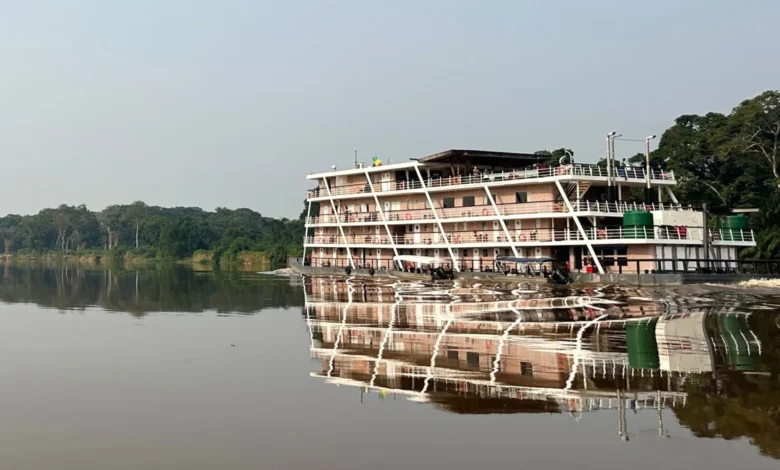
Operating along the waterways of the Republic of Congo, specialized riverboats such as the Princesse Ngalessa, managed by Ducret Expeditions, offer travelers a stark contrast to traditional commercial barges. Equipped with air-conditioned cabins, private sanitation facilities, and dining services, these multi-level vessels serve as the basin’s primary passenger cruise option. Rather than merely passing through isolated communities as an alien spectacle, these modern ships frequently integrate into local commerce, functioning as floating hubs that deliver news, community support, and manufactured goods to riverbank settlements.

Along these routes, travelers encounter vibrant cultural traditions that have persisted for generations. In the riverside village of Ngabe, visitors are occasionally greeted by traditional performances featuring an Ejengi, a forest spirit constructed from palm fronds that dances to rhythmic drumming. Elsewhere, Indigenous communities demonstrate deep pharmacological knowledge, utilizing native flora like the Luma plant to prepare natural pain-relieving remedies. Navigating the flooded secondary forests of the Alima River by kayak allows visitors to observe localized artisanal fishing economies, where independent fishers trade catches directly from traditional wooden pirogues.
Conservation Challenges and Ecological Significance
Beyond its cultural and historical resonance, the Congo Basin remains an ecological cornerstone of global stability. Spanning six countries—the Democratic Republic of Congo, the Republic of Congo, Cameroon, the Central African Republic, Equatorial Guinea, and Gabon—the basin represents the second-largest tropical rainforest on Earth, trailing only the Amazon.

Scientific consensus underscores the region’s irreplaceable role in regulating regional precipitation patterns and sequestering massive quantities of atmospheric carbon. Yet, conservationists warn that the basin is severely underfinanced. Recent environmental assessments indicate that African tropical forests are facing mounting pressures from industrial logging, bushmeat poaching, and inadequate institutional funding, with certain sectors transitioning from carbon sinks to net carbon emitters.
International bodies and local conservation NGOs emphasize that protecting the Congo Basin requires empowering Indigenous communities who have successfully managed these ecosystems for millennia. Unlike other global wilderness areas that have been heavily commodified or overrun by mass tourism, the Congo Basin retains a profound degree of self-reliance. Its Indigenous populations—particularly forest-dwelling groups like the Ba’aka—maintain sustainable lifestyles deeply intertwined with the preservation of forest and river ecosystems.
Implications for the Future of Central African Travel

The transition of the Congo Basin from a feared imperial frontier into a carefully managed eco-tourism destination signals a broader shift in how remote geographies are engaged by the global community. While the physical environment remains raw, dynamic, and challenging, the narrative surrounding the region is steadily moving away from colonial tropes of darkness and peril toward an appreciation of its rich ecological and cultural vitality.
As modern infrastructure gradually improves access to remote outposts like Ouesso and the Sangha Lodge, the imperative for sustainable tourism management becomes increasingly urgent. Experts maintain that balancing economic development, conservation funding, and respect for Indigenous sovereignty will determine whether the Congo Basin can withstand contemporary pressures while preserving its status as one of Earth’s last great wilderness areas.