The Kutupalong-Balukhali Expansion Site in Cox’s Bazar, Bangladesh, stands today as the world’s largest refugee settlement, a sprawling expanse of bamboo and tarpaulin housing over 1.1 million Rohingya people. Eight years after the mass exodus from Rakhine State, Myanmar, in 2017, the camp remains a site of profound confinement. For many of the refugees, the landscape—once a lush, tropical evergreen forest—is now a testament to both environmental degradation and remarkable human resilience. Faced with dwindling international food aid and the encroaching threat of seasonal landslides, Rohingya families are increasingly turning to traditional agroecology and permaculture to stabilize the hillsides and achieve a measure of nutritional self-sufficiency.

A Landscape Transformed: From Forest to Settlement
Before the 2017 crisis, the region surrounding Kutupalong was a critical habitat for the endangered Asian elephant (Elephas maximus) and characterized by dense Dipterocarpus forest cover. The rapid arrival of hundreds of thousands of refugees necessitated an immediate, large-scale clearing of approximately 1,500 hectares of forest land. This deforestation was driven by the urgent need for shelter construction and firewood for cooking.
The ecological consequences were immediate and severe. Without the dense root systems of the native evergreen trees to bind the sandy, porous soil, the monsoonal rains triggered widespread erosion. Annual landslides have since become a seasonal terror for residents, destroying shelters and threatening lives. The transformation of the terrain into a "bare, sandy landscape" created a precarious living environment where the lack of natural drainage and ground cover intensified the vulnerability of the entire settlement.

The Return of Ancestral Knowledge
For refugees like 47-year-old Roshid Ahamed Bin, the transition from being a farmer in Myanmar to a resident of a restricted camp was devastating. "It is like a jail, but it isn’t a jail," Ahamed Bin remarks, noting that while he lacks the physical space of his ancestral farmland, the fundamental knowledge of how to cultivate the earth remains intact.
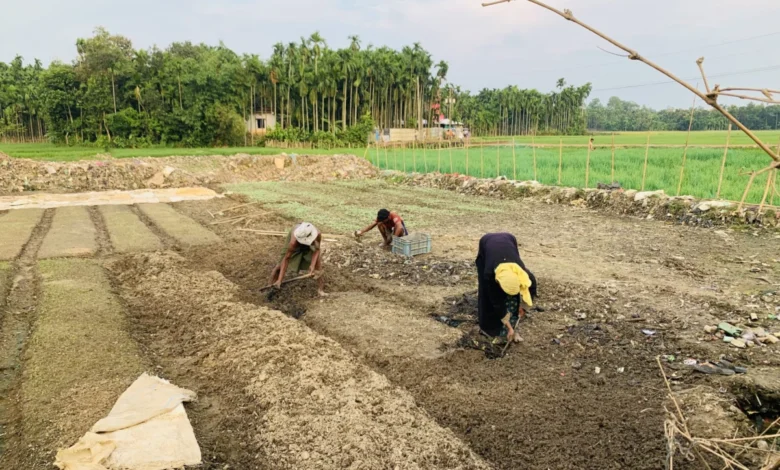
This resilience is manifesting through the adoption of agroforestry—a practice that integrates trees and shrubs into crop and animal farming systems. By utilizing multi-layered intercropping, refugees are mimicking the forest structures of their homeland. They plant tall fruit trees, such as mango and papaya, to provide a canopy that shades the ground and protects more delicate vegetables. Below this canopy, climbing plants like bottle gourds and pumpkins are trained to grow on trellises, maximizing the utility of tiny, allocated plots of land.

This technique serves a dual purpose: it provides essential nutrients for families facing reduced caloric intake from international aid programs, and it provides a critical structural foundation for the soil. The deep roots of these trees and shrubs act as a natural anchor, significantly reducing the risk of slope failure during the heavy monsoon season.
Scaling Sustainability: The Role of NGOs and Humanitarian Agencies
The transition toward sustainable agriculture is not entirely organic; it is supported by a strategic nexus of NGOs and UN agencies, including the UNHCR and the FAO. Projects such as the SuLMER (Sustainable Land Management and Environmental Rehabilitation) initiative have been instrumental in providing technical guidance and resources.

The program’s success hinges on the integration of Rohingya traditional knowledge with modern land management strategies. Humanitarian staff report that they do not merely impose new agricultural methods; rather, they facilitate the refugees’ existing expertise. For instance, the promotion of "sack gardening"—growing crops in large, soil-filled bags—allows families with virtually no land access to grow vegetables on their own verandas. This approach has engaged over 159,000 refugees in various homestead gardening initiatives, creating a decentralized network of green patches across the camps.
Data from the FAO indicates that these restoration efforts are yielding measurable results. In pilot sites, dry-season planting technologies have achieved a 100% seedling survival rate, demonstrating that with appropriate technical support, the camp’s degraded soil can be rehabilitated. Furthermore, the systematic introduction of native tree species is slowly re-establishing biodiversity, offering a degree of ecosystem service that was entirely absent just a few years ago.

Navigating Social and Structural Barriers
Despite the ecological success, the movement faces significant hurdles. A primary issue is the lack of formal land ownership. Under Bangladeshi law, refugees are prohibited from owning land, and their status in the camps is categorized as temporary. This uncertainty makes long-term investment in soil health and reforestation projects difficult, as both the government and humanitarian agencies emphasize that these areas are intended for repatriation, not permanent settlement.
Gender dynamics within the camps have also shifted as a result of these projects. Women like 38-year-old Mabia Khatun and 58-year-old Amina Khatun have become leaders in community nursery projects. By organizing groups of women to manage small, communal plots, they have created an environment that fosters both financial independence and social solidarity. However, these women frequently face cultural pushback from traditionalist elements of the community who are unaccustomed to seeing women perform public agricultural labor. Despite this, the economic benefit—selling surplus seedlings and produce—has provided a vital buffer against the rising cost of living and the volatility of aid supplies.

Broader Implications and Future Outlook
The long-term viability of the Cox’s Bazar agroforestry project remains a point of concern for environmentalists and humanitarians alike. The UNHCR has explicitly warned that the sustainability of these efforts relies on continuous funding and rigorous community oversight. Without consistent maintenance—such as preventing the dumping of solid waste into rehabilitated streams and protecting young trees from unauthorized harvesting—there is a high risk that the restored lands will revert to a degraded state.
From a policy perspective, the situation in Kutupalong serves as a global case study in the intersection of climate adaptation and refugee management. As the climate crisis exacerbates the frequency of extreme weather events, the vulnerability of refugee settlements to environmental degradation is only set to increase. The Rohingya experience demonstrates that environmental rehabilitation is not merely a "green" initiative but a critical humanitarian necessity.

For the families involved, however, the motivation is as much emotional as it is practical. For every seed planted, there is a connection to a lost home in Rakhine and a determination to maintain a cultural heritage that has been systematically erased in their country of origin. As Roshid Ahamed Bin poignantly observes, "Every seed I plant reminds me of my homeland and gives me hope for tomorrow."
As international attention fluctuates, the survival of these gardens may ultimately depend on the ability of the humanitarian community to bridge the gap between temporary emergency response and long-term, community-led environmental stewardship. Whether these patches of green can survive the dual pressures of political uncertainty and a changing climate remains to be seen, but for the present, they represent a significant victory in the effort to maintain human dignity amidst the harsh realities of life in exile.