SS United States Begins Final Voyage to Become the World’s Largest Artificial Reef off the Florida Coast

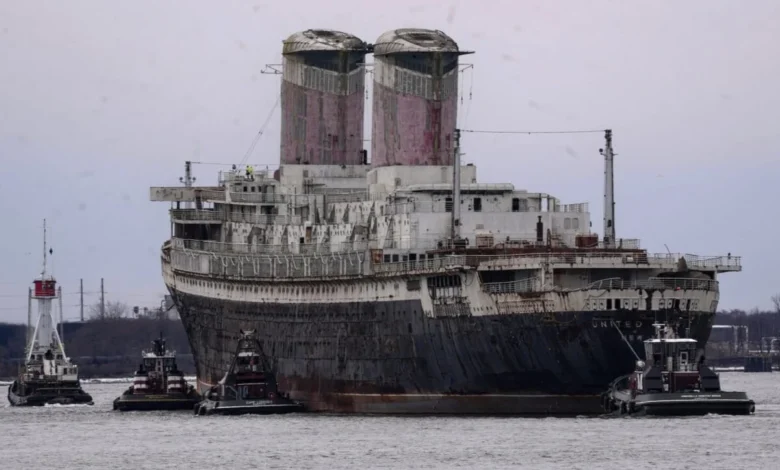
The SS United States, an ocean liner once celebrated as the pinnacle of mid-century maritime engineering and the fastest passenger ship to ever cross the Atlantic, has embarked on its final journey. On Wednesday, officials along Florida’s Panhandle coast oversaw the scuttling of the legendary vessel approximately 25 miles southwest of Destin, marking the conclusion of a long-standing effort to preserve the ship’s legacy by transforming it into the world’s largest artificial reef. The $13.5 million initiative, situated in the waters between Panama City and Pensacola, aims to provide a permanent habitat for marine life while stimulating the local economy through increased diving and recreational fishing tourism.
A Legacy of Speed and Innovation
Commissioned during the height of the Cold War, the SS United States was more than a luxury liner; it was a feat of American industrial might. Designed by naval architect William Francis Gibbs, the ship was built with a dual purpose: it served as a premier transatlantic passenger vessel and was constructed to be rapidly converted into a troopship capable of carrying 14,000 soldiers.
On its maiden voyage in July 1952, the vessel shattered the transatlantic speed record, a feat that remains unsurpassed by any other passenger ship to this day. The "Big U," as it was affectionately known, maintained an average speed of 35.59 knots—approximately 41 miles per hour—during its record-breaking transit. Its structural design, utilizing vast amounts of aluminum to reduce weight and fire risk, made it a technological marvel of the 20th century. For decades, it carried world leaders, celebrities, and travelers, representing the golden age of ocean travel before the onset of the jet age rendered such vessels commercially obsolete.
Chronology of a Final Descent
The journey to the Gulf floor was neither swift nor simple. Following its retirement from active service in 1969, the ship spent years in limbo, docked at various ports and passing through the hands of multiple owners.
- 1952: The SS United States completes its maiden voyage, capturing the Blue Riband for the fastest transatlantic crossing.
- 1969: The vessel is withdrawn from service as international travel patterns shift toward commercial aviation.
- 1996: The ship is towed to Philadelphia, where it remained docked for nearly three decades, serving as a stationary landmark of maritime history.
- 2011: The SS United States Conservancy acquires the ship, launching an exhaustive, decade-long campaign to save it from the scrapyard.
- 2024: Following legal battles over docking fees and the failure of redevelopment proposals, plans are finalized to repurpose the ship as an artificial reef.
- February 2025: The vessel is towed from its long-term berth in Philadelphia toward the Gulf of Mexico.
- March 2025: The final scuttling operation is executed off the coast of Destin, Florida.
The Engineering of an Artificial Reef
Converting a 990-foot ocean liner into a stable, environmentally sound reef is a monumental undertaking. The $13.5 million project required extensive environmental remediation, including the removal of all hazardous materials such as asbestos, fuels, oils, and non-biodegradable plastics. This process ensures that the ship serves as an ecological benefit rather than a source of pollution.
Marine biologists anticipate that the sheer scale of the SS United States will create a massive, multi-level sanctuary for various species. The hull will serve as a substrate for coral growth, while the interior corridors and deck structures are expected to attract apex predators, including tuna, marlin, and swordfish. The complexity of the ship’s internal architecture provides a unique environment for reef fish, effectively creating a vertical reef that spans hundreds of feet from the seafloor toward the surface.
Official Perspectives and Economic Impact
Local and state officials have championed the project as a significant boon for the Florida Panhandle. Destin and the surrounding coastal communities rely heavily on a marine-based economy, and the addition of a world-class dive site is expected to generate significant revenue.

"By repurposing the SS United States, we are not just honoring a piece of maritime history; we are investing in the future of our coastal ecosystem," stated a representative from the local port authority. Economists note that the reef is expected to attract thousands of visitors annually, providing a predictable influx of capital into the hospitality and maritime service sectors. While some historical preservationists expressed disappointment that the ship could not be saved as a museum, the prevailing sentiment among the engineering and environmental community is that the scuttling provides the most dignified and functional outcome for a ship that had otherwise reached the end of its viable lifespan.
Environmental and Biological Implications
The placement of the SS United States on the seafloor is part of a broader trend in marine conservation. Artificial reefs have been proven to increase the biomass of local fish populations by providing protection from currents and predators, as well as offering a foundation for filter-feeding organisms.
Data from similar, albeit smaller, artificial reef projects—such as the scuttling of the USS Oriskany in 2006—demonstrate that such structures can lead to a measurable increase in biodiversity within the first three to five years. The SS United States, due to its unprecedented size, is expected to serve as a research hub for marine scientists studying the colonization of deep-water structures. Analysts suggest that the reef will be a "living laboratory," offering insights into how massive, complex steel structures interact with Gulf currents and native marine flora and fauna over several decades.
A Historical Milestone
The loss of the SS United States as a floating entity marks the end of an era. It was the last great survivor of a time when the crossing of the Atlantic was an event, not a commute. Throughout its tenure in Philadelphia, the ship became a symbol of industrial nostalgia. Its transformation into a reef is a final transition from a vessel of human transit to a vessel of marine sustainability.
Historians argue that the decision to sink the ship is a pragmatic solution to a preservation crisis. The costs of maintaining a vessel of that magnitude in a dry-dock environment were prohibitive, and the structural integrity of the ship had begun to degrade. By choosing to create an artificial reef, the stakeholders have ensured that the SS United States remains in existence, visible to those willing to descend into the Gulf, rather than being dismantled for its metal content.
Conclusion: The Future of the "Big U"
As the SS United States settles into its new, permanent home, it leaves behind a legacy that bridges the gap between mid-20th-century industrial achievement and 21st-century environmental stewardship. While it will no longer cut through the waves at record-breaking speeds, the ship will continue to occupy a central place in maritime history. For the fishing and diving communities of Florida, the ship now represents a new beginning, serving as a beacon of marine life in the vast expanse of the Gulf.
The project stands as a testament to the idea that even when a machine’s original purpose has expired, its utility can be reimagined. The SS United States remains the largest ship to ever be repurposed in such a manner, ensuring that the "Big U" continues to hold records—not for its speed across the surface, but for its scale beneath the sea. The final chapter of this historic liner is not one of decay, but of transformation, securing its place in the history of the Gulf of Mexico for generations to come.