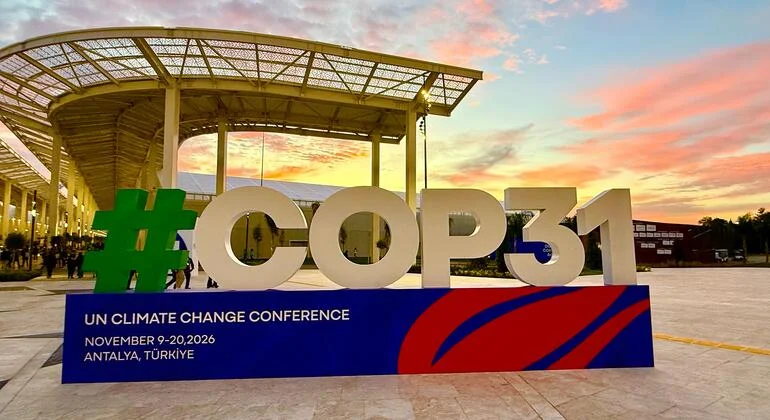
The coastal city of Antalya has transformed into a high-security global diplomacy hub as world leaders, delegates, civil society representatives, and climate scientists converge for the high-level Leaders’ Summit of the 31st United Nations Climate Change Conference (COP31). Co-hosted by Turkey and Australia, this year’s summit opened under intense international scrutiny. Security perimeters, widespread road closures, and a massive influx of participants created a bustling atmosphere across the venue corridors, with early risers arriving as early as 5 a.m. to clear security checkpoints.
While the dawn arrivals were greeted by a striking sunrise over the Mediterranean coast, the prevailing mood inside the plenary halls is marked by deep urgency and palpable frustration. Negotiators and heads of state face the daunting task of accelerating emissions reductions while addressing a stark reality: global efforts to curb climate change are severely lagging behind the physical acceleration of environmental degradation. Despite decades of international summits, scientific consensus indicates that current national climate plans, even if fully implemented, place the planet on a dangerous trajectory toward more than 2.5 degrees Celsius of warming by the end of the century.
Opening the summit, organizers sought to balance sobering statistical warnings with cultural celebration. The opening ceremony featured traditional Turkish dance performances, vibrant artistic displays, and an official COP31 theme song. However, the festive pageantry quickly gave way to unsparing assessments of the global climate crisis from the international community’s highest offices.
A Critical Threshold and the Call for a Climate Justice Compact
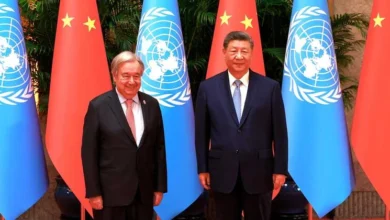
The most striking rhetorical moment of the opening day came from United Nations Secretary-General António Guterres, who delivered a blistering critique of political inaction and corporate obstruction. Addressing the plenary, the UN chief pulled no punches regarding the rapidly narrowing window to avert catastrophic climate impacts.
"Our planet is heating up. The clock is winding down. It’s make or bake time," Mr. Guterres told world leaders, urging them to view the climate emergency through the lens of immediate survival rather than long-term policy abstraction.
The Secretary-General confronted the symbolic and scientific significance of the 1.5-degree Celsius threshold established under the Paris Agreement. While scientists widely agree that temporarily breaching this limit is becoming increasingly likely, Mr. Guterres insisted that this prospect must not serve as an excuse for apathy or retreat.
"Science is not telling us to surrender. It is telling us to fight harder," he stated, emphasizing that every fraction of a degree of avoided warming directly translates to millions of lives saved, ecosystems preserved, and economic damages averted.
To bridge the glaring chasm between climate ambition and financial reality, the UN chief introduced a comprehensive "climate justice compact." This proposed framework is designed to facilitate the transition of developing economies away from fossil fuels while simultaneously securing financial lifelines for communities already experiencing severe loss and damage. The foundational premise of the compact is simple yet politically contentious: nations cannot reasonably demand that developing economies undergo a radical industrial transformation while withholding the financial and technological means to achieve it.
The Financial Disconnect: Fossil Fuel Profits Versus Adaptation Funds
Central to the Secretary-General’s climate justice compact is an uncompromising stance on corporate accountability. Directing his ire at the fossil fuel industry, Mr. Guterres accused major energy companies of deliberately distorting climate science and deploying powerful lobbying apparatuses to obstruct legislative progress.
"Fossil fuels must go the way of the dinosaurs," he declared, drawing applause from the plenary audience. "The dinosaurs did not have a lobby. Fossil fuels do."
To illustrate the profound economic inequality underpinning the global energy transition, Mr. Guterres drew a sharp contrast between corporate revenues and climate adaptation funding. He highlighted that the world’s nine largest oil and gas companies accumulated a staggering $95 billion in profits during a single recent quarter. By comparison, the international fund established to help vulnerable, low-income nations recover from climate-induced loss and damage received a mere $600 million.
Put into perspective, the global loss and damage fund amounts to roughly 14 hours of profits for these nine corporate entities. Citing this immense disparity, the UN chief issued a direct challenge to national governments, urging them to implement aggressive windfall profit taxes on energy corporations to finance climate resilience. "Polluters must pay," he asserted, a declaration that reverberated across the summit floor and set a high benchmark for subsequent ministerial negotiations.
Historical Shortcomings and Geopolitical Distractions
The sentiment that international climate governance has chronically underperformed was echoed by co-host Turkey. Turkish President Recep Tayyip Erdoğan addressed the assembly, acknowledging that three decades of multilateral climate negotiations have yielded impressive theoretical frameworks but lamentable practical outcomes.
"This success at the level of ideas has not produced the same results when it comes to implementation," President Erdoğan noted, reinforcing the urgent need for equitable financial architectures that support developing nations in their green transitions.
Meanwhile, Brazilian President Luiz Inácio Lula da Silva delivered a sobering analysis of the shifting geopolitical landscape, warning that climate action is rapidly losing ground to military conflicts and trade protectionism. As host of the preceding COP30 summit in Belém, Brazil has positioned itself as a vocal advocate for environmental multilateralism and the protection of critical carbon sinks like the Amazon rainforest.
"We started talking more about weapons and tariffs than the survival of future generations," President Lula warned the assembly. He cautioned against the erosion of international cooperation at a historical juncture when both climate science and multilateral institutions face coordinated political attacks. Reaffirming Brazil’s national commitments, President Lula announced that his administration will roll out rigorous national roadmaps designed to phase out fossil fuel dependency and eradicate illegal deforestation, carrying forward the momentum generated in the Amazon basin last year.
Methane Abatement: The Climate Emergency Brake
While high-level political speeches dominated the plenary halls, thematic discussions on Wednesday—designated as "Zero Waste" day—focused heavily on practical, immediate mitigation strategies. Chief among them was the targeted reduction of methane emissions, an invisible and potent greenhouse gas that traps more than 80 times the heat of carbon dioxide over a 20-year timespan.
Methane is responsible for nearly 30 percent of global warming to date, leaking primarily from fossil fuel extraction infrastructure, agricultural operations, and decomposing organic waste in landfills. Because methane breaks down in the atmosphere much faster than carbon dioxide, aggressive abatement measures offer an unprecedented opportunity to slow the rate of near-term warming.
During a specialized thematic event, Secretary-General Guterres called upon the United Nations Environment Programme (UNEP) to spearhead the creation of a universal, binding global standard for near-zero methane emissions across the oil and gas sector. UNEP is already leveraging advanced technology to track and expose major leaks in real time, utilizing high-resolution satellites and artificial intelligence to monitor global infrastructure.
Julia Ferini, who leads UNEP’s International Methane Emissions Observatory (IMEO), detailed the tangible impact of this satellite-tracking initiative in an interview with UN News. According to Ferini, the observatory’s alert system has successfully prompted emissions reductions in 45 distinct cases across 13 countries.
She highlighted a prominent case study in Iraq, where a severely damaged and corroded gas pipeline had been leaking massive quantities of methane for two consecutive years—generating emissions equivalent to the annual output of approximately 350cken,000 passenger vehicles. The leak was successfully plugged simply by applying a protective coating to the compromised pipeline.
"Methane is our climate emergency brake," Ferini explained. "Cutting this short-lived gas can buy us critical time by slowing warming relatively quickly, allowing us the necessary runway to deeply decarbonize our carbon dioxide emissions."
Despite the proven efficacy of satellite monitoring, the initiative faces severe institutional bottlenecks. UNEP has issued more than 5,000 localized emission alerts to governments and corporate operators since 2023, yet barely one in eight alerts has received an official response or corrective action, highlighting a persistent deficit in corporate compliance and regulatory enforcement.
Grassroots Innovation and Economic Pragmatism
While national governments and multinational corporations debate regulatory frameworks and financial commitments, grassroots innovators and young entrepreneurs are already implementing scalable solutions on the ground. These localized initiatives formed a vital counter-narrative to the political gridlock often characterizing high-level climate summits.
In Botswana, young biologist and ecopreneur Mmakwena Moesi is tackling the pervasive crisis of organic waste through an unconventional workforce: more than half a million composting worms. Her enterprise, Viva Organica, partners with local food retailers to collect large volumes of organic waste, transforming it into high-grade organic fertilizer via vermicomposting. This closed-loop process simultaneously enriches impoverished agricultural soils and diverts thousands of tons of waste from decomposing in standard landfills, where it would otherwise generate substantial methane emissions. To date, Viva Organica has processed over 1,000 tonnes of organic waste.
However, Moesi emphasizes that environmental sustainability alone is insufficient to drive mass adoption among agricultural communities. Speaking to reporters in Antalya, she stressed that climate-friendly technologies must align directly with economic incentives to succeed.
"A farmer does not wake up in the morning thinking about what am I gonna do to help sequester this amount of carbon dioxide from the air," Moesi told UN News. "Instead, they want to know how much food they can grow, how to improve their harvests, and whether they can afford the products that can help them."
Looking Ahead: The Road Through Antalya
As the high-level Leaders’ Summit continues over the next 48 hours, the pressure on national delegations is intensifying. COP31 is widely regarded as a critical juncture for translating long-term net-zero pledges into enforceable, finance-backed policies. With the UN Secretary-General’s call for a climate justice compact, ongoing debates over fossil fuel phaseouts, and concrete technological solutions for methane mitigation on the table, the coming days will test the diplomatic resolve of the international community.
Whether the commitments forged in Antalya will match the escalating scale of the climate emergency remains to be seen. However, as delegates navigate the packed corridors of the COP31 venue, the consensus among scientists, activists, and vulnerable nations is absolute: the margins for error have vanished, and the transition from political rhetoric to aggressive implementation is no longer optional—it is a mandatory condition for human survival.