The Federation Internationale de Football Association (FIFA) has unveiled an unprecedented blueprint for the 2030 World Cup, a tournament designed to bridge three continents and six countries in a massive celebration of the sport’s centennial anniversary. Breaking from the traditional single-host or neighboring-country model, the 2030 iteration will see matches played in Uruguay, Argentina, and Paraguay, before the primary tournament shifts to the Mediterranean cluster of Spain, Portugal, and Morocco. This ambitious configuration represents the most geographically expansive sporting event in history, reflecting FIFA’s strategy to globalize the tournament while honoring its historical roots.
The decision, ratified by the FIFA Council, marks the first time a World Cup will be staged across Africa, Europe, and South America. While the majority of the 104-match schedule will take place in the Northern Hemisphere, the tournament’s opening acts are reserved for the Southern Hemisphere to commemorate the 100th anniversary of the inaugural World Cup, which was held in Montevideo, Uruguay, in 1930.
Historical Foundations and the Centennial Tribute
To understand the structure of the 2030 World Cup, one must look back to July 1930. The first-ever FIFA World Cup was a milestone for international athletics, hosted and won by Uruguay. The Estadio Centenario in Montevideo, built specifically for the event, remains a hallowed ground for football enthusiasts. In 1983, FIFA officially designated it as the only Historical Monument of World Football, a status that underscores its significance in the 2030 planning.

The 1930 final between Uruguay and Argentina was famously contentious, nearly derailed by a dispute over which nation’s manufactured ball should be used. The compromise—using an Argentine ball for the first half and a Uruguayan ball for the second—saw Argentina lead 2-1 at halftime, only for Uruguay to roar back and win 4-2. In 2030, the tournament will pay homage to this legacy. The opening match will be held at the Estadio Centenario on June 8, 2030. Following the opener in Montevideo, Argentina and Paraguay will each host one match in their respective capitals, Buenos Aires and Asunción. All three South American nations, along with the three primary hosts, have been granted automatic qualification for the tournament.
The Mediterranean Core: Spain, Portugal, and Morocco
Following the three "Centenary Celebration" matches in South America, the tournament will relocate to the primary host nations: Spain, Portugal, and Morocco. This trio represents a unique cross-continental partnership, linking the Iberian Peninsula with North Africa.
Spain, which last hosted the World Cup in 1982, is expected to provide the largest share of venues. Major cities such as Madrid and Barcelona are central to the bid, with iconic stadiums like the Santiago Bernabéu and the Spotify Camp Nou undergoing massive renovations to meet modern FIFA standards. Portugal will make its debut as a World Cup host, utilizing top-tier infrastructure in Lisbon and Porto, including the Estádio da Luz and the Estádio do Dragão.
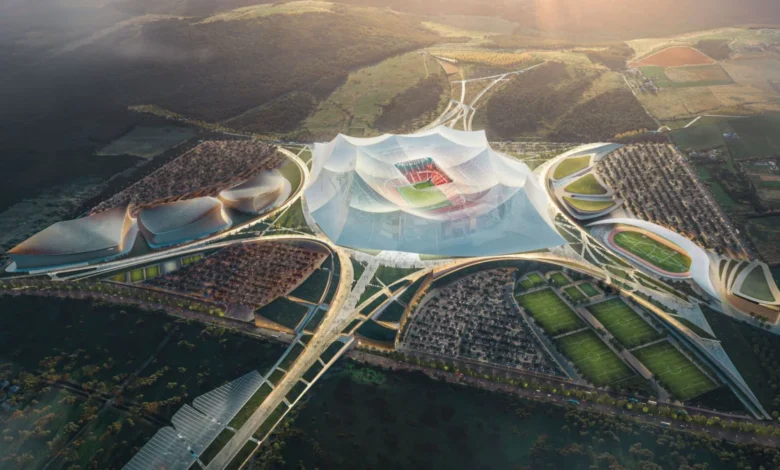
Morocco’s inclusion is particularly significant, as it becomes only the second African nation to host World Cup matches, following South Africa in 2010. The Moroccan government has viewed the 2030 World Cup as a catalyst for national development, announcing plans for six host cities: Tangier, Rabat, Casablanca, Agadir, Marrakech, and Fez. The crown jewel of their infrastructure plan is the Grand Stade Hassan II in Benslimane, near Casablanca. Designed to resemble a traditional Moroccan tent, the stadium is projected to have a capacity of 115,000, which would make it the largest football stadium in the world.

Logistical Challenges and Player Welfare
The 2030 format has invited scrutiny regarding the logistical demands placed on players and fans. With the opening matches in South America and the remainder of the tournament in Europe and North Africa, teams will be required to travel approximately 6,000 miles across the Atlantic Ocean mid-tournament.
FIFA officials have addressed these concerns by highlighting a revamped schedule that includes significant "rest days" to allow for acclimatization and travel recovery. According to official statements, teams playing in South America will have approximately 11 to 12 days of rest and travel time before their second match in the Mediterranean cluster. Despite these assurances, player unions such as FIFPRO have expressed concerns regarding the physical toll of intercontinental travel and the impact of varying climate zones on athlete performance.
The tournament is currently slated to feature 48 teams, following the expansion model debut in the 2026 World Cup (hosted by the US, Canada, and Mexico). However, there is ongoing discussion within the South American football confederation, CONMEBOL, to further expand the field to 64 teams. FIFA President Gianni Infantino has indicated that while the 48-team format is the current standard, the governing body remains open to reviewing the tournament’s scale based on the success of the 2026 event.
The Battle for the Final: A Three-Way Race
While the opening match is set for Montevideo, the location of the 2030 World Cup Final remains a subject of intense competition and diplomatic maneuvering. Three primary contenders have emerged:

- Madrid (Spain): The Santiago Bernabéu, home of Real Madrid, is often considered the frontrunner due to its historical prestige and recent high-tech renovation, which includes a retractable pitch and roof.
- Barcelona (Spain): The Spotify Camp Nou, currently being rebuilt to expand its capacity to over 100,000, offers the largest seating capacity in Europe and remains a symbol of global football culture.
- Casablanca (Morocco): The proposed Grand Stade Hassan II is Morocco’s ambitious bid to steal the spotlight. By offering the world’s largest capacity and a brand-new, state-of-the-art facility, Morocco hopes to secure the final, which would be a historic first for the African continent.
FIFA is expected to announce the final venue selection in December 2026. Regardless of which city is chosen, the proximity of the host nations offers a silver lining for fans. The Strait of Gibraltar, which separates Spain and Morocco, is only about nine miles wide at its narrowest point. Advanced transportation links, including the Al Boraq high-speed rail in Morocco—the first of its kind in Africa—and frequent ferry services, will allow fans to potentially attend matches in two different continents within the same 24-hour period.
Economic and Geopolitical Implications
The 2030 World Cup is expected to generate record-breaking revenue for FIFA and the host nations. The 2026 tournament is already projected to bring in billions in commercial deals, and the 2030 event’s presence in six diverse markets offers even greater opportunities for sponsorship and broadcasting rights.
For the host nations, the tournament serves as a vehicle for soft power and economic stimulus. Morocco, in particular, is using the event to showcase its modernization and tourism potential. The joint bid, titled "Yalla Vamos," emphasizes a message of unity between the Global North and South, as well as between the Arab world and Europe.
However, the environmental impact of such a dispersed tournament has become a point of contention. Critics argue that the carbon footprint associated with flying thousands of fans and dozens of teams across the Atlantic contradicts FIFA’s stated sustainability goals. In response, FIFA has pledged to implement carbon-offsetting programs and promote green energy usage at all 2030 venues.

A Bridge to 2034: The Saudi Arabia Connection
The unique allocation of the 2030 World Cup across three confederations (UEFA, CAF, and CONMEBOL) had a significant ripple effect on the 2034 tournament. Under FIFA’s rotation policy, only member associations from the Asian Football Confederation (AFC) and the Oceania Football Confederation (OFC) were eligible to bid for the 2034 event. This paved the way for Saudi Arabia to emerge as the sole bidder and eventual host of the 2034 World Cup.
By satisfying the hosting aspirations of Europe, Africa, and South America in a single centennial event, FIFA effectively streamlined the selection process for the subsequent decade. This has led some analysts to suggest that the 2030 multi-continent model may become a blueprint for future "mega-events" that seek to balance historical legacy with emerging markets.
Conclusion: A Century of Football
As the 2030 World Cup approaches, the global football community finds itself at a crossroads between tradition and innovation. By returning to the Estadio Centenario, FIFA honors the pioneers of 1930 who turned a regional pastime into a global phenomenon. By expanding into Morocco, Portugal, and Spain, the organization acknowledges the changing landscape of international sports and the necessity of cross-border cooperation.
The 2030 tournament will be more than a series of football matches; it will be a logistical feat of unprecedented scale, a test of athlete endurance, and a celebration of a century of "the beautiful game." From the historic towers of Montevideo to the futuristic arches of Casablanca and the bustling streets of Madrid, the 2030 FIFA World Cup promises to be a truly global spectacle that defines the next era of international sport.
Related posts: