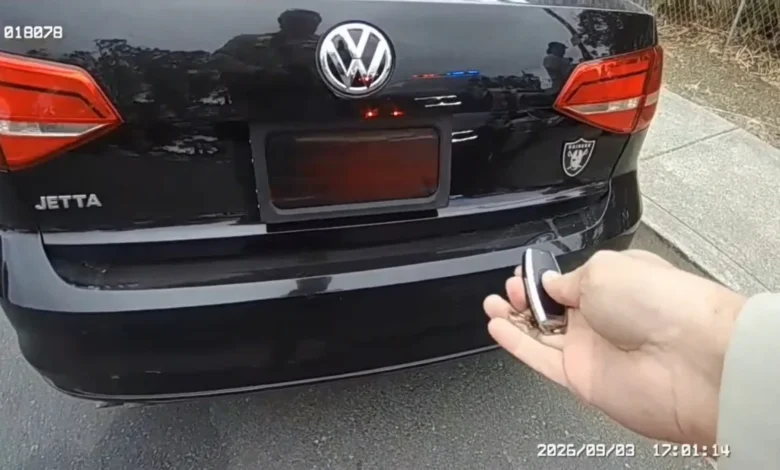
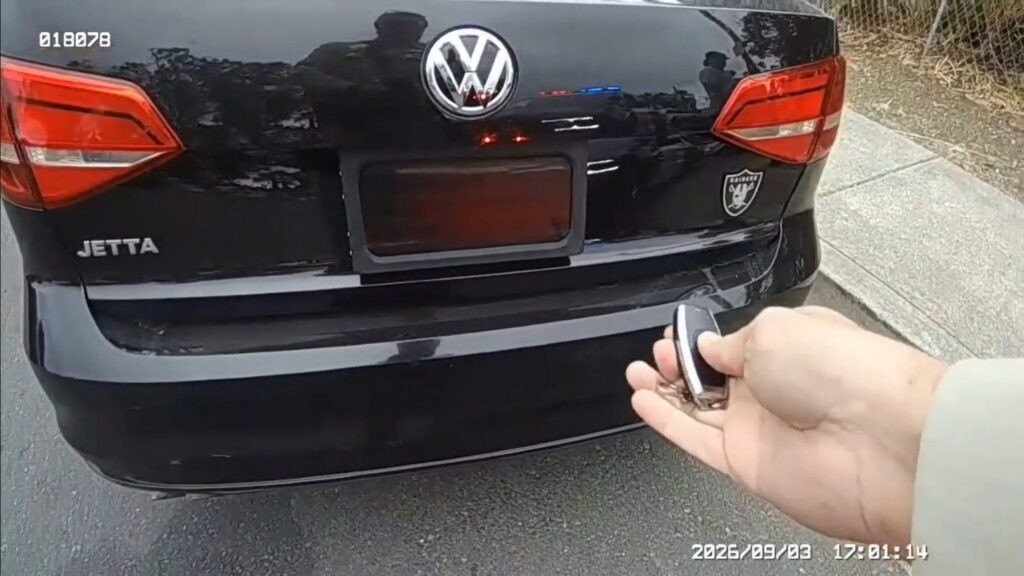
The lengths to which motorists will go to evade routine financial obligations on public infrastructure have escalated from simple evasion tactics to sophisticated, James Bond-style gadgetry. This reality was underscored recently when officers from the California Highway Patrol (CHP) Solano office intercepted a black Volkswagen Jetta equipped with a motorized, push-button license plate concealment device. What began as standard highway surveillance quickly morphed into an open-and-shut case of toll evasion, punctuated by a frank admission from the driver that lays bare the growing cat-and-mouse game between toll authorities and motorists seeking to bypass automated enforcement networks.
The incident highlights a broader, escalating friction point across major metropolitan transit systems, where electronic toll collection has largely replaced traditional cash booths. As state and local transportation authorities increasingly lean on high-definition cameras and automated optical character recognition (OCR) systems to fund bridge maintenance and highway expansions, a subset of drivers has invested in illicit technology designed to render their vehicles invisible to these electronic sentinels. However, as law enforcement agencies deploy advanced dashcam technology and heightened visual awareness training, these high-tech dodges are increasingly resulting in costly legal consequences rather than financial savings.
Chronology of the Interception
The encounter unfolded on a heavily traveled corridor within the CHP Solano jurisdiction. According to dashcam footage released by the agency, a patrol cruiser was maintaining position in the second lane of traffic when the black Volkswagen Jetta passed by. To the casual observer, or a static roadside enforcement camera, the vehicle’s rear identification marker appeared entirely obscured by an opaque barrier.
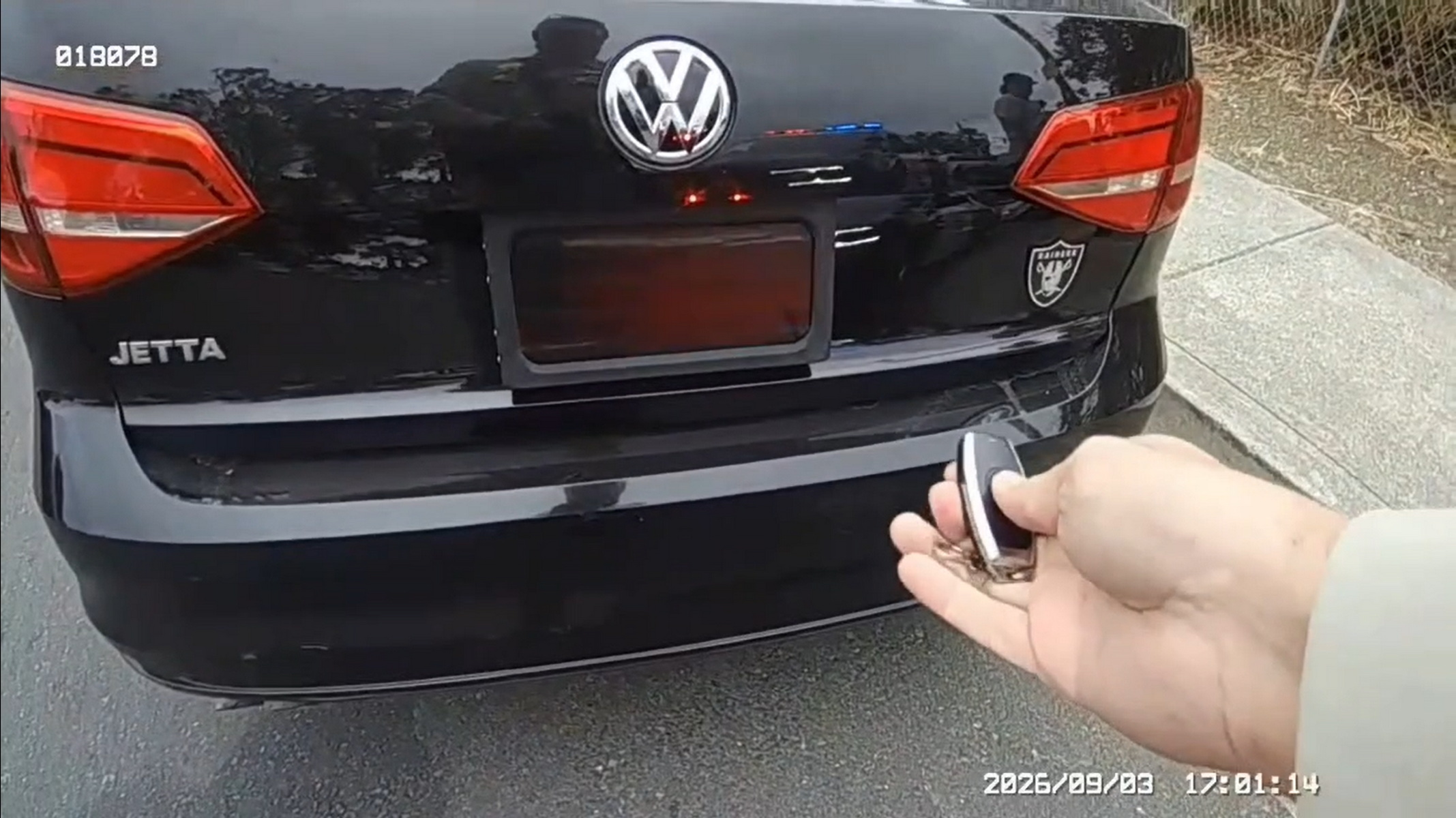
Sensing an anomaly, the observing officers initiated a rolling surveillance sequence, capturing the exact moment the mechanical apparatus manipulated the plate. Within seconds of accelerated documentation, the apparatus retracted or shifted, rendering the registration numbers completely visible once again. The officers quickly closed the distance, executed a standard traffic stop, and made contact with the sole occupant of the vehicle.
During the subsequent roadside interaction, officers engaged the driver regarding the unusual modification. Rather than offering a dubious excuse regarding mechanical failure or accidental obstruction, the motorist reportedly provided an immediate and unprompted confession. According to official CHP statements, the driver openly admitted that the device had been installed and utilized specifically to bypass Express Lane tolls and avoid charges associated with regional Bay Area bridge crossings.
Legal Framework and Financial Penalties
The driver’s candid admission transformed a simple vehicle equipment inspection into a multi-faceted legal violation. California law enforcement agencies have intensified their focus on license plate tampering, viewing such infractions not merely as minor regulatory oversights, but as intentional acts of fraud and evasion that undermine public transit funding structures.
The primary statutory instrument cited in this case is California Vehicle Code (CVC) Section 5201.1. This statute explicitly prohibits the manufacture, sale, distribution, or operation of any device, mechanism, or electronic product designed to obscure, alter, or conceal the reading or recognition of a license plate. The baseline fine for operating a vehicle equipped with a switchable plate frame, a mechanical flipper, or any similar concealment apparatus is set at $250 per violation. However, this figure represents only the starting point; it excludes a wide array of state and county penalty assessments, court fees, and potential administrative charges that typically double or triple the final financial burden on the offender.

Furthermore, the CHP noted additional violations under CVC 5201, which mandates that license plates must be clearly visible and legible at all times while a vehicle is operated on public roadways. Compounding the situation further is CVC 23302(a)(1), which specifically governs toll evasion. Beyond the immediate traffic citations and associated court fines, persistent toll evasion triggers civil penalties, late fees, and administrative holds that can actively prevent the successful registration or renewal of the vehicle through the Department of Motor Vehicles (DMV).
The Broader Crackdown on License Plate Manipulation
The Solano CHP bust does not occur in a vacuum; it is part of a coordinated, statewide pushback against sophisticated methods of license plate obstruction. In recent years, California legislators and law enforcement bodies have recognized that traditional penalties were insufficient to deter motorists from utilizing illegal accessories.
Legislative updates taking effect in 2025 significantly broadened the state’s regulatory net, introducing severe penalties—including potential fines up to $10,000—targeted specifically at commercial entities and individuals attempting to sell or distribute illicit license plate covers, tinted shields, and spray-on reflective coatings designed to defeat infrared and photographic traffic cameras.
State transportation agencies, including the Bay Area Toll Authority (BATA) and regional transportation departments, have reported millions of dollars in annual losses due to intentional toll evasion. These losses directly impact funding for critical infrastructure projects, public transit maintenance, and highway safety initiatives. Consequently, highway patrol divisions across California have made the detection of obscured, altered, or artificially manipulated plates a priority during routine patrols and targeted traffic enforcement operations.
Implications for Modern Automated Enforcement
The proliferation of automated traffic enforcement systems—spanning high-occupancy toll (HOT) lanes, bridge crossings, red-light cameras, and speed-enforcement corridors—has fundamentally altered the relationship between motorists and law enforcement. While these systems are designed to maximize efficiency and ensure equitable cost distribution among road users, they rely heavily on the unobstructed line of sight afforded to optical sensors.
When drivers employ mechanical plate-hiders, flip frames, or electronic shutters, they effectively attempt to exploit a vulnerability in automated infrastructure. However, as the Solano CHP incident demonstrates, these devices often produce the exact opposite of their intended effect. Instead of blending seamlessly into the flow of traffic while evading tolls, a vehicle equipped with an erratic or disappearing plate draws immediate visual scrutiny from experienced patrol officers who are trained to spot non-compliant vehicle modifications.
Ultimately, the driver of the Volkswagen Jetta discovered that the minor convenience of avoiding a few dollars in bridge and express lane tolls carried an exorbitant price tag. Between steep statutory fines, potential court costs, administrative registration complications, and the public scrutiny generated by the agency’s social media documentation, the gamble proved fundamentally unprofitable. As California law enforcement agencies continue to leverage both advanced officer training and updated statutory authorities, the era of the high-tech plate hider is facing an increasingly aggressive and unforgiving enforcement landscape.