The global space industry is experiencing a period of unprecedented activity and transformation, marked by significant strides in rocket reusability, ambitious lunar exploration plans, and a dynamic shift in international partnerships. This week’s developments underscore the relentless pace of innovation and the intense competition among commercial entities and national space agencies alike, as detailed in Edition 8.37 of the Rocket Report. From Blue Origin’s pivotal New Glenn booster re-flight to SpaceX’s latest Starship mega-rocket tests and the ongoing challenges faced by United Launch Alliance, the landscape of space access is rapidly evolving. Meanwhile, international players like China and the European Space Agency are navigating their own paths, pushing the boundaries of technology and strategy in an increasingly complex geopolitical environment.
The Reusability Revolution: Blue Origin and SpaceX Push Boundaries
The pursuit of reusability remains a cornerstone of modern spaceflight, promising to dramatically reduce launch costs and increase mission cadence. Two major players, Blue Origin and SpaceX, are at the forefront of this revolution, each marking significant milestones in recent days.
Blue Origin’s New Glenn Achieves Reusability Milestone
Blue Origin, Jeff Bezos’s space venture, is on the cusp of a critical achievement with the imminent third flight of its New Glenn rocket. Scheduled for the morning of Sunday, April 19, from Cape Canaveral Space Force Station, Florida, this mission is particularly notable as it will feature a reused first-stage booster. The two-hour launch window is set to extend from 6:45 am EDT to 8:45 am EDT. A crucial precursor to this flight occurred recently when the New Glenn’s first stage, previously flown in November, successfully fired its seven BE-4 main engines on the launch pad. This static fire test marked the first instance of a previously flown New Glenn booster being reignited, a vital step in validating its reusability.
However, Blue Origin CEO Dave Limp clarified that while the booster itself is reused, the seven BE-4 engines powering this flight are not the identical set from its inaugural mission. These flight-proven engines are being reserved for subsequent missions. The upcoming launch aims to deploy a cellular broadband satellite for AST SpaceMobile into low-Earth orbit, and Blue Origin intends to attempt another successful landing of the booster, further demonstrating its reusability capabilities. This consistent reusability is key to Blue Origin’s long-term strategy, mirroring the success seen with SpaceX’s Falcon 9, which has drastically reduced launch costs and increased access to space.
In parallel with its Cape Canaveral operations, Blue Origin has also been selected for the next phase of developing a new super-heavy launch facility at Vandenberg Space Force Base, California. The proposed site at Space Launch Complex-14 would become the southernmost launch facility at Vandenberg, situated on previously undisturbed land. This strategic expansion would provide New Glenn with efficient access to high-inclination orbits, crucial for many government and commercial satellite deployments. The selection initiates talks between Blue Origin and the Space Force to finalize a real property use agreement, alongside essential safety and environmental assessments, before any construction or launches can commence. This dual-site strategy underscores Blue Origin’s ambition to be a dominant player in the heavy-lift launch market, serving both geostationary and polar orbit missions.
Starship V3’s Powerful Debut
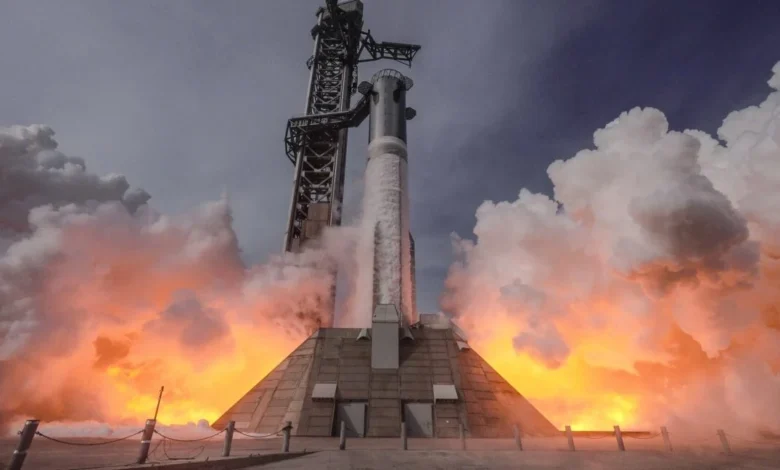
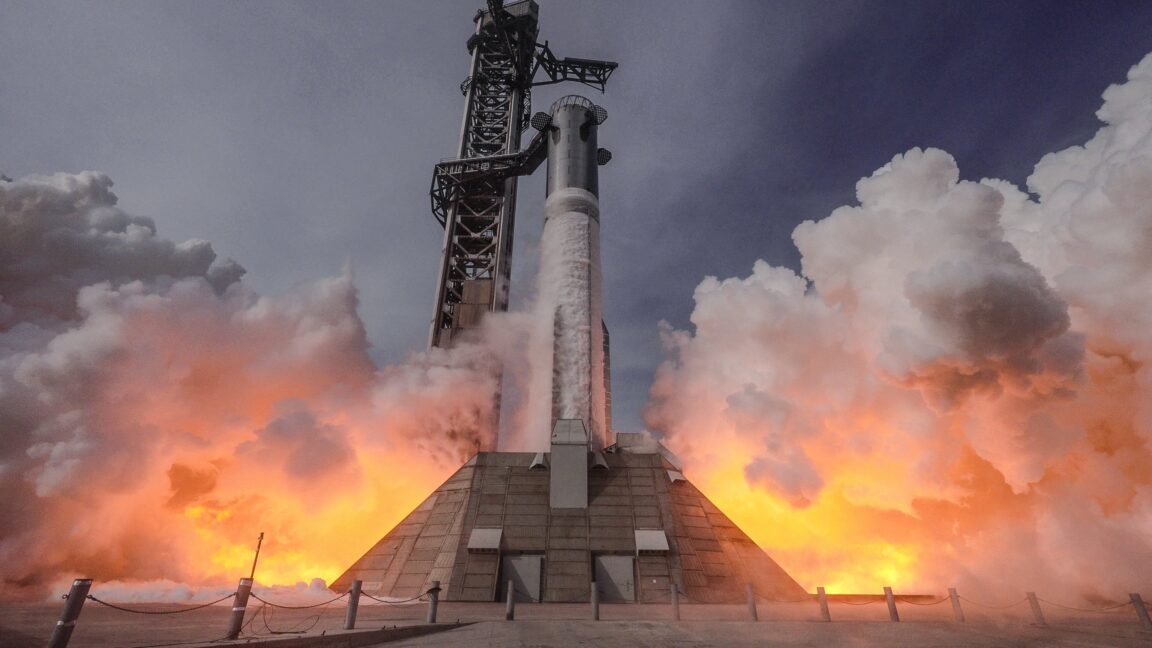
Across the industry, SpaceX is rapidly advancing its Starship mega-rocket, with the "Version 3" variant completing significant ground tests ahead of its anticipated first launch in early or mid-May. This will be the 12th overall flight for Starship, but the inaugural mission for the V3, which boasts enhanced size and power. The vehicle’s six Raptor engines were successfully fired on a test stand in South Texas on Tuesday, following a series of cryogenic proof tests earlier in the year.
The following day, an even more monumental test took place as the Super Heavy booster, designed to propel Starship V3 skyward, ignited all 33 of its Raptor engines directly on SpaceX’s launch pad at Starbase, Texas. This short-duration static fire marked the first time all 33 engines on the new Super Heavy booster were simultaneously ignited, following a previous test last month involving only 10 engines. With these upgrades, including higher-thrust Raptor engines, the Super Heavy booster has officially become the most powerful rocket booster ever fired, a testament to SpaceX’s engineering prowess.
The upcoming Starship V3 launch is not merely another test flight; it is crucial for demonstrating in-orbit refueling capabilities. This technology is an "enabling capability" for Starship to fulfill its role as a human-rated Moon lander for NASA’s Artemis program, a critical component of the agency’s plan to return astronauts to the lunar surface. The six-month gap since the last Starship test flight has heightened anticipation for this next-generation vehicle’s debut.
Lunar Ambitions: Artemis Program and Lander Progress
NASA’s Artemis program continues to be a central focus of human spaceflight, aiming to establish a sustainable human presence on the Moon. Following the resounding success of the Artemis II mission—the first human flight to the Moon since Apollo 17 in 1972—attention has now firmly shifted towards the development of lunar landers that will ferry astronauts to the lunar surface.

Post-Artemis II Focus on Lunar Landers
The Artemis II mission, a critical step in NASA’s ambitious program, saw the Orion spacecraft successfully carry astronauts on a circumlunar trajectory, validating key systems and procedures for future deep-space human exploration. With this mission’s success, the path is now clear for the next major hurdle: ensuring reliable and safe transportation for astronauts from lunar orbit to the Moon’s surface and back. This requires robust Human Landing System (HLS) development, a domain where commercial partners play an indispensable role.
Competing for the Moon: SpaceX and Blue Origin’s Roles
NASA has adopted a strategy of fostering competition and redundancy in its HLS contracts, awarding development contracts to both SpaceX and Blue Origin. SpaceX’s Starship is envisioned as a key component of the Artemis program, particularly for the crewed lunar landing missions. Its sheer capacity and the planned in-orbit refueling system are central to its ability to transport substantial payloads and crew to the lunar surface. The recent Starship V3 tests are therefore directly relevant to its future role in Artemis, demonstrating the thrust and operational capabilities required for such demanding missions.
Blue Origin is also a significant player, having been awarded a contract for its Blue Moon lander. This multi-billion-dollar contract underscores NASA’s commitment to having multiple providers for lunar access, ensuring resilience and fostering innovation. While the original article does not detail specific Blue Moon lander progress this week, its inclusion as a primary contractor highlights the ongoing parallel development efforts. These competitive contracts aim to leverage private sector ingenuity and efficiency to achieve NASA’s lunar exploration goals faster and more sustainably, diversifying the options for landing astronauts on the Moon.
Diverse Innovations: From Electric Thrusters to Electromagnetic Launchers
Beyond the high-profile heavy-lift rockets, the space industry is buzzing with innovative technologies aimed at enhancing various aspects of space operations, from satellite propulsion to novel launch methods.
Rocket Lab’s Strategic Diversification with Gauss Thruster
Rocket Lab, known primarily for its Electron light-class launcher, continues to expand its portfolio, strategically transforming into an end-to-end space manufacturing and services company. This week, the company announced the addition of a high-performance, Hall-effect satellite thruster named Gauss to its offerings. Hall-effect thrusters, which use an electric field to ionize and accelerate propellant (typically xenon), are highly efficient for in-orbit maneuvering and station-keeping, especially for large constellations.

Rocket Lab has established a production line capable of manufacturing up to 200 Gauss thrusters annually, addressing a critical bottleneck in the rapidly expanding satellite constellation market. CEO Peter Beck emphasized that while proliferated constellations are becoming the norm, reliable propulsion systems at scale have been lacking. The Gauss thruster aims to fill this void, building on Rocket Lab’s proven ability to scale manufacturing of other satellite components like solar panels, reaction wheels, and star trackers to thousands of units per year. This move is consistent with Rocket Lab’s broader strategy, which includes developing the partially reusable medium-lift Neutron rocket and acquiring companies that bolster its capabilities in satellite construction and components.
Moonshot Space Pioneers Electromagnetic Launch from Alaska
In a more radical departure from traditional chemical propulsion, Israel-based Moonshot Space is advancing a high-power electromagnetic launcher system. This week, the company announced a memorandum of understanding with the Alaska Aerospace Corporation (AAC) to site its first electromagnetic accelerator in Fairbanks, Alaska. Moonshot, which emerged from stealth mode in December with $12 million in funding, aims to propel payloads into space at hypersonic speeds using electricity instead of chemical fuels.
This innovative approach seeks to deliver cargo into orbit with significantly reduced energy costs compared to conventional rockets. John Oberst, AAC’s CEO, highlighted the agreement as a commitment to pioneering innovation in Alaska, aligning infrastructure and regulatory pathways for next-generation space access. Shahar Bahiri, Moonshot’s COO and co-founder, acknowledged the "extremely brave" nature of their vision and expressed gratitude for AAC’s embrace of such a novel concept.
While the technology promises potential cost efficiencies and environmental benefits by avoiding chemical propellants, it presents considerable challenges. The extreme accelerations inherent in kinetic launch could damage or destroy conventional satellites. Consequently, Moonshot envisions its primary application as launching raw materials into orbit for in-space manufacturing, where the payloads are inherently more robust and less sensitive to high g-forces. This approach could revolutionize orbital logistics by providing a cheaper, more frequent method for supplying orbital factories and future space infrastructure projects.
Global Space Dynamics: China, Europe, and Commercial Partnerships
The global space arena is a complex tapestry of national ambitions, international collaborations, and increasingly, commercial pragmatism that transcends traditional alliances.

China’s Reusable Rocket Ambitions with Long March 10B
China is making steady progress in its own reusable rocket development, a critical step towards enhancing its spacefaring capabilities and reducing launch costs. The China Academy of Launch Vehicle Technology (CALT), the nation’s leading state-owned launch enterprise, recently conducted what appears to be a wet dress rehearsal—a fueling test—for its Long March 10B rocket. This test signals that a potential launch could occur within weeks.
The Long March 10B is a commercial variant within China’s new Long March 10 family. While the Long March 10 and 10A are earmarked for crewed lunar missions and low-Earth orbit crew transport, respectively, the 10B is specifically designed for satellite launches. Crucially, all versions of the Long March 10 family are intended to feature reusable boosters. China is preparing for an attempt to recover the Long March 10B booster in the South China Sea, downrange from its launch pad on Hainan Island. This would be China’s third attempt to recover an orbital-class booster, following two unsuccessful landings on the inaugural flights of the Zhuque-3 and Long March 12A rockets in December. Those earlier attempts involved downrange landing pads in the Gobi Desert, whereas the 10B will employ a net system on a ship, showcasing a diversified approach to recovery technologies.
Europe’s Cautious Steps Towards Independent Human Spaceflight
The European Space Agency (ESA) is taking tentative steps towards developing an independent human spaceflight capability, a long-held ambition that has historically struggled to materialize. ESA has officially opened its call for proposals for the Crew Launch Abort Demonstrator, a project announced last November. This initial phase, budgeted at 1 million euros ($1.2 million) and expected to last no longer than 12 months, focuses on the "system level definition phase." Its primary objective is to model a launch abort sequence using an Ariane 6 rocket, with particular emphasis on pad abort scenarios, which are critical safety measures for crewed missions.
This demonstrator project appears to be linked to ESA’s broader Low-Earth Orbit Cargo Return Service initiative, which aims to develop a European cargo transportation system capable of initial tests at the International Space Station. A key requirement for this cargo vehicle is its adaptability into a crewed vehicle, suggesting a long-term vision for human spaceflight. However, ESA has a history of exploring independent human spaceflight concepts, such as the Hermes shuttle project in the 1980s, none of which have ever reached the launch pad. The agency has traditionally relied on partnerships with the United States and Russia to send its astronauts into space. Given the significant financial and technological investment required, it is likely that ESA will continue to depend on international partners for human spaceflight for the foreseeable future, making the Crew Launch Abort Demonstrator a cautious, yet significant, exploratory step.
Commercial Pragmatism: SpaceX Resupplies ISS for Northrop Grumman
Geopolitical events continue to reshape commercial space partnerships, as evidenced by SpaceX launching a Cygnus cargo ship for Northrop Grumman to the International Space Station (ISS) on Saturday. The SpaceX Falcon 9 rocket successfully delivered the Cygnus supply ship, named S.S. Steven R. Nagel, carrying approximately 11,000 pounds (5,000 kilograms) of science and supplies, including hardware for the Cold Atom Laboratory and a new contingency cooling system for the station’s avionics.

This mission marks the fourth time Northrop Grumman has relied on SpaceX for an ISS resupply flight. While both companies are primary resupply contractors for NASA, each with its own rockets and cargo ships, Northrop Grumman’s Antares rocket has been out of service. This hiatus stems from the loss of access to Russian-made rocket engines in the aftermath of Russia’s invasion of Ukraine, forcing Northrop Grumman to temporarily procure launch services from its competitor. The next Cygnus mission is officially slated to launch on the new Antares 330 rocket, which will feature US-made engines from Firefly Aerospace. The success of that plan, however, remains contingent on the continued development and readiness of the new Antares booster stage by Northrop Grumman and Firefly. This commercial arrangement highlights the adaptability and interconnectedness of the space industry in the face of geopolitical disruptions.
Challenges and Shifting Fortunes in Heavy Lift
The heavy-lift launch market, crucial for national security and large-scale space infrastructure, is characterized by intense competition and occasional setbacks, profoundly influencing strategic decisions by government agencies.
ULA’s Vulcan Faces Persistent Setbacks
United Launch Alliance (ULA) continues to grapple with significant challenges for its Vulcan rocket, facing its second grounding in less than two years. This situation has created near-term implications for the U.S. Space Force, which relies on Vulcan as one of its two primary launch vehicles, alongside SpaceX’s Falcon 9, for placing satellites into orbit. Despite a backlog of nearly 70 launches, Vulcan has only flown four times since its debut in January 2024. Troublingly, two of those four flights experienced anomalies with one of its solid rocket boosters. Although the rockets successfully reached orbit, these booster nozzle malfunctions point to serious underlying issues at ULA and its booster supplier, Northrop Grumman.
Col. Eric Zarybnisky, head of Space Systems Command’s Space Access office, indicated that the Space Force is "working through a significant number" of potential additional rocket swaps from Vulcan to other launch vehicles, most likely SpaceX’s Falcon 9 or Falcon Heavy. Industry sources suggest that Vulcan may not return to flight for the U.S. military before the end of the year, further delaying critical national security missions. In the past two years, the Space Force has already moved four launches of new GPS navigation satellites from ULA to SpaceX due to Vulcan’s delays, highlighting the growing impact of these issues on military space procurement and operations. The persistent setbacks for Vulcan are likely to influence how the Pentagon buys launch services in the future, potentially leading to a greater reliance on SpaceX and a re-evaluation of its diversified launch provider strategy.
SpaceX Secures Historic Mars Mission for ESA’s Rosalind Franklin Rover
In a significant development reflecting geopolitical shifts and the evolving commercial space landscape, NASA confirmed this week that SpaceX will launch the European Space Agency’s Rosalind Franklin Mars rover. The mission, potentially as early as late 2028, will utilize a Falcon Heavy rocket from Kennedy Space Center, Florida. This decision marks a historic moment as it will be SpaceX’s first launch contract for a mission to Mars, a planet of particular interest to Elon Musk and his long-term vision for human settlement.

The journey of the Rosalind Franklin rover to secure a launch provider has been a saga spanning nearly a quarter-century, fraught with broken promises, technical setbacks, and geopolitical drama. Originally part of the joint European-Russian ExoMars program, the rover lost its launch vehicle and associated hardware following Russia’s invasion of Ukraine. This forced ESA to seek new partners and prompted NASA to step in and facilitate a solution, underscoring the complexities of international space cooperation.
While Elon Musk’s ultimate ambition is to send Starship to Mars, the new mega-rocket is still several years away from achieving that capability. Therefore, the Falcon Heavy, a proven heavy-lift vehicle, will make SpaceX’s inaugural journey to the Red Planet on behalf of NASA and ESA. This contract is a testament to the Falcon Heavy’s reliability and capacity, and it represents a significant milestone for SpaceX, aligning with its broader aspirations for Mars exploration.
Upcoming Launches
The immediate future of space launches remains busy, with several missions scheduled to deploy critical payloads:
- April 18: Falcon 9 | Starlink 17-22 | Vandenberg Space Force Base, California | 14:00 UTC
- April 19: New Glenn | BlueBird Block 2 FM2 | Cape Canaveral Space Force Station, Florida | 10:45 UTC
- April 20: Falcon 9 | GPS III SV10 | Cape Canaveral Space Force Station, Florida | 06:57 UTC
The ongoing developments across commercial, national, and international space programs highlight an era of intense competition and rapid innovation. As companies push the boundaries of reusability and new propulsion technologies, and as geopolitical events continue to influence strategic partnerships, the landscape of space access is being reshaped at an unprecedented pace. The race to the Moon and Mars, coupled with the increasing demand for satellite services, ensures that the coming years will be filled with continued advancements and dynamic shifts in the global space industry.