Hubble Captures Dazzling Barred Spiral Galaxy IC 486, Revealing Secrets of Galactic Evolution

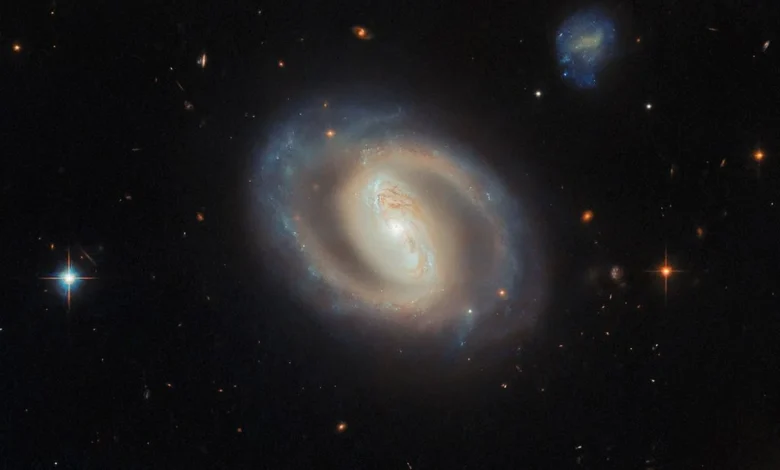
The Hubble Space Telescope has unfurled a breathtaking vista of the cosmos, capturing a stunning new image of the barred spiral galaxy IC 486. This celestial marvel, swirling with luminous tendrils of stars and cosmic dust, offers astronomers a unique window into the dynamic processes that shape galaxies across the universe. Located approximately 380 million light-years from Earth, IC 486 resides in the celestial vicinity of the constellation Gemini, a region rich with astronomical wonders. The galaxy’s distinctive barred spiral structure, characterized by a central bar of stars from which its spiral arms emanate, is a common but fascinating morphological feature observed in roughly two-thirds of all spiral galaxies cataloged to date. This particular image, a testament to Hubble’s unparalleled observational capabilities, not only showcases the sheer aesthetic grandeur of IC 486 but also provides crucial data for understanding galactic evolution, the nature of active galactic nuclei, and the distribution of matter in the universe.
Unveiling IC 486: A Celestial Masterpiece
The image from the Hubble Space Telescope presents IC 486 in exquisite detail. The galaxy’s spiral arms are a tapestry of starlight, punctuated by darker lanes of interstellar dust that trace the intricate pathways of galactic rotation. At the heart of IC 486 lies a brilliant white core, a beacon that signifies the presence of an active galactic nucleus (AGN). This energetic phenomenon is powered by a supermassive black hole at the galaxy’s center, an entity that actively accretes surrounding matter, releasing vast amounts of radiation across the electromagnetic spectrum. The precise nature of these AGNs, including their impact on star formation and the overall evolution of their host galaxies, remains a significant area of research in astrophysics.
The classification of IC 486 as a barred spiral galaxy places it within a significant subset of galactic structures. While spiral galaxies are defined by their flattened, rotating disks with prominent spiral arms, the presence of a bar-like structure of stars extending from the central bulge fundamentally influences the galaxy’s dynamics. These bars are thought to channel gas and dust towards the galactic center, potentially fueling starburst activity and the growth of the central supermassive black hole. Understanding the formation and evolution of these bars is key to comprehending the diverse morphologies observed in spiral galaxies.
Hubble’s Enduring Legacy in Galactic Exploration
The Hubble Space Telescope, a joint project of NASA and the European Space Agency (ESA), has been a cornerstone of astronomical observation since its launch in 1990. Its position above Earth’s distorting atmosphere allows it to capture images with unprecedented clarity and detail, revolutionizing our understanding of the universe. The observations of IC 486 are part of a continuous effort by astronomers to survey and analyze galaxies across cosmic time and distance. Each new image from Hubble not only enriches our visual appreciation of the cosmos but also contributes vital data points to complex astrophysical models.
The scientific value of images like the one of IC 486 extends far beyond their visual appeal. Astronomers analyze the spectral signatures of light emitted by the galaxy to determine its chemical composition, the ages of its stellar populations, and the velocities of its constituent parts. This information is crucial for testing theories of galaxy formation and evolution, understanding the interplay between black holes and their host galaxies, and mapping the large-scale structure of the universe. The detailed imaging of IC 486 will likely contribute to ongoing research into the characteristics of barred spiral galaxies and the processes that drive their activity.
The Active Galactic Nucleus: A Cosmic Powerhouse
The luminous core of IC 486 is a focal point of scientific interest. Active Galactic Nuclei (AGNs) are among the most luminous and energetic phenomena in the universe, powered by the gravitational pull of supermassive black holes. As gas and dust spiral into these black holes, they form an accretion disk that heats up to incredibly high temperatures, emitting intense radiation. In some AGNs, powerful jets of plasma are also ejected at near-light speeds.
The study of AGNs has revealed a complex relationship between the black hole’s mass, the rate at which it accretes matter, and the properties of the host galaxy. It is now widely believed that AGNs play a significant role in regulating star formation within galaxies. The energy released by the AGN can heat or expel gas, preventing it from cooling and collapsing to form new stars. This feedback mechanism is thought to be crucial in shaping the evolution of galaxies, preventing them from becoming overly massive. The bright central glow of IC 486 suggests a particularly active black hole, making it a prime candidate for further investigation into these feedback processes.
Barred Spiral Galaxies: A Significant Galactic Population
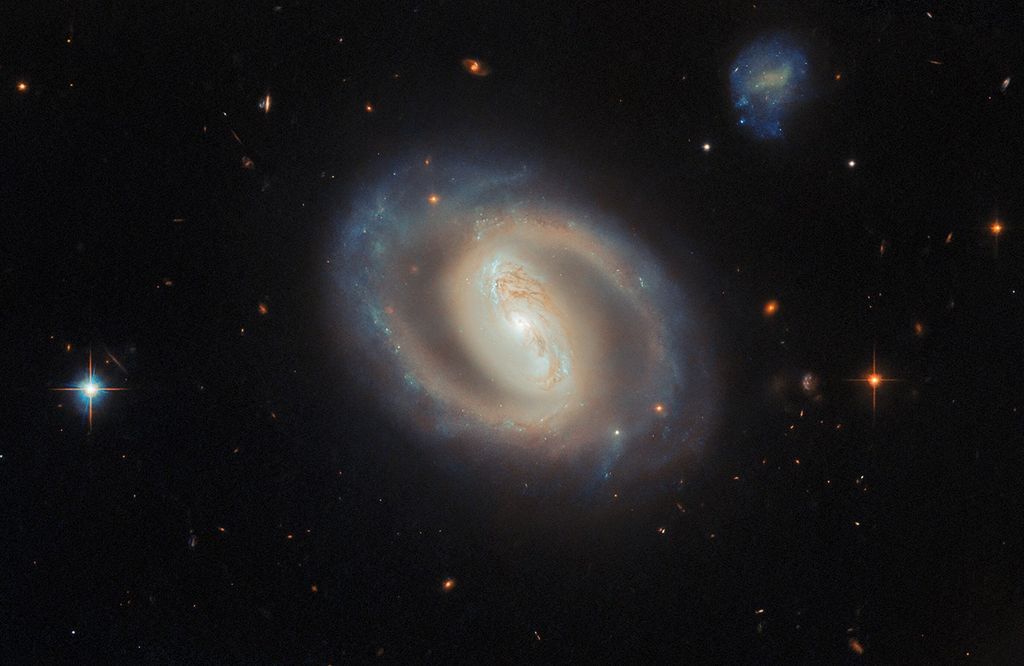
The prevalence of barred spiral galaxies underscores their importance in the cosmic landscape. The presence of a bar is not merely an aesthetic feature; it has profound implications for the internal dynamics of a galaxy. The gravitational influence of the bar can drive gas towards the galactic center, potentially triggering bursts of star formation and feeding the central black hole. This process can also lead to the formation of new structures within the galaxy, such as rings or spiral arms.
The study of the bar in IC 486 could provide valuable insights into how these structures form and evolve. Current theories suggest that bars can arise from gravitational instabilities within the stellar disk of a galaxy. Over time, these instabilities can amplify, leading to the formation of a coherent bar structure. The longevity and evolution of these bars are influenced by a variety of factors, including interactions with other galaxies and the presence of a central bulge. By analyzing the stellar populations and kinematics within the bar of IC 486, astronomers can refine these models and gain a deeper understanding of galactic structure formation.
Data and Context: Placing IC 486 in Perspective
IC 486 is a member of the Virgo Supercluster, a vast collection of galaxies that includes our own Local Group. While its distance of 380 million light-years places it within a relatively nearby cosmic neighborhood, it is still far enough to represent a significant epoch in the universe’s history. The light we observe from IC 486 today began its journey when Earth was experiencing the late stages of the Mesozoic Era, a testament to the immense timescales involved in cosmic evolution.
The discovery and characterization of galaxies like IC 486 are part of ongoing efforts to map the universe and understand its structure. Surveys such as the Sloan Digital Sky Survey (SDSS) and the Dark Energy Survey (DES) have cataloged millions of galaxies, providing a statistical foundation for understanding galactic populations and their distribution. Hubble’s deep-field observations, like this one of IC 486, complement these large-scale surveys by providing high-resolution images of individual galaxies, allowing for detailed studies of their internal properties.
Implications for Galactic Evolution and Cosmology
The detailed imaging of IC 486 has several key implications for our understanding of galactic evolution and cosmology. Firstly, it provides further evidence for the prevalence and significance of barred spiral galaxies, reinforcing the idea that bars play a crucial role in shaping the structure and evolution of spiral galaxies. Secondly, the detailed study of its active galactic nucleus will contribute to our understanding of the co-evolution of supermassive black holes and their host galaxies, a fundamental aspect of galaxy formation.
Furthermore, the precise distance measurement to IC 486, obtained through various astronomical techniques, helps refine our understanding of the cosmic distance ladder. Accurate distance measurements are essential for determining the size, age, and expansion rate of the universe. Each new, well-characterized galaxy contributes to the growing body of data used by cosmologists to test and refine their models of the universe.
Future Research and Exploration
The captured image of IC 486 is not an endpoint but a beginning for further scientific inquiry. Astronomers will undoubtedly use this data to conduct more in-depth analyses. Future observations, potentially with the James Webb Space Telescope, could probe the galaxy in infrared wavelengths, allowing for the study of dust properties and star formation in regions obscured by dust in visible light. Investigations into the galaxy’s stellar kinematics, the motion of its stars, will provide crucial information about the gravitational potential and the presence of dark matter.
The ongoing mission of telescopes like Hubble and Webb underscores humanity’s insatiable curiosity about the universe. Each new discovery, from the intricate dance of stars within a distant galaxy to the fundamental laws governing cosmic expansion, pushes the boundaries of our knowledge and inspires future generations of scientists and explorers. The image of IC 486, a luminous beacon in the cosmic darkness, serves as a powerful reminder of the vastness and wonder of the universe that we are only just beginning to comprehend.