Defense Secretary Pete Hegseth’s Controversial Use of Religious Rhetoric to Justify Iran War Draws Widespread Condemnation

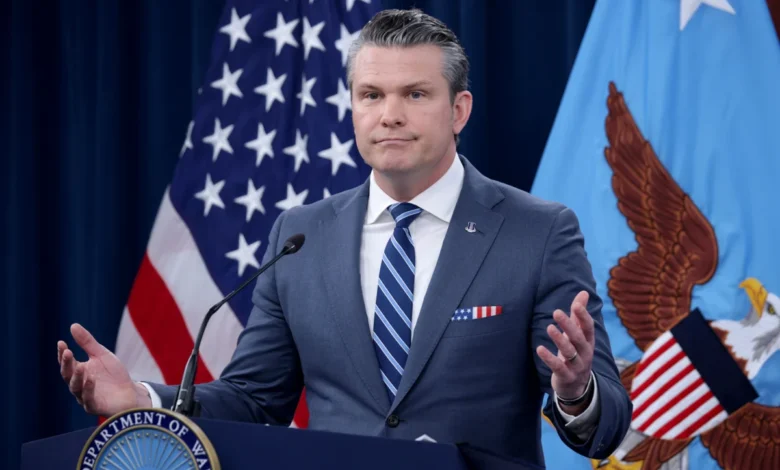
The administration of Donald Trump has continued its controversial practice of invoking religious scripture, often inaccurately, to defend its policies, particularly the ongoing conflict with Iran. This week, Defense Secretary Pete Hegseth became the latest high-profile official to draw criticism, delivering a lengthy address that conflated cinematic dialogue with sacred texts and later berating members of the press with a problematic biblical analogy. These actions have ignited a fresh wave of debate regarding the separation of church and state, the weaponization of faith in political discourse, and the integrity of public statements by senior government officials.
The Pentagon Pulpit: Fictional Scripture and Military Justification
On Wednesday, Defense Secretary Hegseth hosted what he termed a "worship service and sermon" at the Pentagon, an event that quickly garnered national attention for its unusual content. During his speech, Hegseth recited a violent monologue, presenting it as a prayer used by a Combat Search and Rescue (CSAR) team. He claimed the team, which had recently recovered a downed pilot from Iran, referred to this passage as "CSAR 25:17," suggesting it was meant to echo the biblical verse Ezekiel 25:17.
Hegseth’s recitation proceeded: “The path of the downed aviator is beset on all sides by the iniquities of the selfish and the tyranny of evil men. Blessed is he who, in the name of camaraderie and duty, shepherds the lost through the valley of darkness, for he is truly his brother’s keeper and the finder of lost children. I will strike down upon thee with great vengeance and furious anger those who attempt to capture and destroy my brother. And you will know my call sign is Sandy 1 when I lay my vengeance upon thee, and amen.”
This monologue, however, is not a direct quote from Ezekiel 25:17. It is, almost word-for-word, the iconic speech delivered by Samuel L. Jackson’s character, Jules Winnfield, in Quentin Tarantino’s 1999 Oscar-winning film Pulp Fiction. In the film, Winnfield recites this passage—a loose adaptation of Ezekiel 25:17, significantly embellished with original writing—three times before executing victims. The character’s journey through the film involves grappling with the violence he perpetrates and attempting to find redemption from his own nihilistic existence, giving the monologue a complex and ultimately ironic context within the narrative.
The actual Ezekiel 25:17 reads: "I will carry out great vengeance on them and punish them in my wrath. Then they will know that I am the LORD, when I take vengeance on them." While the film’s dialogue retains the theme of vengeance, it dramatically expands and recontextualizes the original biblical verse, inserting themes of brotherhood and duty that are entirely absent from the scripture. The film’s monologue concludes with a line about knowing "my name is the Lord when I lay my vengeance upon thee," which Jules Winnfield later reinterprets as he seeks to move away from violence.
Religious scholars and commentators were quick to point out the significant misattribution. Dr. Eleanor Vance, a professor of biblical studies at a prominent seminary, stated, "To present a fictional, violent speech from a cult classic film as a prayer, and imply it’s rooted in scripture and used by our military, demonstrates a profound misunderstanding or deliberate distortion of religious texts. It trivializes the sacred and misrepresents the very serious nature of military service and the moral considerations involved in warfare."
Critics argue that whether Hegseth was genuinely unaware of the monologue’s origin or deliberately avoided acknowledging it, the act serves to blur the lines between reality and fiction, and between religious piety and political propaganda. Such misrepresentations, they contend, can undermine public trust in official statements and disrespect both religious traditions and the solemnity of military operations.
Escalating Tensions with Iran: The Broader Context
Hegseth’s remarks come against a backdrop of heightened and prolonged tensions between the United States and Iran under the Trump administration. The conflict escalated dramatically following the U.S. withdrawal from the Joint Comprehensive Plan of Action (JCPOA), commonly known as the Iran nuclear deal, in May 2018. This withdrawal was followed by the re-imposition and tightening of severe economic sanctions on Iran, which the administration asserted were aimed at forcing Tehran to renegotiate a more comprehensive agreement.
Key events in the escalating confrontation include:
- May 2019: Mysterious attacks on oil tankers in the Gulf of Oman, which the U.S. attributed to Iran.
- June 2019: Iran shot down a U.S. surveillance drone over the Strait of Hormuz, prompting President Trump to approve and then abruptly call off retaliatory strikes.
- September 2019: Drone and missile attacks on Saudi Arabian oil facilities, for which the U.S. and Saudi Arabia blamed Iran.
- January 2020: The U.S. assassination of Iranian General Qasem Soleimani in Baghdad, leading to Iranian retaliatory missile strikes on U.S. bases in Iraq.
- Recent Weeks: Reports of increased military posturing and rhetoric from both sides, including the "downed pilot" incident that Hegseth referenced, which involved a U.S. airman safely recovered after an incident near Iranian airspace. Specific details of this incident remain under wraps, but it has been cited by the administration as justification for continued military vigilance and pressure on Iran.
The administration has consistently framed its actions against Iran as necessary for national security and regional stability, often employing strong, even apocalyptic, language. Hegseth’s use of religious imagery and rhetoric is thus seen by many as an extension of this broader strategy to garner public support for a confrontational stance.
Biblical Analogies and Political Attacks: The Press as Pharisees
Beyond the Pulp Fiction gaffe, Hegseth further inflamed controversy during a press conference on Thursday. In a scathing attack on journalists, he compared members of the Pentagon press corps to the Pharisees, a Jewish social movement during the Second Temple period that significantly contributed to the development of Rabbinic Judaism.
Hegseth complained: “I just can’t help but notice the endless stream of garbage, the relentlessly negative coverage you cannot resist peddling, despite the historic and important success of this effort and the success of our troops.” He then recounted a recent Sunday sermon at his church where the minister discussed the Pharisees. “You see, the Pharisees, the so-called and self-appointed elites of their time… even though they witnessed a literal miracle, it didn’t matter. They were only there to explain away the goodness in pursuit of their agenda,” Hegseth recounted. He concluded, “I sat there in church and I thought, ‘Our press are just like these Pharisees, not all of you, but the legacy, Trump-hating press.’”
He continued his condemnation: “Your politically motivated animus for President Trump nearly completely blinds you from the brilliance of our American warriors. The Pharisees scrutinized every good act in order to find a violation, only looking for the negative. The hardened hearts of our press are calibrated only to impugn. I would ask you to open your eyes to the goodness, the historic success of our troops, the courage of this president, and this historic moment for a deal that could end the Iranian nuclear threat, the incredible battlefield victory laid before your eyes.”
In the New Testament, the Pharisees are frequently depicted in adversarial roles with Jesus of Nazareth, often challenging his interpretations of religious law and his claims of divine authority. A notable instance involves their accusation of blasphemy after Jesus forgives the sins of a paralyzed man. While some modern biblical scholarship offers a more nuanced view of the Pharisees, recognizing their significant contributions to Jewish religious life, their New Testament portrayal has historically been used to characterize those who are legalistic, hypocritical, or resistant to new spiritual truths.
By equating critical journalists with the Pharisees, Hegseth implicitly positioned President Trump and his administration as analogous to Jesus, performing "miracles" that the "hardened hearts" of the press refused to acknowledge. This analogy not only denigrates the press but also elevates the administration to a sacrosanct status, making criticism akin to blasphemy.
The comparison sparked immediate backlash from press freedom advocates and religious leaders alike. Sarah Jenkins, president of the National Association of Journalists, issued a statement condemning the remarks: "Attacking the press by invoking religious analogies and questioning their faith is a dangerous and undemocratic tactic. Our role is to hold power accountable, not to offer uncritical praise. Such rhetoric undermines the very foundations of a free press and seeks to silence dissenting voices."
Presidential Parallels: Trump and Christ
Hegseth’s comparison of the administration to Jesus was particularly sensitive given President Trump’s own recent controversial social media post where he directly compared himself to Jesus Christ. In that instance, Trump shared an image on Truth Social depicting himself as Jesus, an act that drew widespread condemnation from across the political and religious spectrum.
Throughout his presidency, Trump has frequently invoked religious themes and courted evangelical Christian support, often framing his political battles in spiritual terms. However, direct comparisons of himself or his administration to Jesus have consistently been met with strong disapproval from many Christian leaders, who view such analogies as sacrilegious and an affront to the divine nature of Christ. Polls consistently show that while a significant portion of evangelical voters support Trump, there’s also a segment that expresses discomfort with such rhetoric, particularly when it appears to appropriate sacred figures for political gain.
Clash with the Vatican: Pope Leo XIV’s Condemnation
The religious rhetoric emanating from the administration also intensified its ongoing feud with Pope Leo XIV. The Pope has been an outspoken critic of the war in Iran and has repeatedly sparred with President Trump over threats to commit crimes against humanity if Iran does not surrender. Catholic social teaching emphasizes peace, diplomacy, and the protection of human life, principles that stand in stark contrast to the administration’s more confrontational stance.
Previously, Pope Leo XIV had publicly condemned what he called "the logic of war" and called for diplomatic solutions to international conflicts, implicitly criticizing the U.S. approach to Iran. He had also directly addressed Trump’s rhetoric, specifically his threats against Iranian cultural sites and civilian populations, which the Pope deemed "morally reprehensible" and in violation of international law.
Following Hegseth’s press conference, Pope Leo XIV wasted no time in issuing a pointed rebuke via social media. He wrote: “Woe to those who manipulate religion and the very name of God for their own military, economic, and political gain, dragging that which is sacred into darkness and filth.” While not directly naming Hegseth or the Trump administration, the timing and context of the Pope’s statement left little doubt as to its target.
This strong condemnation from the head of the Catholic Church highlights the deep ethical and theological divides that have emerged between the administration’s policies and major religious institutions. It also puts pressure on Catholic political figures and voters in the U.S., who are often urged to consider papal teachings in their political decisions. The ongoing public disagreements between the White House and the Vatican underscore the global implications of the administration’s religious and foreign policy rhetoric.
Analysis of Implications: Religion, State, and Public Trust
The actions and statements by Defense Secretary Hegseth, coupled with the President’s own history of religious rhetoric, carry significant implications for American society and its standing on the world stage.
- Erosion of Separation of Church and State: The use of the Pentagon as a venue for a "sermon," the explicit invocation of religious texts (even misattributed ones) to justify military actions, and the comparison of political critics to biblical antagonists challenge the traditional American principle of separation of church and state. Critics argue that such actions risk alienating non-religious citizens and members of other faiths, creating an environment where religious adherence becomes a de facto requirement for patriotism.
- Impact on Civil-Military Relations: The military is designed to be an apolitical institution, serving all Americans regardless of their religious or political beliefs. When senior defense officials engage in overtly religious and politically charged rhetoric, it can politicize the military, potentially undermining morale, cohesion, and public trust in the armed forces.
- Disinformation and Public Discourse: The misattribution of a violent film monologue as scripture, particularly by a high-ranking official, contributes to a broader landscape of disinformation. In an era where factual accuracy is increasingly scrutinized, such errors or deliberate misrepresentations can further erode public trust in government communications and the media.
- International Perception: The use of religious justifications for war, especially against a predominantly Muslim nation like Iran, can be perceived internationally as a "clash of civilizations" or a religious crusade. This perception can complicate diplomatic efforts, fuel anti-American sentiment, and potentially destabilize already volatile regions.
- Weaponization of Faith: For many, the incident represents a cynical weaponization of faith for political and military ends. By selectively quoting or misquoting scripture and using religious analogies to attack critics, the administration risks cheapening the spiritual significance of these texts and alienating religious communities who feel their faith is being exploited.
In conclusion, Defense Secretary Pete Hegseth’s recent actions, from quoting Pulp Fiction as scripture to likening critical journalists to Pharisees, represent a troubling continuation of the administration’s controversial use of religious rhetoric. These incidents have not only drawn sharp rebukes from religious leaders like Pope Leo XIV but have also intensified concerns about the integrity of public discourse, the boundaries between faith and state, and the broader implications for American democracy and its global standing. The ongoing debate underscores the profound challenges when political agendas become intertwined with sacred texts, often at the expense of accuracy, respect, and informed public debate.