A Father-Daughter Pilgrimage to Islay: Exploring Scotland’s Legendary Whisky Coast on a Four-Day Small-Group Tour

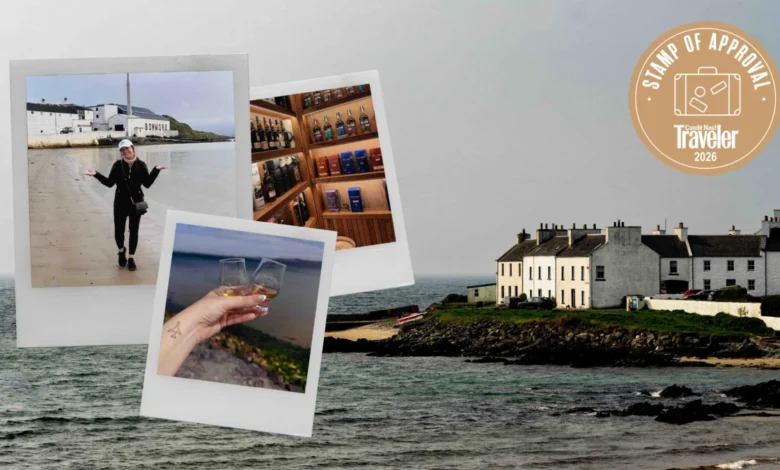
Celebrating milestone birthdays often prompts elaborate travel itineraries, but few journeys match the thematic dedication of a specialized pilgrimage. When an avid connoisseur with a discerning palate and a personal collection exceeding two hundred bottles approached his sixtieth birthday, his lifelong ambition pointed squarely toward the rugged coastline of Islay. Famed worldwide for its intensely smoky, peated single malt whiskies, this southernmost island of Scotland’s Inner Hebrides represents the spiritual heartland of traditional distilling. To navigate the complex logistics of remote coastal travel without resorting to solitary driving, the birthday traveler and his daughter enlisted Rabbie’s four-day Islay and Whisky Coast tour departing from Edinburgh.
The resulting excursion illustrates the growing viability of structured small-group travel for specialized hobbyists. Combining pre-arranged ferry crossings, localized transportation aboard a 16-seat Mercedes mini-coach, and shared cottage accommodations in the island village of Bowmore, the itinerary offers a streamlined approach to a destination otherwise characterized by fragmented transport schedules and remote rural geography.

Planning, Logistics, and Financial Framework
Organizing independent travel to Islay requires coordinating mainland driving routes, timed ferry reservations across the Sound of Jura, and advance bookings for distillery tours that frequently operate at full capacity months in advance. For travelers unfamiliar with single-track Scottish coastal roads or ferry cancellations dictated by North Atlantic weather patterns, packaged tours present a reliable alternative.
Rabbie’s four-day itinerary is structured to remove administrative friction. Base pricing begins at approximately $609 per adult, covering transportation, guide services, and driving logistics. For travelers seeking an all-inclusive experience—incorporating three nights of shared cottage lodging in Bowmore and curated distillery admissions—the total cost scales to roughly $1,464 per person. Independent travel analysts note that while self-guided driving tours offer ultimate flexibility, packaged itineraries provide essential cost predictability and guaranteed seating on heavily demanded ferry routes managed by Caledonian MacBrayne.
The tour operator, founded in Edinburgh in 1993, has expanded operations across the United Kingdom, Ireland, and continental Europe, specializing in small-group excursions capped at 16 passengers. This passenger ceiling ensures manageable group dynamics while maintaining the intimacy required for rural exploration.

Chronological Overview of the Four-Day Itinerary
Day One: From the Lowlands to the Gateway of the Isles
The expedition commences in Edinburgh, where participants gather at the central bus station to meet their driver-guide. Setting off northward, the route typically incorporates historical waypoints designed to contextualize Scotland’s industrial and cultural heritage. The initial stop at Falkirk features the towering Kelpies sculptures—30-meter-high horse-head structures designed by artist Andy Scott that honor the heavy horses central to Scotland’s canal and industrial history.
Traversing the Lowlands, the mini-coach enters the dramatic topography of Loch Lomond and The Trossachs National Park. The journey continues toward Oban, widely designated as the "Gateway to the Isles." Here, travelers are afforded time to explore local seafood vendors and visit the Oban Distillery, established in 1794 and tucked into the cliffs overlooking the town’s harbor.
Following a preliminary tasting, the group reboards for the drive south to Kennacraig, the mainland port for Islay ferries. The subsequent two-hour sailing across the Sound of Jura offers panoramic views of the Paps of Jura mountains before docking at port on Islay, signaling arrival in a territory spanning approximately 240 square miles with a permanent population hovering around 3,000 residents.

Day Two: Distilling Traditions in Bowmore and the Northern Coast
Establishing base camp in Bowmore provides immediate proximity to the island’s administrative and historical center. The morning of the first full day on Islay initiates with a visit to the Bowmore Distillery, the island’s oldest active production facility, tracing its lineage back over two centuries to 1779. Participants experience subterranean cellar tastings directly from the cask, followed by comparative flights overlooking the sea.
Given Islay’s island constraints and seasonal operational shifts, itineraries frequently require dynamic adjustments. Guided groups routinely adapt to distillery closures by substituting scheduled visits with alternatives such as Ardnahoe Distillery—one of the island’s newest production sites, opened in 2019—and the remote northern outpost of Bunnahabhain, renowned for its unpeated expressions and sweeping views across the sound toward the Paps of Jura.
Day Three: The Southern Coast and Historic Monuments
The third day centers on the legendary Kildalton distillation corridor along Islay’s southeastern shore, home to three heavyweights of peated whisky: Ardbeg, Lagavulin, and Laphroaig.

The morning begins at Ardbeg Distillery, where visitors navigate the historic facility and engage in comparative tastings. Between distillery appointments, the group detours inland to examine the Kildalton Cross, an exceptional monolithic free-standing Celtic cross carved from epidiorite in the eighth century. This site serves as a vital historical anchor, reminding visitors of Islay’s deep ecclesiastical roots predating the modern distilling economy by a millennium.
After lunch in the coastal village of Port Ellen, the afternoon proceeds with visits to Lagavulin and Laphroaig. At Laphroaig, visitors receive an immersive walk-through of the traditional floor-malting floors, peat kilns, and maturation warehouses, solidifying an understanding of the chemical interactions between Islay peat smoke, maritime air, and barley.
Day Four: Return via Inveraray and the Arrochar Alps
The final morning requires an early departure from Bowmore to catch the return ferry across the Sound of Jura to Kennacraig. The return leg to Edinburgh transitions through the castle town of Inveraray on the shores of Loch Fyne, offering opportunities for historic exploration and regional dining.

The journey concludes with a traverse of the Arrochar Alps, pausing at the historic "Rest and Be Thankful" mountain pass viewpoint—named by British soldiers building military roads through the Highlands in 1753—before a final stop in the conservation village of Luss on the western banks of Loch Lomond.
Economic and Cultural Implications of Whisky Tourism
The expansion of structured whisky tourism reflects broader shifts in Scotland’s rural economy. According to data from the Scotch Whisky Association (SWA), spirits tourism generates hundreds of millions of pounds annually, with historic distilleries serving as primary economic drivers in remote regions like the Inner Hebrides.
Industry analysts observe that small-group tour operators play a critical role in distributing economic benefits beyond major urban centers like Edinburgh and Glasgow. By funneling travelers into remote island communities, these companies support local hospitality providers, independent retailers, and heritage preservation projects. However, this growth places infrastructural demands on isolated regions, requiring careful management of water resources, waste disposal, and seasonal housing availability.

For participants, the value proposition extends beyond commercial acquisition. Travel psychologists note that shared experiential learning—such as multi-day thematic tours focused on a specific craft or hobby—accelerates social bonding among strangers while deepening intergenerational connections within families.
Conclusion
Navigating the nuanced landscape of Islay’s distilleries requires a balance of rigorous planning and flexible execution. For travelers seeking an immersive introduction to Scotland’s peated single malts without the administrative burdens of independent navigation, packaged small-group models offer a balanced solution. As reflected by seasoned collectors experiencing the region firsthand, structured itineraries successfully bridge the gap between remote exploration and accessible luxury, transforming a milestone birthday into an enduring family legacy.