Forged in County Mayo: How Ashford Castle’s Artisanal Itineraries Are Preserving Ireland’s Living Craft Traditions

The resurgence of interest in ancestral trades—particularly blacksmithing, metalworking, and traditional carpentry—has transformed how modern travelers seek out cultural immersion. Across Europe, heritage tourism is shifting away from passive sightseeing toward participatory workshops, where visitors engage directly with generational artisans. This trend is especially pronounced in Ireland, where rural communities are finding new economic viability by opening their historic workshops to international guests. Against this backdrop of cultural preservation, historic estate hotels are reimagining their guest programming to bridge the gap between five-star luxury and foundational local history.
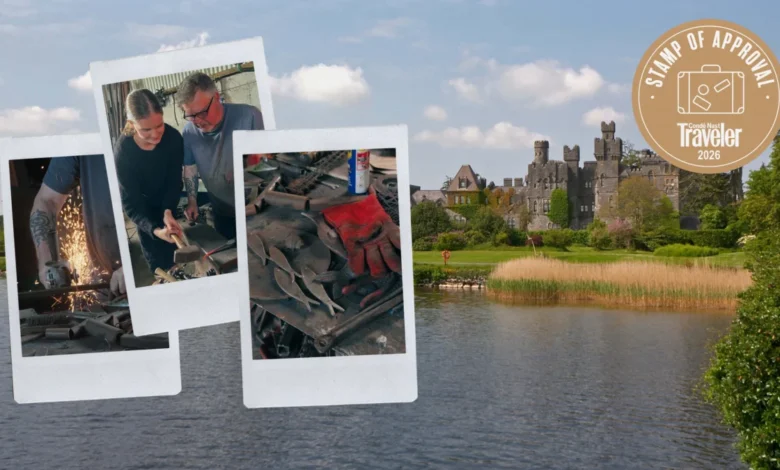
At Ashford Castle in County Mayo, this philosophy has materialized in the Meet the Makers initiative, a specialized cultural program designed to connect visitors with authentic Irish craftspeople. Among the most popular offerings within this portfolio is the Fire & Wood itinerary, a curated full-day experience that pairs historic estate education with off-site visits to working rural workshops. For travelers seeking a departure from standard hospitality offerings, the program provides a rare, tactile look at the trades that built rural Ireland, transforming luxury travel into an exercise in historical preservation and artisanal apprenticeship.

Historical Foundations and the Guinness Legacy
To fully understand the context of Ashford Castle’s craft-focused programming, one must examine the estate’s centuries-old relationship with manual labor and rural industry. Situated on the shores of Lough Corrib, the 800-year-old castle transitioned through various aristocratic hands before becoming globally renowned as the ancestral estate of the Guinness family. During their tenure, the Guinnesses relied heavily on a specialized ecosystem of estate workers, craftsmen, and agricultural laborers to maintain the vast property.
Chief among these were the Hickey family, a lineage of resident blacksmiths whose responsibilities extended far beyond routine horseshoeing. Historical records maintained by the estate detail a wide scope of metalwork produced on-site, including ornamental iron fencing, secure estate gates, structural building components, agricultural implements, and tactical weaponry. In rural Ireland, the village forge historically served as a vital social nucleus. Because it was one of the few locations with a perpetual fire, it functioned as a communal gathering space where news, folklore, and local politics were exchanged. By introducing guests to modern working forges, Ashford Castle aims to resurrect this communal heritage, positioning the blacksmith not merely as an industrial laborer, but as a central pillar of Irish cultural history.
The Immersive Itinerary: From Estate History to Rural Galway
The Fire & Wood itinerary begins with a comprehensive historical orientation led by estate historian Fintan Gorman, who details the socio-economic importance of local trade during the Anglo-Irish estate era. Rather than treating the history as a static museum exhibit, the program transitions quickly into active participation. Following the morning briefing, guests are equipped with professional safety gear—including heavy-duty rubber wellingtons and protective outerwear—before embarking on a guided transit into the neighboring countryside.
.jpg)
The journey leads approximately forty minutes southeast into the heart of County Galway, arriving at the rural workshop of independent blacksmith Stephen Quinn in Kilreekil. Unlike sanitized demonstration forges found in open-air museums, Quinn’s workshop is an active, industrial workspace framed by complex wrought-iron architectural elements, balconies, and custom gates in various stages of completion.
The workshop experience prioritizes experiential learning over passive observation. Under Quinn’s direct supervision, participants engage in the physical mechanics of metalworking, managing the coal-fed forge, observing optimal metal temperatures through color-metric shifts, and utilizing traditional hand hammers and power machinery. Guests are given the choice to forge functional items, such as leaf-shaped hooks or stylized animal motifs, which are subsequently treated with traditional blackening agents like linseed oil and beeswax. The two-hour session combines rigorous physical labor with historical instruction, offering a precise replication of traditional workshop conditions.
Culinary Integration and Regional Artisan Partnerships
Beyond metalworking, the broader Meet the Makers framework extends into regional agricultural traditions, incorporating private visits to generational food producers in the West of Ireland. Following the morning workshop, the itinerary typically transitions to Kylemore Farmhouse Cheese, operated by fourth-generation dairy farmer and artisan cheese producer Teresa Roche.

This component of the program highlights the continuity of rural Irish enterprise, offering visitors direct access to the milk production, curd processing, and subterranean cheese-curing facilities. By allowing guests to sample products directly from the production line and partake in private farmhouse lunches featuring regionally sourced ingredients and family recipes, the estate reinforces a holistic narrative of local sustainability. This cross-sector approach—linking heavy industrial craft with agrarian food production—provides a multi-dimensional analysis of Galway and Mayo’s contemporary rural economy.
Economic Implications and the Evolution of Luxury Tourism
The introduction of immersive, maker-led itineraries reflects a broader paradigm shift in the global luxury travel sector. According to tourism analysts, high-net-worth consumers increasingly prioritize experiential authenticity over material opulence. Programs like Ashford Castle’s Meet the Makers represent a strategic response to this demand, leveraging cultural heritage as a primary value driver.
Priced starting at $3,400 for a two-person custom itinerary, these full-day excursions require significant logistical coordination between the hotel, regional independent businesses, and private guides. Industry observers note that such initiatives generate vital secondary revenue streams for rural artisans, helping to subsidize traditional trades that might otherwise struggle against mass-produced industrial imports. By embedding local craftspeople into the commercial ecosystem of a five-star hotel, properties like Ashford Castle help ensure the intergenerational transfer of specialized knowledge, safeguarding intangible cultural heritage for future decades.

Future Outlook and Booking Architecture
As traveler demand for bespoke, educational tourism continues to rise, properties offering deep-dive artisanal experiences are expected to set a new benchmark for luxury hospitality. The success of Ashford Castle’s Fire & Wood itinerary underscores the viability of pairing elite accommodations with rugged, blue-collar heritage education.
Reservations for the Exceptional Irish Experiences program, including the Meet the Makers subset, are managed directly through the Ashford Castle official website via a bespoke inquiry system. Prospective guests collaborate with estate coordinators to tailor itineraries according to their specific interests, scheduling availability, and time constraints. As heritage tourism evolves, these collaborative models between luxury hotels and independent regional makers offer a sustainable framework for cultural preservation, economic support, and authentic global engagement.