After nearly a decade of planning, architectural revisions, construction hurdles, and public anticipation, the Lucas Museum of Narrative Art officially opens its doors to the general public in Los Angeles’s Exposition Park. Backed by a staggering $1 billion investment funded primarily by Star Wars creator George Lucas and his wife, prominent businesswoman Mellody Hobson, the institution introduces a new paradigm to the cultural landscape of Southern California. Spanning an expansive campus designed to function as both a civic amenity and a world-class cultural repository, the museum houses a foundational collection of more than 40,000 works of art and pop culture artifacts. Among its most striking offerings is an unprecedented exploration of vehicular art, bridging the gap between traditional automotive design, cinematic engineering, and fine art illustration.
Main Facts and Institutional Scope
The newly opened institution operates on a premise distinct from both traditional art museums and conventional automotive galleries. While mainstream fine art institutions often relegate industrial design and commercial illustration to peripheral status, and traditional car museums focus strictly on mechanical specifications or marketing ephemera, the Lucas Museum positions vehicles as essential instruments of visual storytelling.
Out of the massive foundational inventory accumulated by Lucas and Hobson over decades, approximately 1,200 works are currently on display across more than 30 galleries. These galleries investigate narrative art through diverse mediums, including painting, illustration, comic book proofs, photography, sculpture, and cinematic props. Within this multidisciplinary framework, automobiles, motorcycles, locomotives, watercraft, aircraft, and speculative spacecraft feature prominently as primary vectors for driving narrative progression.
Historical Chronology and Development Timeline
The realization of the Lucas Museum of Narrative Art represents the culmination of a protracted and often complex development process:
- 2014: George Lucas initially selects Chicago as the intended site for his museum, aiming to build along the city’s lakefront. However, prolonged legal challenges from local civic preservation groups stall the initiative.
- 2016: Following continued opposition in Illinois, Lucas officially abandons the Chicago proposal and turns his attention to the West Coast, ultimately selecting Los Angeles as the permanent home for the institution.
- 2018: Groundbreaking commences in Exposition Park, transforming a former parking lot adjacent to the Los Angeles Memorial Coliseum and the California Science Center into a futuristic, undulating architectural landmark designed by Ma Yansong of MAD Architects.
- 2021–2023: Construction timelines face widespread adjustments due to global supply chain disruptions and labor market shifts associated with the COVID-19 pandemic.
- Mid-2024: Interior installation begins, involving the meticulous placement of massive cinematic props, delicate scale miniatures, and priceless archival illustrations.
- September 2024: Exclusive member and press preview events take place, offering early insights into the museum’s layout and curatorial strategy.
- September 22: The Lucas Museum of Narrative Art officially opens its doors to the general public, welcoming visitors to its inaugural exhibitions.
Cinematic Engineering and the Star Wars Legacy
While items originating from the Star Wars franchise account for less than 10 percent of the museum’s total inventory, the dedicated cinematic galleries represent a cornerstone of the visitor experience. These spaces offer rare, close-up access to full-scale vehicles and meticulous models that defined modern cinematic history.
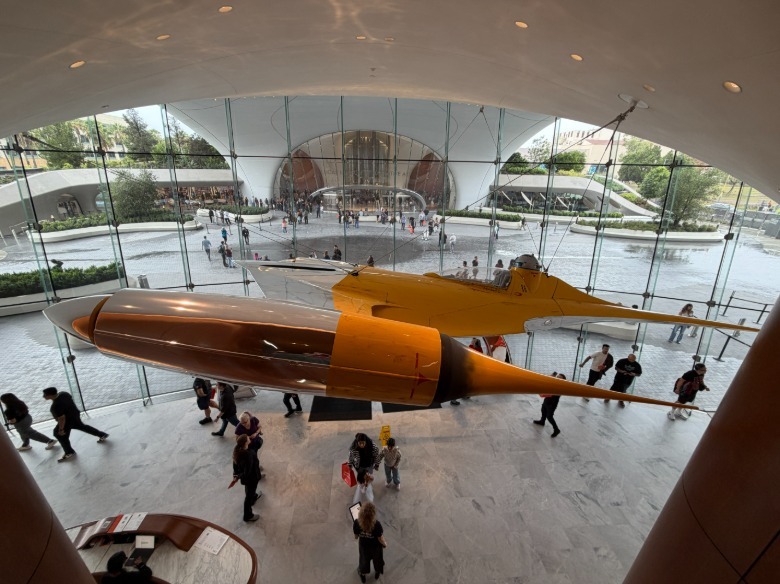
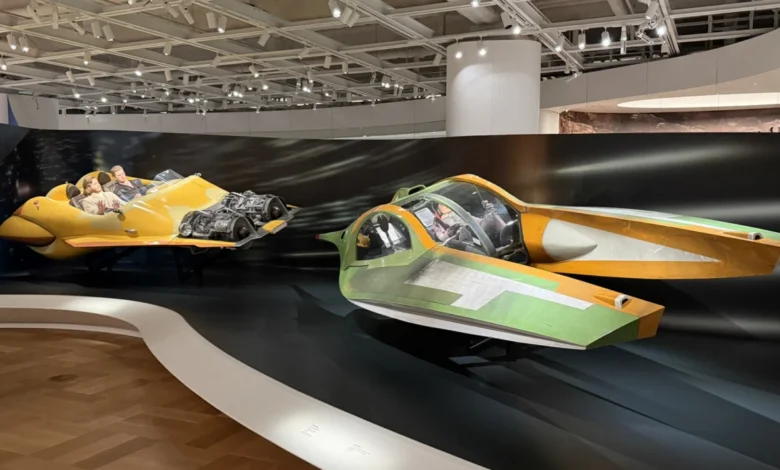
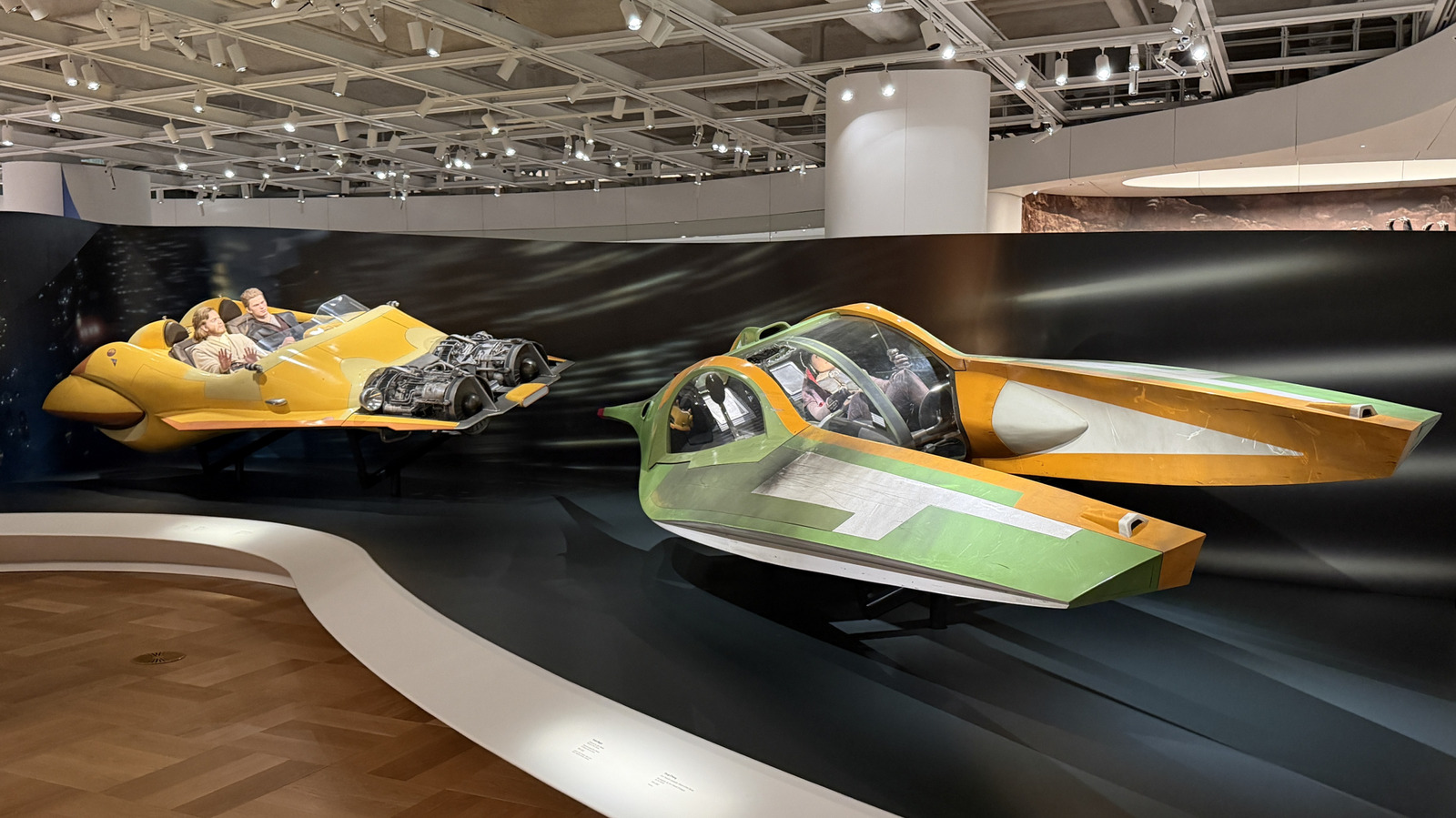
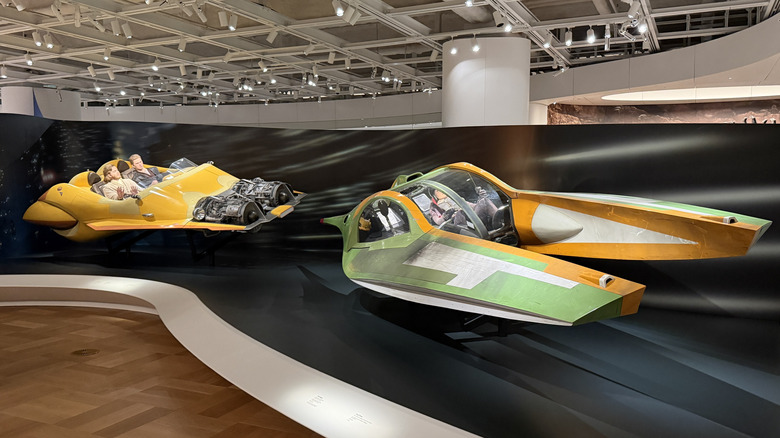
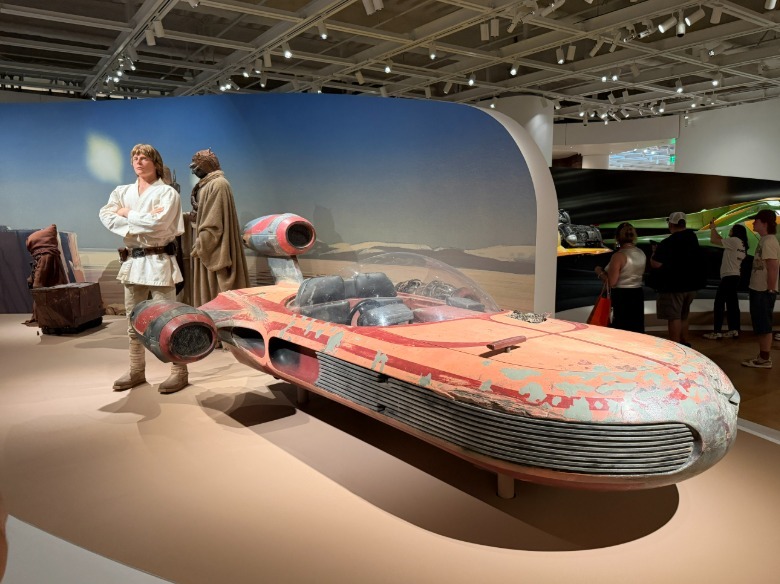
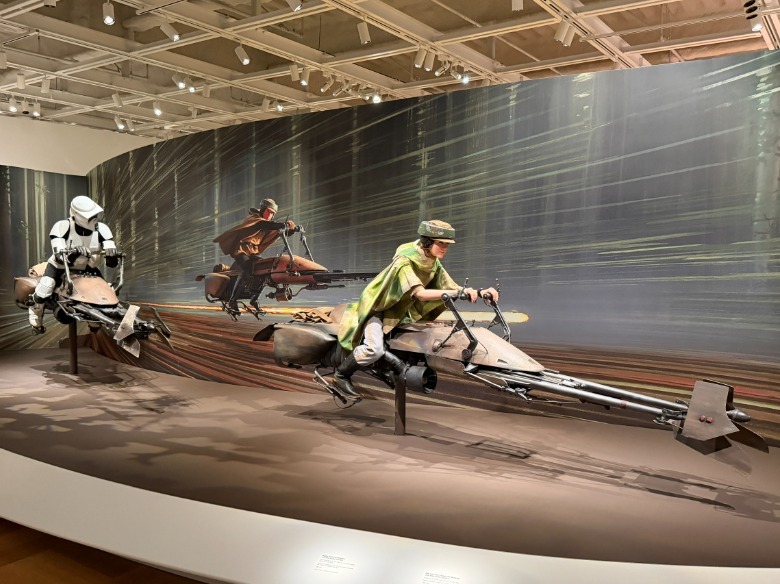
Upon entering the primary cinematic gallery, visitors encounter a full-scale replica of Anakin Skywalker’s podracer from Star Wars: Episode I – The Phantom Menace. This display is accompanied by full-scale fiberglass speeder models utilized during the arena and forest chase sequences in Episode II – Attack of the Clones and Episode VI – Return of the Jedi. Overhead, suspended within the atrium of the museum’s research library, hangs an original Naboo Starfighter, showcasing the aerodynamic design principles pioneered by concept artist Doug Chiang and his team at Industrial Light & Magic (ILM).
Beyond full-scale builds, the institution showcases an exhaustive collection of scale models that highlight the precision of practical visual effects before the dominance of computer-generated imagery. Highlights include:
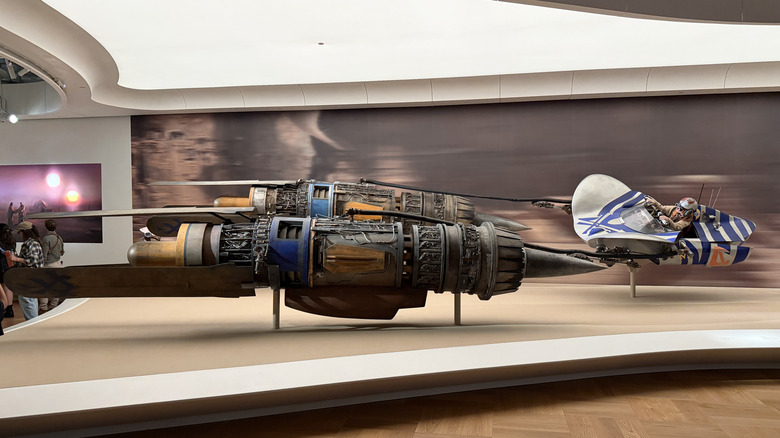
- Miniature iterations of podracers, including Sebulba’s distinct craft.
- Trade Federation AAT tanks and MTT troop carriers complete with weathering and battle patina.
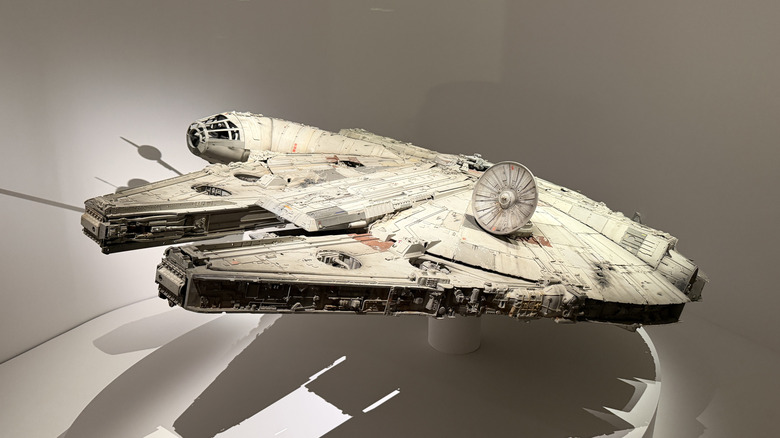
- A physical scale model of the Millennium Falcon, constructed using "kit-bashing" techniques that incorporated over 2,500 individual components sourced from approximately 150 commercial model kits, including historical military armor, aircraft, and Formula 1 race cars.
- Miniature iterations of A-wings, Y-wings, AT-ST walkers, and a diorama featuring a downed AT-AT embedded in artificial snow.
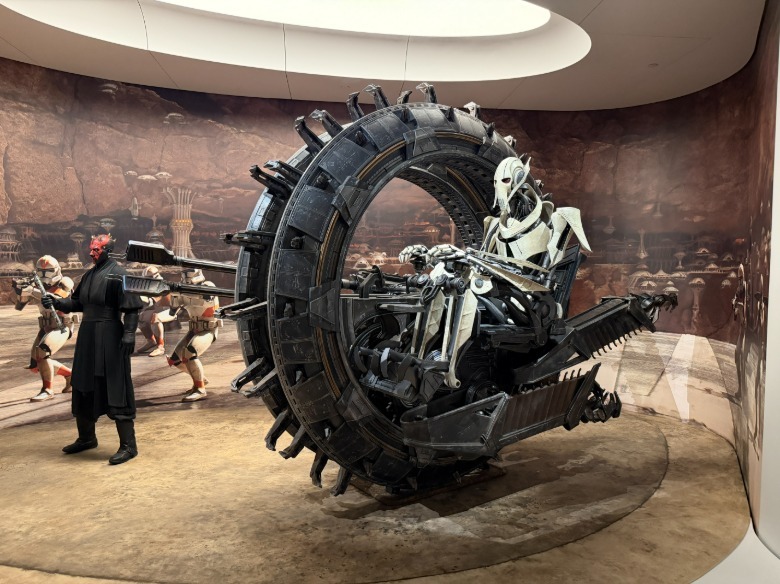
- A life-size replica of General Grievous’s single-wheel claw-bike from Episode III – Revenge of the Sith, constructed specifically for the museum’s opening despite the vehicle existing only as a digital asset in the final theatrical cut.
Beyond a Galaxy Far, Far Away: Diverse Vehicular Narrative Art
The institutional mandate of the Lucas Museum extends far beyond the science fiction genre, establishing a broad survey of transportation across multiple centuries and artistic movements.
The Graphic Stories, Manga, and Comics galleries present original ink drawings, cover layouts, and strip proofs featuring vehicles as narrative catalysts. Prominent displays include action illustrations from Ghost Rider and Kamen Rider, alongside historical racing art from titles like Grand Prix.
In the Science Fiction and pulp illustration galleries, works by masters of the genre—such as Robert McCall, whose 1970 painting Heavy Traffic anchors the collection—demonstrate how mid-century illustrators utilized futuristic transportation to project societal anxieties and aspirations. McCall’s work, alongside pieces by Vincent Di Fate and Ed Emshwiller, illustrates the intersection of aerospace engineering and speculative fiction.
Additional galleries incorporate transportation into everyday narrative contexts. The Children’s Stories section features Charles Twelvetrees’s 1910 gouache and watercolor work, Little Boy and Dog in Speeding Roadster, while the Play section houses John Philip Falter’s 1961 oil painting, Drive-In Movie in the Rain. These works utilize automotive lighting, weather conditions, and spatial composition to evoke psychological depth, proving that cars and transit serve as vital emotional anchors in domestic and leisure-oriented art.
Broader Impact, Economic Implications, and Cultural Analysis
The opening of the Lucas Museum of Narrative Art carries significant implications for the cultural economy of Los Angeles and the broader museum sector. By unifying populist art forms—such as comic books, illustration, cinematic concept art, and commercial design—with traditional fine art paradigms, the institution challenges historical hierarchies within the museum community.
Cultural analysts note that the institution’s arrival in Exposition Park bolsters an already dense cluster of educational and recreational facilities, including the Natural History Museum of Los Angeles County, the California Science Center, and the USC campus. This geographic synergy is projected to increase tourism revenue and stimulate local economic activity in South Los Angeles.
Furthermore, the museum’s operational model incorporates dynamic curation. Museum leadership has confirmed that galleries—including the high-profile cinematic spaces—will feature rotating installations, drawing continuously from the vast archival holdings of Lucas and Hobson, as well as institutional loans. This strategy ensures repeated visitation and sustained academic engagement.
Visitor Logistics and Accessibility
Located at 3900 Exposition Boulevard, the museum is designed to integrate modern civic infrastructure with cultural patronage. In an urban environment heavily defined by automobile transit, the facility features an expansive, modern subterranean parking structure equipped with prominent electronic vehicle (EV) charging stations and streamlined ingress and egress points.
General admission tickets are available through the official Lucas Museum of Narrative Art website, with timed-entry reservations recommended to manage visitor flow. As the institution welcomes its first wave of international and local patrons, it stands as a permanent monument to the power of visual storytelling, redefining how society perceives the machines that propel both real-world history and imaginary voyages.