French sports car manufacturer Alpine is entering a defining chapter in its storied history. While automotive design often draws poetic comparisons to sculpture, Alpine has taken this metaphor literally for its upcoming Paris Motor Show presentation. The brand is set to showcase a full-scale, sculptural preview of the next-generation Alpine A110, offering a tantalizing yet heavily concealed look at the sports car that will lead the marque into an electrified era by 2028.
The unveiling serves as a focal point for enthusiasts and industry analysts alike, as it represents a delicate balancing act. Alpine must successfully transition its lightweight, highly praised driver’s car into the battery-electric vehicle (BEV) mainstream without alienating the purists who fell in love with the classic styling and analogue driving dynamics of the original 1960s icon and its modern revival. Beyond the aesthetic evolution, the underlying architecture, weight challenges, potential internal combustion engine (ICE) contingencies, and prospective entry into the North American market will ultimately determine whether this ambitious French coupe succeeds on the global stage.
A Sculptural Teaser: Merging Heritage with Aerodynamic Futures
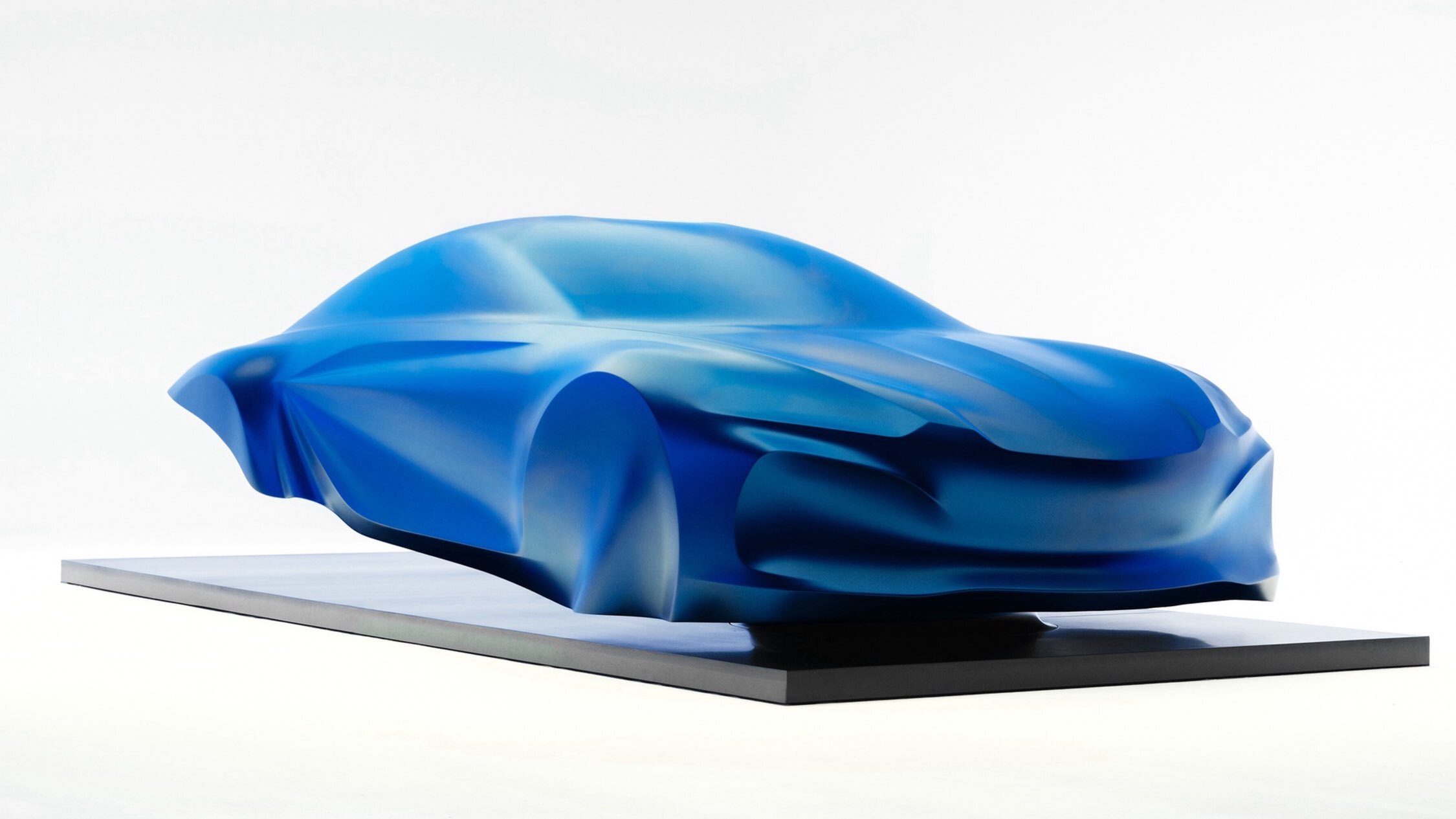
At the upcoming Paris Motor Show this October, visitors will encounter an unusual exhibit: a full-size sculptural model draped in what appears to be a tight, blue silk sheet. According to Alpine’s design team, the tension visible across the fabric is meant to evoke the impression of wind resistance, serving as a subtle nod to aerodynamic efficiency and structural lightness. The design philosophy also draws unexpected inspiration from the Concorde, the joint British-French supersonic passenger jet renowned for its pioneering aerodynamic profile.
Despite the shrouded nature of the display, the sculpture clearly retains foundational design DNA from the outgoing A110. The unmistakable V-shaped nose and dual-tier headlight arrangement remain prominent features, preserving a direct visual link to both the modern classic and the vintage 1960s forebear. Observers note that the new coupe appears leaner, longer, and lower than its predecessor, suggesting a more aggressive stance that capitalizes on its upcoming mechanical layout while maintaining immediate brand recognition.
Powertrain Revolution: Electric Innovation and Chassis Engineering
While the exterior pays homage to Alpine’s design heritage, the engineering underneath represents a radical departure. The current generation A110 has won universal acclaim for its featherlight agility and nimble handling—qualities that present a formidable challenge when converting a sports car to battery power.

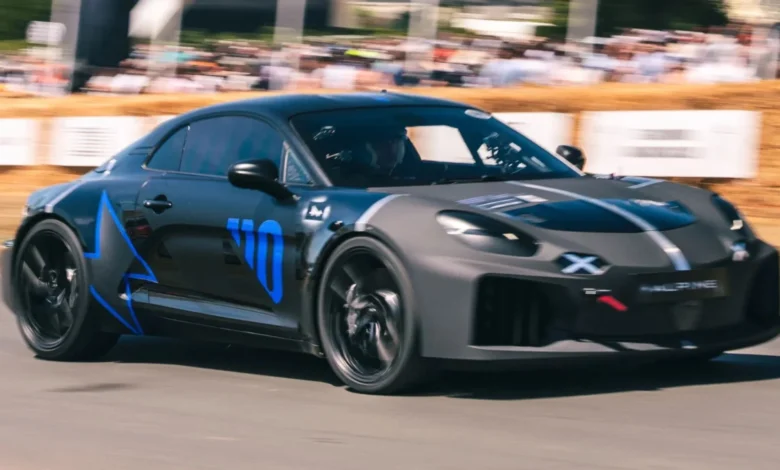
Alpine first demonstrated its new hardware stack at the Goodwood Festival of Speed earlier this year, utilizing a stretched test mule dubbed the A110 Future. The setup incorporates a sophisticated dual-motor rear-axle layout featuring active torque vectoring and advanced wheel-slip control. Rather than employing a single heavy battery pack embedded uniformly beneath a traditional floorpan—a common approach in modern EVs that often raises the center of gravity and roofline—Alpine has engineered an unconventional split-battery architecture.
By positioning two smaller battery modules at the extreme front and rear ends of the proprietary APP platform, engineers have successfully preserved a low-slung floorpan, ensuring that the driver’s seating position and overall roof height remain appropriately sports-car low. Furthermore, this layout helps achieve an optimal 40:60 front-to-rear weight distribution. Supported by an 800-volt electrical architecture, the vehicle promises ultra-fast charging capabilities. However, exact range figures, charging speeds, and curb weights remain strictly under wraps, though analysts project a weight penalty of approximately 660 pounds (300 kg) compared to the current petrol-powered model.
Listening to the Market: The Potential ICE Contingency
The decision to transition the A110 to an exclusively electric format was initially made during a period of rapid legislative and market shifts favoring zero-emission vehicles in Europe. Yet, the automotive landscape has evolved unevenly. While European EV adoption continues to climb steadily—now accounting for roughly one in four new vehicle registrations—driving enthusiasts have repeatedly voiced a strong preference for the sensory feedback, acoustic engagement, and reduced weight associated with internal combustion engines.
Recognizing this enthusiast pushback, Alpine has engineered its next-generation platform with remarkable flexibility. In March, Alpine CEO Philippe Krief confirmed to automotive media that the underlying architecture was intentionally designed to accommodate an internal combustion engine if market demand warranted it. By July at Goodwood, Krief clarified that a formal executive decision regarding the introduction of a petrol or hybrid variant would be finalized by the end of 2026. Should the combustion option receive official authorization, it would require an estimated two-year development window before reaching commercial production lines.
Should Alpine move forward with a hybrid or combustion powertrain, a logical mechanical source is readily available within the corporate ecosystem. Horse Powertrain—a joint venture established between Alpine’s parent company, Renault, and China’s Geely—has developed advanced hybrid power units, including a robust system capable of generating 349 horsepower (354 PS) and 380 lb-ft (515 Nm) of torque.
Strategic Implications and the North American Horizon
The prospect of an internal combustion or hybrid variant carries massive strategic implications, particularly regarding a long-rumored expansion into the North American market. The current generation A110 was never officially sold in the United States, primarily due to homologation hurdles and the absence of a localized sales network.

While initial corporate strategies included a planned push into North America, those timelines were temporarily shelved amid shifting trade policies and regulatory headwinds, including the introduction of import tariffs. Nevertheless, underlying preparations have quietly continued. Krief revealed during the summer that Alpine has been actively subjecting A110 prototypes to rigorous U.S. crash-testing protocols.
Given that consumer adoption of pure electric sports cars remains subdued in North America compared to Europe, offering a multi-powertrain strategy—or a high-performance hybrid option—could prove essential if Alpine intends to successfully launch the A110 across the Atlantic. Without a combustion alternative, establishing a viable foothold in the U.S. performance car sector could face severe headwinds.
Timeline and Outlook
As the automotive industry looks toward the remainder of the decade, Alpine’s roadmap is coming into sharper focus:

- July 2026: Alpine debuts its electric hardware via the "A110 Future" test mule at the Goodwood Festival of Speed, while CEO Philippe Krief announces that an ICE-compatible platform decision is pending.
- October 2026: The brand reveals the full-scale sculptural design preview at the Paris Motor Show, offering the first tangible glimpse of the 2028 production model’s proportions.
- Late 2026: Alpine leadership is slated to make a final decision on whether to greenlight a petrol or hybrid variant alongside the primary electric model.
- 2028: Anticipated market launch of the next-generation Alpine A110, marking the brand’s definitive entry into the modern high-performance EV era.
Ultimately, Alpine’s upcoming sports car represents a high-stakes gamble. By wrapping futuristic 800-volt electric architecture and innovative split-battery packaging inside a breathtaking, aerodynamically optimized silhouette, the French manufacturer is attempting to rewrite the rulebook for lightweight electric performance. Whether the finished product can match the beloved agility of its predecessor—and whether market pressures will ultimately force Alpine to offer a petrol-fueled alternative—will dictate the ultimate legacy of the brand’s electric renaissance.