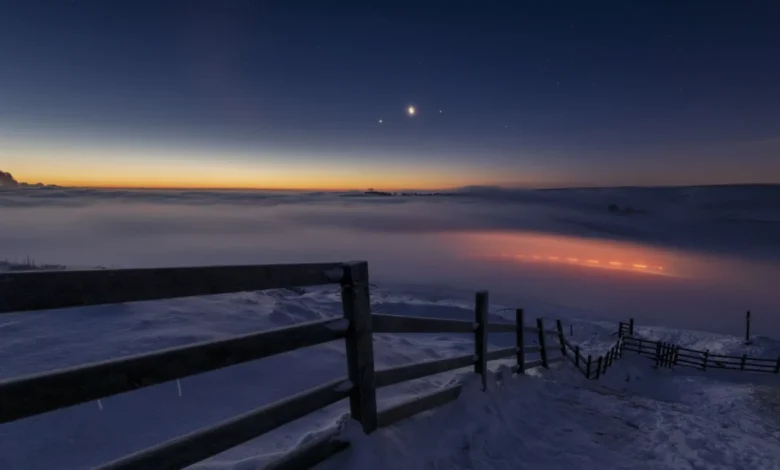
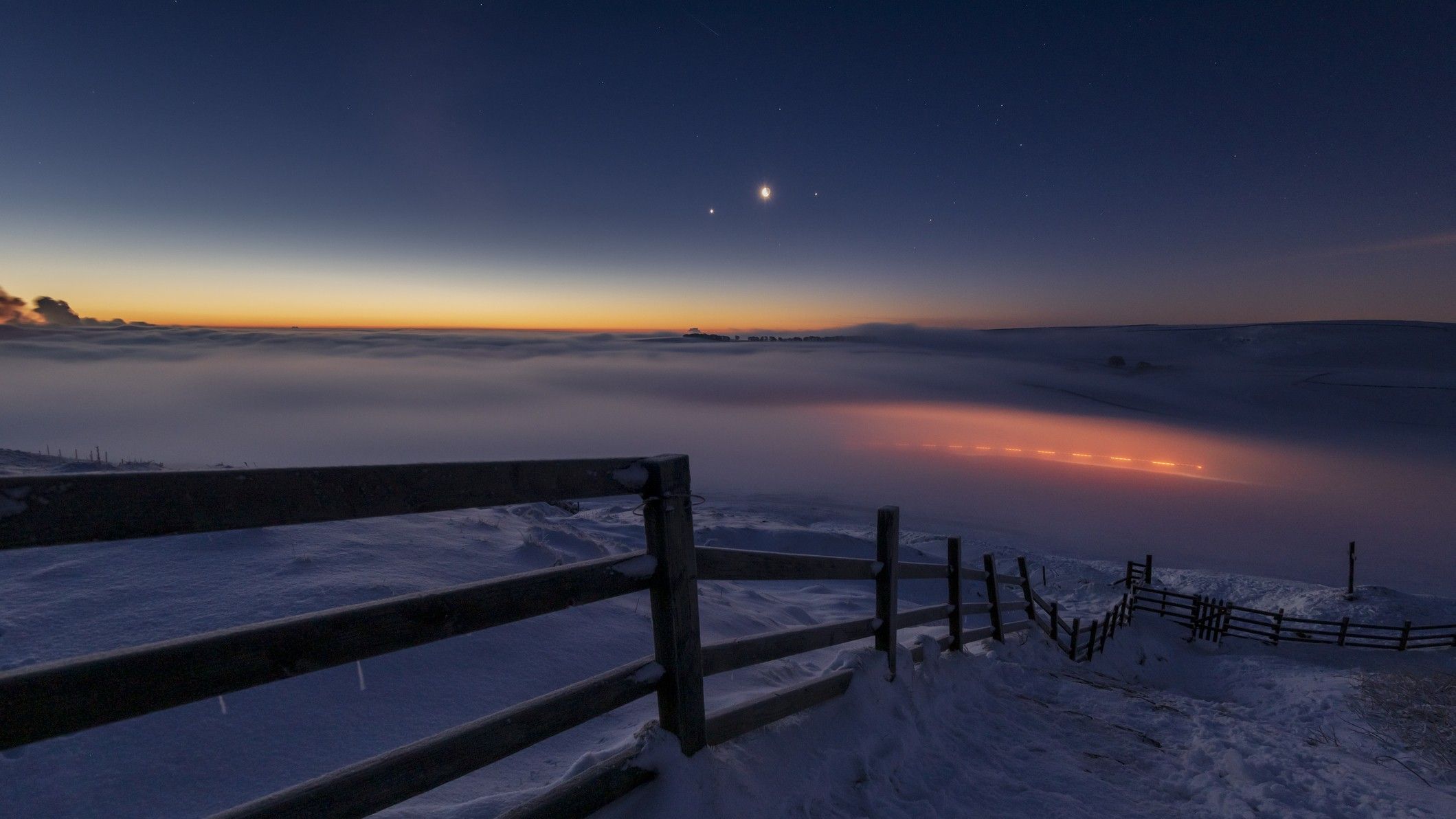
Early morning commuters and eager skywatchers stepping outside before sunrise are currently being greeted by an unmistakable, brilliant celestial beacon low in the east-southeast sky. For millions of early risers heading to work or school, this dazzling point of light has seemed to materialize out of nowhere over the past few weeks, commanding immediate attention with its fierce luminescence.
The brilliant object is the planet Venus, which has embarked on one of its most striking and prominent appearances in the morning sky. Following an inferior conjunction on October 24, when it passed directly between the Earth and the sun, Venus transitioned seamlessly from an evening fixture into a commanding morning star. Astronomers and meteorologists note that this planetary transition is setting the stage for a prolonged period of exceptional visibility, offering amateur astronomers and casual observers alike a rare opportunity to witness planetary motion with the naked eye.
The Celestial Mechanics Behind the Brilliance
To understand why Venus appears so overwhelmingly bright, one must look to the orbital mechanics governing our solar system. As an inferior planet—meaning its orbit lies closer to the sun than Earth’s—Venus goes through regular cycles of phase changes and proximity shifts relative to our vantage point.
During the October 24 inferior conjunction, Venus positioned itself approximately in line with Earth and the sun, presenting its unilluminated side toward us and momentarily vanishing into the solar glare. As it swiftly continues along its faster internal orbit, Venus has now pulled away from the sun from our perspective on Earth, rapidly ascending into the pre-dawn sky.
This orbital geometry not only increases the angular separation between Venus and the sun—allowing the planet to rise well before dawn—but also alters the phase of Venus as seen through a telescope, shifting it from a thin crescent toward a broader, illuminated disc. Because Venus is enveloped in highly reflective, dense clouds of sulfuric acid, it reflects a vast majority of the sunlight that strikes it. When combined with its relative proximity to Earth during this phase of its orbit, the result is an astronomical display of unmatched brightness.
A Chronology of the Morning Apparition
The trajectory of Venus over the coming months follows a predictable yet breathtaking timeline that offers continuous viewing opportunities for anyone willing to brave the early morning chill.
In the initial weeks following its emergence from solar conjunction, Venus steadily improved its pre-dawn altitude. Currently, the planet is rising more than 90 minutes before the first glimmers of dawn. However, this lead time is expanding rapidly. Because of its swift orbital velocity, Venus gains approximately three minutes of head start each day over the rising sun.
By mid-December, specifically around December 17, this progression reaches a crucial milestone. On this date, Venus will rise nearly four hours—specifically 3 hours and 50 minutes—before the sun. This extended lead time ensures that the planet will blaze brilliantly in a completely dark sky for more than two hours before morning twilight even begins to wash out background stars.
This sustained visibility makes Venus an unofficial, modern-day equivalent of the legendary "Christmas Star" described in ancient texts, shining with radiant intensity in the eastern sky during the darkest mornings of the winter season.
Following its peak morning prominence in mid-December, Venus will begin a slow, graceful descent back toward the solar horizon. Starting on New Year’s Day and extending through late March, the planet will rise roughly one and a half minutes later each morning. By the arrival of spring, Venus will emerge just as dawn is breaking, roughly 100 minutes before sunrise.
The descent continues through the spring months. By late June, Venus will break the horizon less than an hour before the sun, ultimately getting swallowed by the bright dawn twilight by July. The planet will then enter a brief "summer sabbatical," remaining hidden from view as it swings around the far side of the sun, before returning next year to grace our evening skies once again.
Data and Magnitudes: How Bright is Bright?
To quantify the sheer visual power of Venus during this apparition, astronomers rely on the astronomical magnitude scale, where lower numbers indicate brighter objects.
On November 29, Venus is projected to reach its absolute peak brilliance for this cycle, shining at an eye-popping magnitude of -4.9. To put this figure into perspective, Venus will outshine Jupiter—its nearest planetary competitor in the solar system—by a factor of 12. Compared to Sirius, the brightest individual star in the night sky, Venus will appear a staggering 25 times more dazzling.
Under optimal viewing conditions, particularly for observers located in rural areas free from the detrimental effects of urban light pollution, Venus’s light is intense enough to cast a faint, perceptible shadow on the ground. Furthermore, because of its extreme magnitude, observers who track Venus right through the sunrise will find that the planet does not fade away with the stars. Instead, it remains entirely visible to the naked eye against the bright blue canvas of a full daytime sky, appearing as a tiny, stark white speck suspended in the atmosphere.
Public Reactions and Misidentifications
Every time Venus undergoes such a dramatic shift into high visibility, local emergency services, astronomy hotlines, and media outlets experience a predictable surge in inquiries. The sudden appearance of a hyper-bright object moving across the pre-dawn sky frequently sparks confusion among the general public.
In regions with high volumes of early-morning commuters, drivers traveling eastward toward the rising sun cannot miss the planet, which often appears suspended directly in their line of sight. Over the decades, these bright planetary apparitions have consistently generated reports of unidentified flying objects (UFOs) from startled citizens convinced they are witnessing extraterrestrial spacecraft.
Astronomers, meteorologists, and science educators routinely use these seasonal events as teachable moments to demystify celestial mechanics. Public relations representatives from major planetariums emphasize that while the suddenness of the sighting can feel startling, it is entirely a product of predictable planetary orbits. As veteran science communicators often joke to reassure inquiring citizens: it is not an interstellar visitor or advanced technology—it is simply Venus.
Broader Implications and Scientific Value
Beyond providing a magnificent spectacle for amateur stargazers and casual observers, Venus’s current morning apparition serves as an ideal reminder of the dynamic nature of our solar system. Educational institutions, science museums, and planetariums frequently leverage these high-visibility phases to engage the public in broader discussions about planetary science, orbital mechanics, and the ongoing study of our planetary neighbor.
Venus shares many structural similarities with Earth, often referred to as our planet’s "sister world" due to its comparable size, mass, and bulk composition. However, its runaway greenhouse effect, crushing atmospheric pressure, and surface temperatures hot enough to melt lead provide a stark warning regarding climatic extremes. While early morning viewers gaze up at a serene, twinkling diamond of light in the eastern sky, planetary scientists continue to study Venus through space probes to understand how a world so similar to Earth in its infancy could diverge into such a radically different, hostile environment.
For now, however, the primary impact of Venus is purely aesthetic. As the holiday season approaches and the mornings grow colder and darker, the brilliant morning star offers a reliable, breathtaking anchor for anyone stepping outside before the world wakes up. Whether viewed from a quiet countryside field or through the windshield of a car navigating morning traffic, Venus remains the undisputed king of the pre-dawn sky.
Related posts: