Revolutionary MIT Nanoparticle Technique Transforms Immune Cells Into Cancer-Fighters Directly Inside the Body

In a monumental breakthrough for modern biotechnology, researchers at the Massachusetts Institute of Technology (MIT) have engineered a groundbreaking delivery mechanism that transforms immune cells into potent cancer fighters directly inside a patient’s body. Published in the prestigious journal Nature Biotechnology, the study outlines a novel approach that could fundamentally eliminate the complex, time-consuming, and exorbitantly expensive manufacturing processes that have historically defined personalized cellular therapies. By utilizing specialized lipid nanoparticles to transport genetic instructions straight to natural killer (NK) cells in vivo, the scientific team successfully reprogrammed the body’s native defenses to seek out and destroy malignant tumors and aggressive autoimmune threats in preclinical animal models.
This pioneering development promises to democratize access to advanced immunotherapies, shifting the paradigm from laborious, ex vivo laboratory fabrication to streamlined, injection-based clinical interventions.
The Manufacturing Bottleneck of Contemporary Immunotherapy
To understand the magnitude of the MIT team’s achievement, one must examine the state of contemporary cellular immunotherapy. Over the past decade, oncology has been profoundly altered by the advent of chimeric antigen receptor (CAR) T-cell therapies. Approved by the U.S. Food and Drug Administration (FDA) for various refractory blood cancers—including specific forms of leukemia, B-cell lymphoma, and multiple myeloma—these treatments involve harvesting a patient’s own T cells, dispatching them to a centralized bio-manufacturing facility, and genetically modifying them using viral vectors. Once engineered to express receptors that specifically lock onto surface antigens of cancerous cells, these T cells are cultivated by the billions, rigorously tested, shipped back to the clinical site, and reinfused into the patient.
While undeniably lifesaving for thousands of patients who had exhausted all other therapeutic avenues, this conventional methodology introduces staggering logistical hurdles. The pipeline is plagued by extended turnaround times, which can span several weeks—a dangerous delay for patients fighting fast-moving malignancies. Furthermore, the specialized infrastructure, labor, and quality control protocols required to produce personalized cell batches drive astronomical costs, frequently scaling into hundreds of thousands of dollars per patient. These financial and operational barriers restrict the widespread adoption of CAR-T therapies, leaving them accessible primarily to well-resourced medical centers and affluent populations.
Recognizing these severe limitations, biomedical engineers have spent recent years searching for methods to bypass external cellular manufacturing entirely. The holy grail of the field has long been in vivo engineering: the direct administration of a therapeutic agent that can locate target immune cells within the human body and reprogram them on-site. The MIT research group’s latest publication marks a decisive stride toward realizing this ambition.
Harnessing Natural Killer Cells to Overcome Cellular Conflict
While traditional cell therapies rely predominantly on T cells, the MIT researchers focused their efforts on a different class of immune sentinel: natural killer (NK) cells. Part of the innate immune system, NK cells possess an intrinsic ability to recognize and lyse stressed, virally infected, or malignant cells without requiring prior sensitization.
Shifting the focus to NK cells solves a critical immunological complication associated with treating T-cell-derived malignancies and autoimmune disorders. When attempting to use conventional CAR-T cells to target diseased T cells—such as those driving T-cell lymphoma or autoimmune hepatitis—a devastating phenomenon known as "fratricide" occurs. Because both the therapeutic agent and the target cell are T cells, the engineered defenders frequently recognize one another as enemies, launching mutual attacks that neutralize the treatment’s efficacy.
Natural killer cells bypass this roadblock entirely. Because they belong to a distinct lineage from T cells, they can be genetically instructed to hunt down and eliminate rogue T cells without falling victim to friendly fire.
"NK cells can treat these T cell malignancies—not only T cell cancer, but also T cell autoimmune diseases," explains Yuang Chen, an MIT postdoctoral researcher and lead co-author of the study.
Despite their therapeutic versatility, engineering CAR NK cells outside the body traditionally suffered from the exact same logistical bottlenecks as CAR-T therapies. They still required extraction, centralized laboratory processing, and reinfusion. The MIT team hypothesized that if these cells could be programmed in vivo using targeted nanocarriers, the entire paradigm could be revolutionized.
The Mechanics of mRNA Nanoparticle Reprogramming
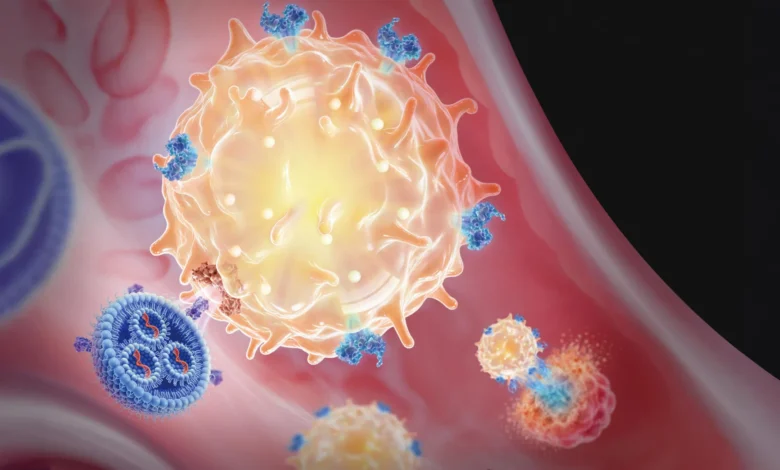
The foundational technology underpinning this breakthrough relies on lipid nanoparticles (LNPs)—the same sophisticated microscopic fat bubbles that famously enabled the rapid deployment of mRNA-based COVID-19 vaccines. The MIT researchers designed specialized LNPs engineered to carry messenger RNA (mRNA) molecules straight to the cytoplasm of natural killer cells circulating within the body.
The encapsulated mRNA contains precise genetic blueprints for constructing chimeric antigen receptors (CARs). Once the nanoparticle successfully delivers its cargo into an NK cell, the cellular machinery translates the mRNA, causing the NK cell to display the custom-designed CAR on its surface. This newly acquired receptor acts as a molecular guidance system, directing the NK cell toward specific target proteins associated with disease.
Crucially, this modular platform can be tailored to address a wide spectrum of pathologies simply by altering the genetic instructions encoded within the mRNA. For instance, the nanoparticles can be programmed to produce receptors that bind to CD19, a hallmark protein found on malignant B cells, or CD3, a protein expressed on T cells that drive aberrant autoimmune attacks.
To ensure the nanoparticles selectively seek out NK cells rather than off-target tissues or other immune cells, the research team engineered the surface of the LNPs. By decorating the lipid shell with specific antibody fragments that recognize and bind exclusively to receptors on the surface of NK cells, the scientists created a homing mechanism that guarantees precise delivery of the genetic payload.
"If a patient can just get an infusion of nanoparticles, it would dramatically simplify the process and reduce costs," notes Daniel Anderson, a professor in MIT’s Department of Chemical Engineering, a member of the Koch Institute for Integrative Cancer Research, and the senior author of the published study.
Preclinical Success: Eliminating Tumors and Reversing Autoimmune Damage
To evaluate the translational viability of their technology, the MIT team conducted rigorous preclinical trials utilizing murine models. The results exceeded initial expectations. Following a single systemic injection, the lipid nanoparticles successfully modified approximately 80 percent of the targeted natural killer cells in vivo.
The team subsequently tested the therapeutic capabilities of these endogenously reprogrammed cells against aggressive forms of cancer. In murine models bearing advanced melanoma, administration of the nanoparticle treatment yielded remarkable outcomes: three out of five treated animals experienced complete and durable tumor remission.
To investigate the technology’s efficacy against human diseases, the researchers utilized "humanized" mouse models—animals engrafted with human blood cells to simulate human immunological responses. In mice bearing aggressive T-cell lymphoma, a regimen consisting of five nanoparticle injections resulted in the total eradication of the tumors. Notably, the therapeutic potency of the in vivo engineered cells matched the performance of CAR NK cells manufactured via traditional, labor-intensive ex vivo laboratory protocols.
Beyond oncology, the research team explored the technology’s potential in managing autoimmune diseases, where a misdirected immune system attacks the body’s own healthy tissues. They focused on autoimmune hepatitis, a debilitating condition characterized by autoreactive T cells destroying hepatocytes, the primary functional cells of the liver.
By engineering nanoparticles that instructed NK cells to eliminate these specific autoreactive T cells, the researchers successfully halted the pathogenic immune response. Remarkably, just a single nanoparticle injection cleared the harmful cells and allowed the damaged liver tissue to spontaneously regenerate and heal.
"This study is an excellent example of the power of nano delivery systems and their ability to potentially treat cancer and other diseases," remarks Robert Langer, MIT’s David H. Koch Institute Professor and co-author of the study.
Broader Implications and Future Clinical Horizons
The successful demonstration of in vivo cellular reprogramming opens vast new horizons for translational medicine. Beyond melanoma, lymphoma, and autoimmune hepatitis, the MIT researchers believe the underlying platform can be adapted to tackle a diverse array of chronic and debilitating conditions driven by immune system dysfunction, including multiple sclerosis and rheumatoid arthritis.
While the scientific community has greeted the findings with immense enthusiasm, experts emphasize that significant developmental hurdles remain before human clinical trials can commence. All current validation has been performed in animal models; extensive safety, toxicology, and pharmacokinetic studies will be required to confirm that the nanoparticle delivery system behaves predictably and benignly in human physiology.
Nevertheless, the implications of this research are profound. By effectively removing the cleanroom, the specialized bio-reactors, and the weeks-long waiting periods from the cellular therapy equation, nanoparticle-mediated in vivo engineering could transform complex biological treatments into off-the-shelf, needle-delivered pharmaceuticals. If successfully translated to human medicine, this innovation could herald a new era of accessible, rapid, and cost-effective immunotherapy, fundamentally altering how modern medicine combats both cancer and autoimmune disease.
The research was generously supported by funding from Sanofi, the Marble Center for Cancer Nanomedicine, and a Koch Institute Support (core) Grant from the National Cancer Institute.