The 2026 Rock & Roll Hall of Fame Induction Ceremony Proves That Rock Is Alive and Well

The 2026 Rock & Roll Hall of Fame induction ceremony at Los Angeles’ Peacock Theater served as a definitive rebuttal to any lingering narratives regarding the decline of rock music. Through a sprawling, high-octane evening that bridged generations, genres, and geographies, the event underscored the enduring vitality of the medium. Producer Rick Rubin, who received the Musical Excellence Award, encapsulated the night’s ethos with a succinct six-word assessment: “You can’t kill rock ’n’ roll.”
The gala, which featured a diverse array of musical titans, was characterized by both poignant tributes and raucous performances. As the industry looks toward the broadcast on ABC on December 8 and streaming on Disney+ and Hulu, the event stands as a masterclass in musical legacy management.
A Legacy of Excellence: The Inductees and Their Impact
The class of 2026 reflected a broad definition of "rock and roll," incorporating hip-hop pioneers, post-punk architects, and pop-soul icons. This year’s list included the Wu-Tang Clan, Queen Latifah, Phil Collins, Billy Idol, Oasis, Iron Maiden, Luther Vandross, and the influential duo of Joy Division and New Order.

The evening was framed by the contributions of Rick Rubin, arguably the most important producer of the modern era. Inducted by longtime collaborator Neil Young, Rubin’s influence—spanning from the seminal rap records of the 1980s to the genre-defying soundscapes of the Chili Peppers and beyond—was the connective tissue of the ceremony. The Red Hot Chili Peppers provided a humorous homage, performing "Give It Away" while dressed as the iconic, bearded producer, a moment that underscored the camaraderie and irreverence that remains central to the rock tradition.
The Dynamics of Attendance: When Absence Speaks Volumes
A recurring theme in the Hall of Fame’s history is the tension between recognition and participation. This year, the absence of Oasis and Iron Maiden served as a focal point for the evening’s narrative. Bob Odenkirk, who provided a deadpan induction for Oasis, framed the band’s non-appearance as an essential component of their mythos. "Anybody surprised they didn’t show up?" Odenkirk asked the audience. "It would have been out of character if they had."
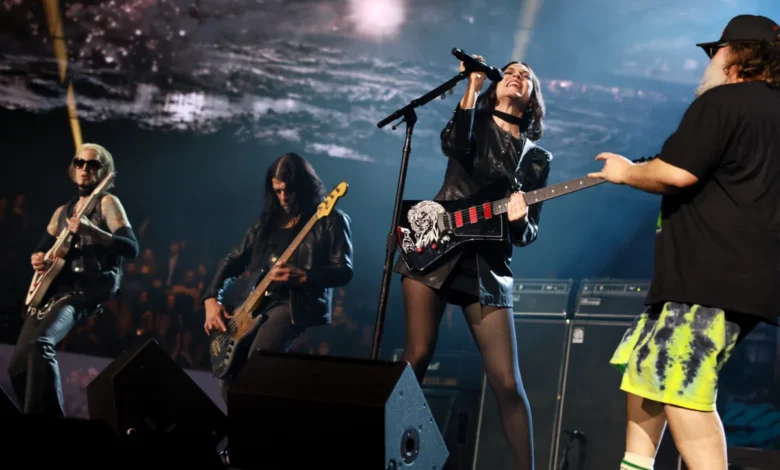
Similarly, Iron Maiden, currently engaged in an extensive Australian tour, remained absent. However, their legacy was fiercely defended by Jack Black, who spearheaded an all-star performance of "The Trooper." Featuring members of Metallica and Rage Against the Machine, alongside the art-rock sensibilities of St. Vincent, the segment demonstrated how the Hall can maintain its energy even in the absence of the primary inductees. This adaptive approach—utilizing "stand-in" supergroups—has become a hallmark of the ceremony, ensuring that the music takes precedence over the politics of attendance.
Phil Collins and the Power of Musical Resilience
The most emotionally resonant portion of the evening belonged to Phil Collins. His return to the stage, assisted by walking canes but met with a thunderous standing ovation, provided a stark, powerful contrast to the high-energy sets of his peers. Travis Barker’s introduction, which focused on the technical brilliance of the "In the Air Tonight" drum break, served as a bridge between the classic rock era and modern rhythmic sensibilities.

Collins, who was previously inducted as a member of Genesis, used his time at the podium to reflect on the nature of his career. "Everything else has been a really happy accident," he remarked, acknowledging the physical toll his career has taken while expressing gratitude for the support system that allowed him to attend. When Cynthia Erivo took the stage to perform "In the Air Tonight" with Barker, the performance served as a cathartic reminder of how a single piece of music can define an era and inspire subsequent generations of musicians.
Hip-Hop’s Institutional Integration
The induction of the Wu-Tang Clan and Queen Latifah further cemented the Hall’s commitment to acknowledging hip-hop as a foundational element of the rock-and-roll story. Chris Rock’s tribute to the Wu-Tang Clan highlighted the group’s DIY business model and their transformative impact on the cultural landscape of the early 1990s.
Similarly, Megan Thee Stallion’s induction of Queen Latifah focused on the necessity of resilience in a male-dominated industry. Latifah’s speech, which shifted focus away from her own accomplishments to the contributions of MC Lyte and the collaborative spirit of the early hip-hop scene, highlighted the "full circle" nature of the evening. The performances by these artists demonstrated that the "rebellion" often associated with rock music is deeply embedded in the origins of hip-hop as well.
The Institutional Blueprint: Joy Division and New Order
The induction of Joy Division and New Order offered an academic, yet emotionally charged, look at the transition from post-punk to synth-pop. Trent Reznor’s analysis of the band’s "blueprint" provided essential context for how the architecture of 1980s British music informed the global rock landscape.

Peter Hook, representing the collective legacy of both bands, was joined by Chino Moreno of the Deftones and Lauren Mayberry of CHVRCHES for iconic renditions of "Love Will Tear Us Apart" and "Bizarre Love Triangle." This segment served as a reminder that the influence of a band is measured not just in sales, but in the stylistic DNA they leave behind for others to decode and reinvent.
Billy Idol and the Philosophy of Punk
Billy Idol’s induction felt like a long-overdue validation of his transition from a rebellious schoolboy labeled "idle" to an international rock icon. Gwen Stefani’s tribute—which focused on the visual and sonic impact of Idol’s 1980s work—was followed by a performance that proved his stage presence remains intact.
Idol’s acceptance speech was perhaps the most articulate defense of the night, positioning punk rock not merely as a sonic aesthetic but as a "philosophy of freedom." By framing his career as a pursuit of one’s own path, he provided a rallying cry for younger generations: "Go make the impossible possible. Find out who you are. And be it."
Broader Implications and Institutional Legacy
The 2026 ceremony was not merely a retrospective; it was an exercise in institutional continuity. By including pioneers like Celia Cruz and Fela Kuti, the Rock & Roll Hall of Fame is signaling a more global, inclusive strategy for future inductions. Furthermore, the inclusion of industry figures like Ed Sullivan and producers like Arif Mardin and Jimmy Miller emphasizes that the "rock" story is a collaborative one, involving architects behind the scenes as much as the stars on the stage.

Data from the event suggests that the "Rock Hall" is successfully transitioning from a traditionalist organization to a broader cultural curator. The ability to pull in diverse audiences—from country-rock fans to hip-hop purists—demonstrates the Hall’s role in preserving the "big tent" of modern music.
Final Reflections
As the ceremony concluded with a surprise performance of "Walk This Way" by Run-DMC and Aerosmith, the evening came full circle. The synergy between classic rock and hip-hop, which was pioneered in the 1980s with the help of Rick Rubin, remains a vital, working model.
The 2026 induction ceremony succeeded because it refused to treat rock music as a museum piece. Instead, it treated it as a living, evolving organism. Whether through the sheer volume of the Metallica-backed Maiden tribute or the tenderness of Luther Vandross’s remembered legacy via Oprah Winfrey, the event confirmed that while the faces may change and the physical capabilities of the artists may fluctuate, the fundamental impulse of rock—to challenge, to unite, and to endure—remains as powerful as ever. The night concluded with the industry feeling rejuvenated, proving that while legends may pass the torch, the fire is far from extinguished.