Breaking Barriers in Orbit: How Mae Jemison Became the First African American Woman in Space and Redefined the Cosmos

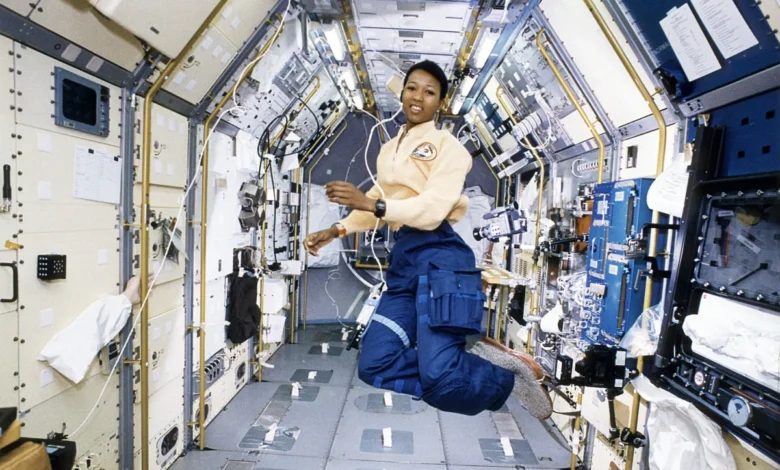
On September 12, 1992, NASA astronaut Mae Jemison etched her name into the history books by launching aboard the space shuttle Endeavour on mission STS-47, officially becoming the first African American woman to travel into space. This watershed moment represented not only a personal triumph for a remarkably accomplished physician, engineer, and scientist, but also a significant, albeit delayed, milestone in NASA’s ongoing evolution toward diversity and inclusion. While space exploration has historically been dominated by homogenous cohorts of military test pilots and scientists, Jemison’s flight symbolized the gradual opening of the final frontier to a broader representation of humanity.
A Legacy of Exclusion and Gradual Integration
To fully understand the magnitude of Mae Jemison’s flight in 1992, it is crucial to examine the historical demographic landscape of human spaceflight. In the nascent decades of the United States space program, the astronaut corps was exclusively comprised of military men, effectively barring women and people of color from consideration. The selection criteria heavily favored white male test pilots coming from military aviation backgrounds, systemic barriers that persisted well into the Space Shuttle era.
Demographic shifts began to materialize slowly in the late 1970s and early 1980s. NASA selected its first group of female and minority astronaut candidates in 1978, a cohort that included trailblazers Sally Ride—who would become the first American woman in space in June 1983 during the seventh space shuttle mission, STS-7—and Guion Bluford, who broke the barrier for African American men just months later in August 1983 aboard STS-8.
Despite these monumental breakthroughs, nearly another decade passed before an African American woman was assigned to a flight crew. When Jemison finally launched on STS-47—the milestone 50th mission of the space shuttle program—she stepped into a legacy built by her predecessors while single-handedly expanding the horizons for future generations of women and minority scientists.
An Extraordinary Educational and Professional Path
Before ever donning a pressurized orange launch and entry suit, Mae Jemison had already cultivated an extraordinarily diverse and accomplished professional background. Born in Decatur, Alabama, and raised in Chicago, Illinois, Jemison exhibited an early fascination with science and astronomy, drawing inspiration from science fiction television—most notably portrayals of diversity in space, such as Lieutenant Uhura in Star Trek.
Her academic trajectory was equally stellar. Jemison entered Stanford University at the young age of 16, where she pursued a Bachelor of Science degree in chemical engineering while simultaneously engaging in African American studies. Graduating in 1977, she transitioned to Cornell University Medical College, earning her Doctor of Medicine degree in 1981. Following her medical training, she completed an internship at Los Angeles County-USC Medical Center and briefly worked as a general practitioner.
Demonstrating a profound commitment to humanitarian service, Jemison served as a Peace Corps medical officer from 1983 to 1985. Stationed in West Africa, she oversaw healthcare delivery for Peace Corps volunteers and resident populations in Sierra Leone and Liberia, managing public health issues, authoring self-care manuals, and coordinating research with the Centers for Disease Control and Prevention (CDC).
Upon returning to the United States, Jemison combined her engineering acumen and medical expertise to apply for NASA’s astronaut program. Out of thousands of applicants, she was selected in June 1987 as one of just 15 candidates in NASA Group 12, officially commencing her career as an astronaut.
The Historic Mission: STS-47 and Spacelab J
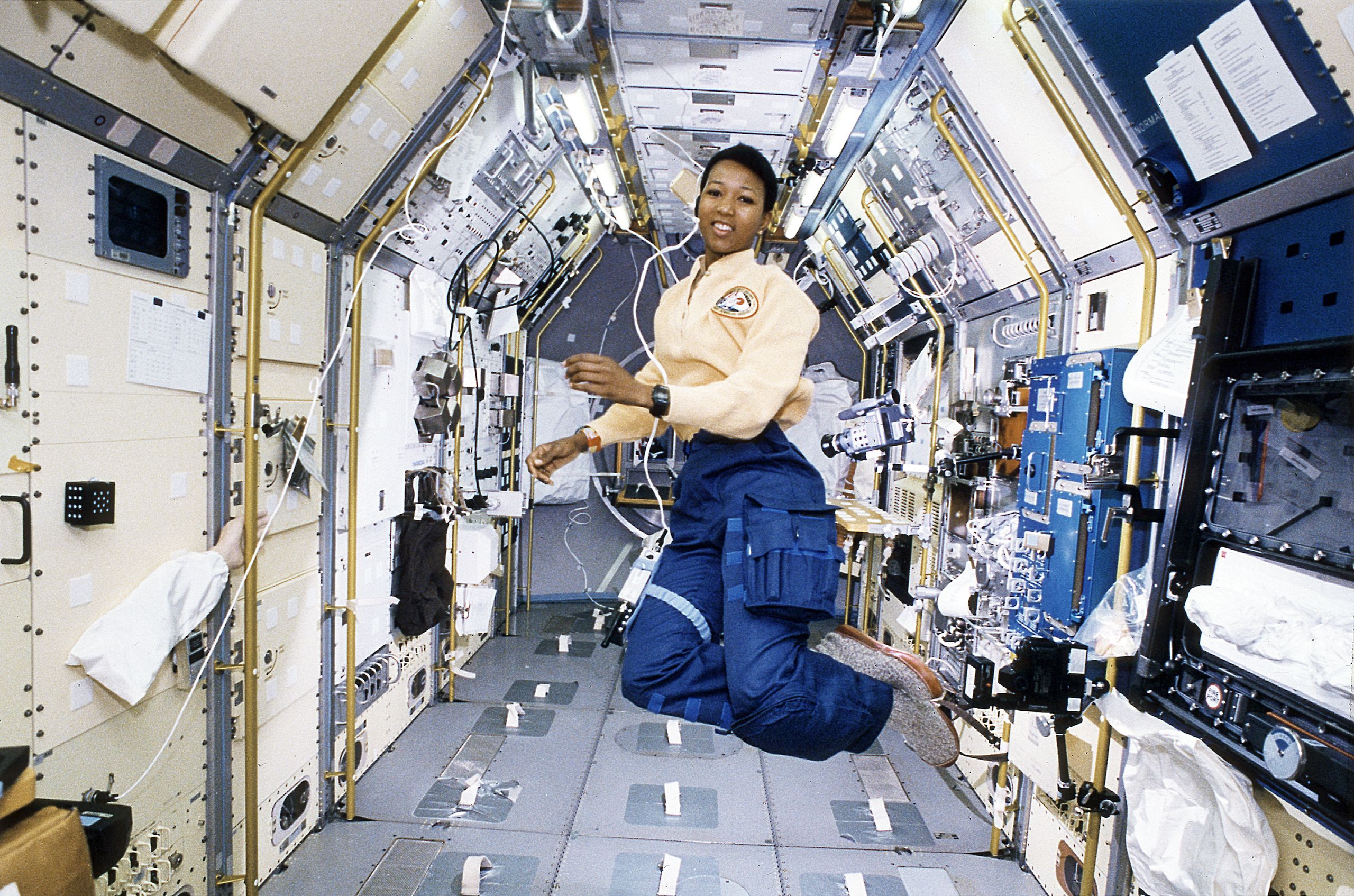
Jemison’s historic flight took place during STS-47, a cooperative Spacelab mission conducted jointly by the United States and Japan. Launched on September 12, 1992, space shuttle Endeavour carried a seven-person crew into orbit for a mission dedicated heavily to life sciences, materials processing, and technological demonstrations inside the pressurized Spacelab J module.
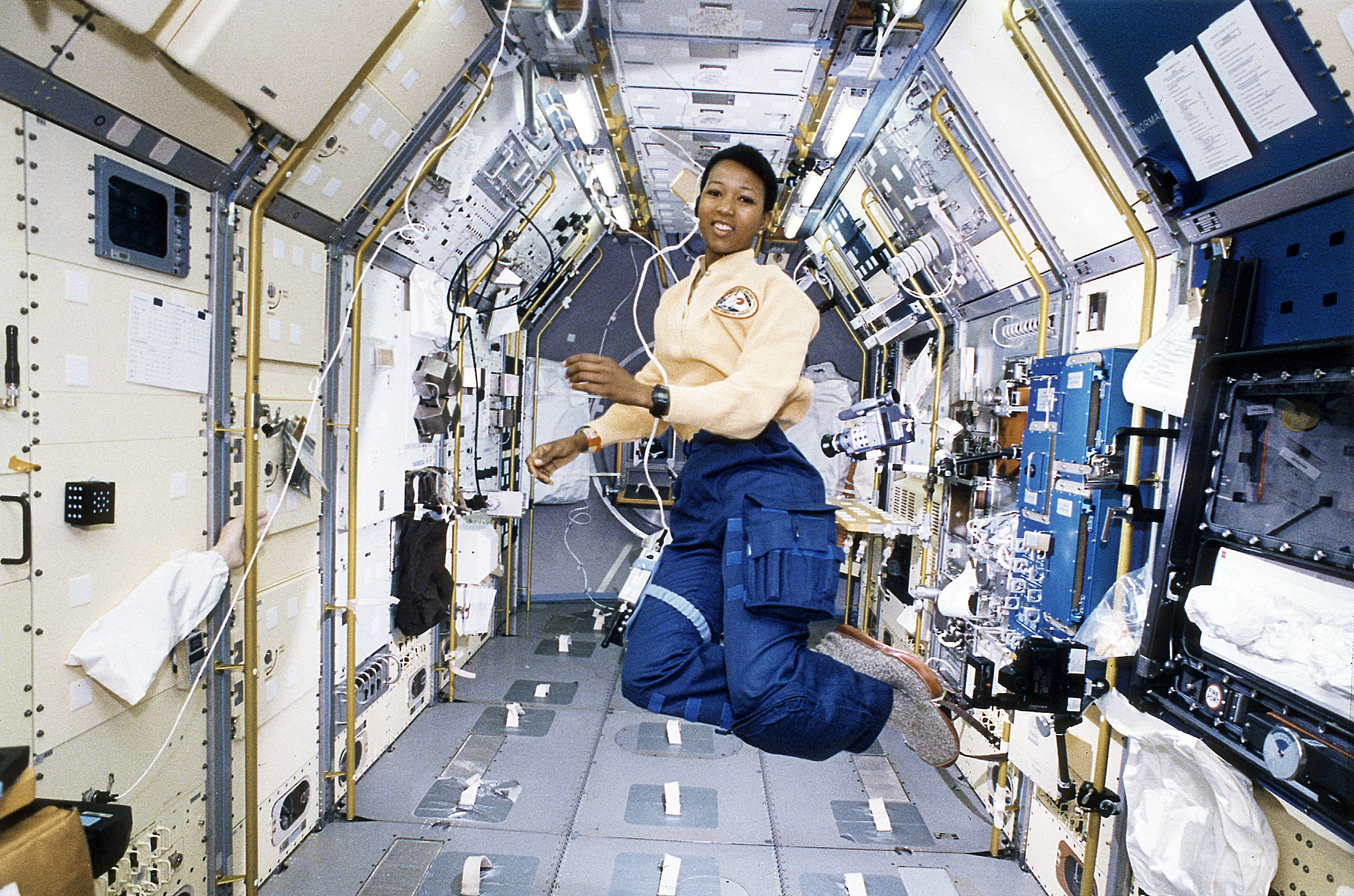
Serving as a science mission specialist, Jemison was tasked with overseeing a complex portfolio of 44 cooperative experiments. Her responsibilities included investigating bone cell research, monitoring the physiological adaptation of crew members to microgravity, and conducting tests on various materials in the unique environment of space. Additionally, she functioned as a co-investigator on a bone cell study, contributing valuable data to the understanding of how long-duration spaceflight impacts human skeletal structures.
During the eight-day, twenty-two-hour mission, Jemison logged a total of 190 hours, 30 minutes, and 23 seconds in space. On September 20, 1992, Endeavour successfully touched down at Kennedy Space Center in Florida, bringing a safe end to the flight. Although STS-47 would remain her sole spaceflight, the density of scientific output and the cultural resonance of her presence aboard the spacecraft left an indelible mark on the agency.
Cultural Impact, Post-NASA Endeavors, and Star Trek
Jemison’s influence extended far beyond the confines of NASA. In March 1993, she resigned from the space agency to establish the Jemison Group, a technology consulting firm focused on integrating socio-cultural considerations into the design and implementation of advanced science and technology. Her entrepreneurial spirit highlighted the practical applications of aerospace research in addressing earthly challenges.
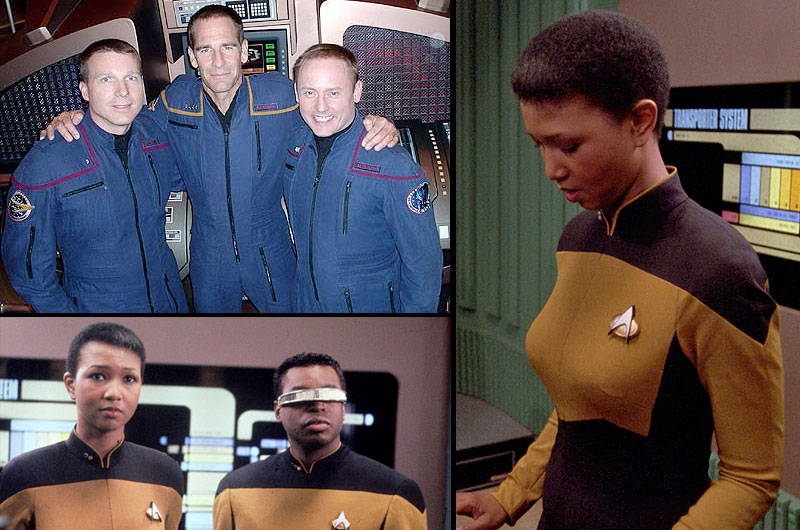
In a delightful convergence of childhood inspiration and adult reality, Jemison’s journey came full circle in 1993 when she made a guest appearance on an episode of Star Trek: The Next Generation, titled "Second Chances." Portraying Lieutenant Palmer, she became the first actual space traveler to appear in the iconic science fiction franchise, cementing her status as a cultural icon who bridged the gap between speculative fiction and scientific fact.
Jemison’s leadership in aerospace education and advocacy also led her to direct the 100-Year Starship project, an initiative launched under the Defense Advanced Research Projects Agency (DARPA) and later sustained by the Dorothy Jemison Foundation for Excellence. The project aims to foster the necessary research and long-term commitment to enable human interstellar travel within the next century.
Her contributions to science and representation have been repeatedly recognized by the global community. In 2017, toy manufacturer Lego honored her legacy by immortalizing her as an official minifigure in the popular "Women of NASA" set, ensuring that children worldwide could hold a physical representation of her historic achievement.
Implications for the Future of Space Exploration
The broader implications of Mae Jemison’s career resonate strongly within modern aerospace initiatives. As space agencies and commercial entities alike look toward establishing permanent outposts on the Moon through the Artemis program and eventually sending crewed missions to Mars, the emphasis on inclusive workforce pipelines has never been more critical.
Industry analysts and organizational psychologists frequently note that diverse teams drive innovation by bringing multifaceted perspectives to complex problem-solving—a necessity in high-stakes environments like space exploration. Jemison’s pioneering flight served as a catalyst, proving that excellence in science, medicine, and engineering transcends racial and gender boundaries.
Decades after her historic launch, Mae Jemison remains an active and vocal advocate for STEM education, particularly targeting young girls and underrepresented minority students. Through public speaking engagements, educational foundations, and ongoing thought leadership, she continues to inspire the next generation of engineers, scientists, and explorers who will ultimately carry humanity further into the cosmos.
Related posts: