On Friday nights, IndieWire After Dark celebrates the enduring appeal of fringe cinema in the streaming age, delving into midnight movies from across film history. This week, we explore a peculiar genre pick that resonates with current cultural currents, examining its specific niche before offering a spoiler-filled assessment of its enduring worth.
The Bait: The Enduring Allure of the Epic Journey
The cultural zeitgeist is currently captivated by tales of epic journeys, a phenomenon vividly illustrated by the widespread fascination with Christopher Nolan’s recent cinematic interpretation of "The Odyssey." This renewed interest has spurred a deeper engagement with Homer’s seminal work, prompting many, including this author, to revisit Emily Wilson’s acclaimed translation of the poem. The cultural resonance extends to popular adaptations like the Coen Brothers’ "O Brother, Where Art Thou?" and even the 1997 television miniseries. Beyond the realm of fiction, the "Odyssey" fever has also ignited curiosity into historical enigmas, such as the cryptic Sea Peoples.
This widespread fascination with "The Odyssey" is not merely a superficial trend; it taps into fundamental human archetypes and narrative structures that have captivated audiences for millennia. The epic poem, a cornerstone of Western literature, explores profound themes of longing, loyalty, belonging, self-definition, and the intricate interplay of responsibility, luck, and fate. It also offers timeless meditations on our treatment of strangers and the philosophical underpinnings of societal structures. These weighty themes have even drawn the attention of acclaimed director Christopher Nolan, who recently brought his distinct vision to the material, presenting it in the immersive IMAX 70mm format.

However, the enduring power of Homer’s epic also lies in its vibrant and imaginative fantasy elements. The dazzling episodes, filled with mythical creatures and extraordinary challenges, possess an immediate accessibility and allure, speaking to the child within us who, as G.K. Chesterton might suggest, doesn’t need to be told that dragons are real, but rather that it is possible to slay them and return home. Nolan’s "The Odyssey," while a masterful cinematic achievement, appears to lean more towards the psychological and existential, eschewing the overt fantastical elements that define the original poem’s broad appeal. The universe depicted in the film, characteristic of Nolan’s oeuvre, is rendered in muted tones of reluctant determination and structured by a gravity of inexpressible guilt. For those seeking such a profound, introspective voyage, the film offers a compelling experience.
Yet, there exists another narrative, a winding tale of a clever thief and an inventive trickster who, drawn from his home, embarks on a great adventure in lands beyond the wildest imagination. This story, of course, is "The Hobbit." J.R.R. Tolkien’s legendarium, in the year 2026, presents a complex and somewhat fraught legacy. Peter Jackson’s live-action adaptations of "The Lord of the Rings" in the early 2000s were landmark cinematic achievements, revolutionizing visual effects and profoundly influencing the film industry. These films are widely considered a high-water mark in fantasy filmmaking.
However, the proliferation of Tolkien adaptations has, in some respects, led to a sense of creative fatigue. Jackson’s subsequent "Hobbit" trilogy, while commercially successful, was criticized for its protracted pacing and perceived dilution of the source material’s spirit. The ongoing development of new projects, such as "The Hunt for Gollum," continues to spark debate among fans and critics, with some expressing concern over the potential for further commodification of Tolkien’s richly imagined world. This, in turn, highlights the delicate balance between honoring a beloved literary universe and ensuring its cinematic adaptations remain fresh and engaging.
The Cinematic Tapestry of Middle-earth
Middle-earth, the sprawling fantasy realm crafted by Tolkien, is as vast and captivating as the ocean Odysseus traversed over ten arduous years. It is a world populated by a diverse array of beings and phenomena: fearsome monsters, hidden caverns, avaricious kings, treasure-seeking adventurers, wise wizards, ethereal elves, stout dwarves, and majestic eagles that soar through the skies. The protagonist of "The Hobbit," Bilbo Baggins, is not defined by his martial prowess or unwavering bravery. Instead, his strength lies in his quick wit and irrepressible humor, qualities that consistently extricate him and his companions from perilous situations. He is, in essence, a hobbit of unexpected twists and turns.

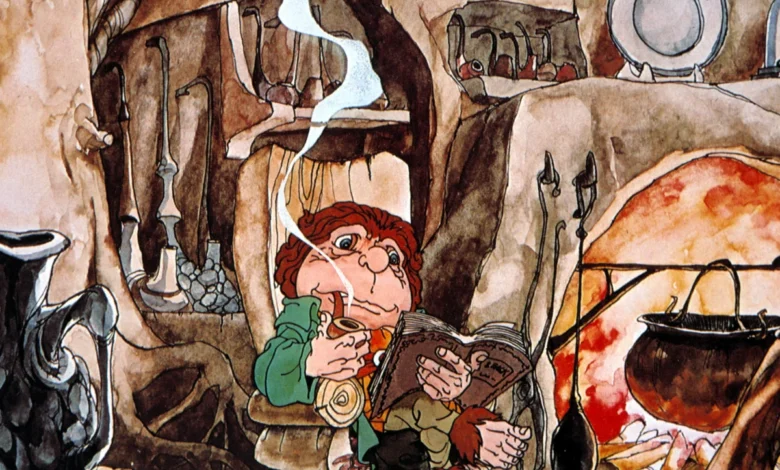
The decision to spotlight the 1977 animated adaptation of "The Hobbit," produced by Arthur Rankin Jr. and Jules Bass, stems from a confluence of factors, including a playful nod to Bilbo Baggins’s fictional age of 111 at the outset of "The Fellowship of the Ring." More importantly, this particular adaptation embodies the spirit of pure fantasy in a way that contrasts sharply with more grounded interpretations. It possesses a unique quality that joyfully affirms for the inner child that life’s possibilities are as boundless as our deepest desires.
The film’s pacing is notably abrupt, often humorous, and imbued with a distinctive, almost hippie-esque sensibility that defies easy categorization. The voice cast, a veritable who’s who of 1970s cinema, is a significant draw. The legendary John Huston lends his distinctive voice to Gandalf, while Otto Preminger, a filmmaker celebrated by "IndieWire After Dark" for his own genre contributions, portrays the Elf King. This eclectic ensemble imbues the characters with a unique gravitas and charm. The score, characterized by its folksy melodies and whimsical musical interludes, propels the narrative forward at a brisk and enjoyable pace, concluding within a refreshing 78 minutes.
The animation style of the 1977 "The Hobbit" is equally striking, evoking a sense of a bygone era of imagination. The strong linework and expressive watercolor landscapes coalesce to create a world that feels both like a piece of stained glass and a vibrant storybook. The blend of Western and Eastern iconography, particularly evident in the design of Smaug, contributes to the tale’s unique aesthetic, making it feel like a half-remembered dream and a wholly original revelation simultaneously.
It is noteworthy that TopCraft, the Japanese animation studio responsible for the 1977 "The Hobbit," also produced "Nausicaä of the Valley of the Wind." The heroine of that film is named after a princess from "The Odyssey," and its director, Hayao Miyazaki, would go on to create numerous other worlds where the core lesson of "The Hobbit"—the value of simple pleasures and fellowship over material wealth—resides at the heart of the narrative. This connection underscores the enduring influence of these foundational fantasy narratives across generations and cultures.

The Bite: Rediscovering Adventure in Unexpected Places
Sarah Shachat’s insightful commentary and the triumphant finale of the 1977 animated "The Hobbit" evoked a profound emotional response, a testament to the film’s enduring power. This week’s selection for IndieWire After Dark also served as a poignant reminder of a hopeful sentiment recently shared by a close friend: "Maybe you don’t have to look for your next chapter. Maybe it will find you."
In recent months, a pervasive sense of unease has settled over society, exacerbated by the relentless churn of the entertainment industry, ongoing political anxieties, and the sheer weight of envisioning an uncertain future. This atmosphere has, for many, fostered a mood of stagnation rather than progress, leading to a natural inclination to retreat inward rather than venture outward. Even the seemingly simple act of purchasing tickets to a highly anticipated film like Nolan’s "The Odyssey" can take on an existential dimension, reflecting a desperation to experience cultural moments before they potentially recede from reach.
This pervasive sense of vague dread has, for some, mirrored the initial reluctance of Bilbo Baggins himself, who, at the outset of his hero’s journey, finds comfort in the quietude of his hobbit hole. However, this charming, psychedelic interpretation of "The Hobbit" offered a maiden voyage to Middle-earth that subtly but significantly shifted my perspective.
Stepping back nearly 50 years to the Rankin and Bass version, I realized that the unrelenting stress of contemporary life has made it all too easy to postpone meaningful experiences, treating them as rewards for a future, more composed self. The landscape of modern existence has changed so dramatically that the very notion of being "present" has become a challenging aspiration.

As a media enthusiast, this impulse has been particularly acute concerning Tolkien’s works and their cinematic adaptations. The desire to fully immerse oneself in the world of "The Lord of the Rings" has long been a quiet aspiration, fueled by the evangelism of figures like Stephen Colbert. The realization that this epic pursuit had yet to be undertaken felt less like a personal failing and more like a deferred opportunity.
It was through Sarah’s curation and the serendipitous timing of the 111th "After Dark" installment that Bilbo Baggins, in a sense, found me. His endearing, slightly bewildered expression, his distinctive wavy hair reminiscent of character actress Margo Martindale, and his immediate readiness to embrace adventure—"ACTION WAS CALLED FOR!"—capture a spirit that is both relatable and undeniably charming.
The 1977 made-for-television adaptation of "The Hobbit" presents a scenario akin to answering a rather unusual Craigslist ad. Yet, its pint-sized protagonist demonstrates that the most crucial quality for a hero is not brute strength but a profound desire to protect, and a spirit that is itself worth safeguarding. The true victory lies not in the confrontation with Smaug, but in Bilbo’s internal struggle with fear. As he ventures alone into a dark tunnel, a voice poses the pivotal question: "You can still go back… Here is where you fight your real battle, Bilbo Baggins. Do you go back?"
This seemingly simple choice marks a profound turning point. Bilbo has demonstrated his mettle on multiple occasions, yet this moment precedes any actual act of thievery. Before he can outwit Smaug, his true triumph comes from his decision to embrace the unknown with courage and spunk, rather than retreat. This illustrates a fundamental truth: the quests that define us are not always the ones we actively seek; they are often the unexpected encounters that compel us to discover who we are willing to become in order to navigate them.

As a made-for-television special, the 1977 "The Hobbit" could have easily faded into obscurity. Yet, nearly five decades later, its resonance persists because of the dedicated efforts of countless individuals—filmmakers, writers, and viewers alike—who have championed Bilbo’s enduring wisdom since his inception on the page. In an era where the preservation of older, fringe works is crucial for public access and appreciation, this film serves as a powerful example of a timeless story waiting to be rediscovered, earnest and as relevant as ever.
While professional obligations, including covering an awards show and attending the Fantasia Festival in Canada, require attention, the decision to finally make time for "The Hobbit" has been immensely rewarding. The adventure into Middle-earth has proven to be a deeply fulfilling experience, and the prospect of further exploration within this rich tapestry of narrative is now a welcome one. The question of Ralph Bakshi’s own animated adaptations of Tolkien’s work now looms, suggesting further avenues for cinematic exploration within this beloved fantasy universe.
"The Hobbit" (1977) is currently available for streaming on HBO Max and for Video on Demand.
Read more installments of After Dark, IndieWire’s midnight movie club:
- [Link to previous After Dark article 1]
- [Link to previous After Dark article 2]
- [Link to previous After Dark article 3]