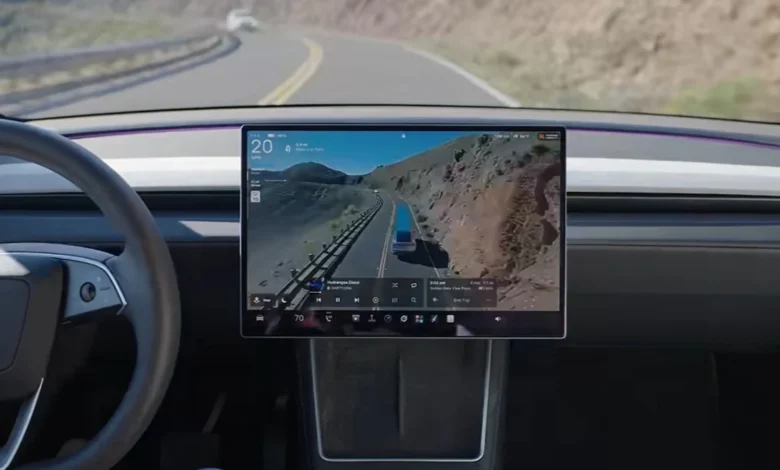
Tesla has officially rolled out its highly anticipated Full Self-Driving (FSD) version 15 update, bringing a sweeping overhaul to both the system’s underlying safety algorithms and its visual interface. The most striking element of the v15 release is an entirely redesigned driving visualization system for the central touchscreen. Utilizing powerful onboard computers and advanced artificial intelligence technologies, the software renders the vehicle’s real-world environment with a fidelity that many early testers have compared to a modern video game. Moving away from the relatively simple, schematic animations of past iterations, FSD v15 constructs a complex, real-time virtual environment. This updated display accurately tracks and depicts surrounding vehicles, pedestrians, buildings, mature trees, and complex street signs with a remarkable degree of graphical detail.
Branded by Tesla as Reality View, the interface introduces immersive visual elements, such as augmented-reality style directional arrows that project onto the screen to guide drivers smoothly through upcoming turns. However, this massive leap in graphical complexity does not come without compromises. Early adopters and automotive reviewers have noted that because the system demands significantly more processing power from the central display, the interface occasionally feels less responsive to rapid finger taps and swipes compared to previous, stripped-down software versions. Furthermore, capturing the minute details of the physical world remains a persistent challenge. Physical boundaries such as curbs and freshly painted lane markings occasionally appear to morph, shift, or flicker on the screen as the neural network continuously recalibrates its spatial understanding. Despite these initial visual anomalies, software engineers and industry analysts view Reality View as a foundational first generation that will inevitably mature and refine through subsequent over-the-air patches and data accumulation.
The Evolution of Tesla Full Self-Driving: A Chronological Overview
To understand the magnitude of the v15 rollout, it is necessary to examine the rapid and aggressive deployment schedule that has defined Tesla’s driver-assistance software strategy over the past decade. Launched initially as an ambitious suite of convenience features under the Autopilot banner, Tesla’s software ecosystem has steadily evolved from basic lane-centering and adaptive cruise control into an end-to-end neural network architecture.
In its earliest phases, Tesla relied heavily on hardware supplied by third-party vendors, most notably Mobileye, before parting ways to develop proprietary silicon and customized neural net training clusters like the Dojo supercomputer. The transition to FSD Beta, and eventually to Supervised FSD, marked a critical pivot away from hard-coded C++ programming rules toward machine learning models trained on millions of miles of fleet-derived driving data.
Version 14 established a baseline for urban navigation, handling complex intersections, traffic lights, and unprotected left turns with varying degrees of autonomy. However, independent audits and regulatory scrutiny revealed persistent quirks, including inconsistent speed management. For instance, a notable safety analysis conducted in Belgium demonstrated that vehicles running FSD version 14.2.2.6 frequently struggled with localized speed limits, exceeding strict 19 mph thresholds on specific residential roads more than half the time during a rigorous three-day evaluation.
Recognizing these vulnerabilities, Tesla positioned the v15 update as a definitive safety and architectural milestone. By unifying the neural network architecture directly with its upcoming Robotaxi platform initiatives, the company aims to bridge the gap between consumer-facing driver assistance and fully autonomous commercial deployment.
Deconstructing Safety Claims: The 25x Improvement Metric
Alongside the visual overhaul, the core narrative surrounding the v15 release centers on substantial safety enhancements. Tesla has boldly asserted that the v15 software is twenty-five times better at managing critical safety edge cases compared to its predecessor iterations. According to official corporate statements released via digital channels, vehicles operating on FSD v15 are now calculated to be nine times safer than an average human driver when measured across standardized operational metrics.
As has frequently been the case with major software releases from the Austin-based electric vehicle manufacturer, these sweeping statistical claims were delivered to the public without a detailed white paper or a transparent disclosure of the underlying testing methodology. Independent safety researchers, regulatory bodies, and academic institutions often find themselves navigating a data vacuum when evaluating Tesla’s proprietary safety assertions. Nevertheless, the company insists that the exponential jump in safety performance is driven by a unified neural network that shares learnings seamlessly across the entire global fleet.
Beyond raw statistical models, v15 introduces tangible functional upgrades designed to mitigate specific road hazards. The software package incorporates enhanced debris detection algorithms, allowing vehicles to identify and react to foreign objects on the asphalt much earlier than before. Pothole avoidance has also been noticeably refined, utilizing vertical surface mapping to steer the vehicle around deep road depressions that could otherwise damage suspension components or compromise tire integrity. Additionally, the navigation suite has been upgraded to recognize and actively avoid flooded roadways, a critical capability for drivers navigating severe weather events and flash flooding.
Navigational Refinements and Driver Monitoring Enhancements
The v15 package extends far beyond graphical and emergency-avoidance upgrades, introducing a host of Quality-of-Life improvements requested by the user community. Among the more subtle adjustments, Tesla has modified the cabin acoustics by making the turn signal indicators noticeably quieter, addressing minor customer complaints regarding repetitive clicking sounds during long-distance highway driving.
Navigation and parking functionalities have likewise received significant attention. The upgraded parking location selection system offers greater precision when mapping destination arrival points, seamlessly integrating with destination charging networks and private residential driveways. Furthermore, the internal cabin camera system—vital for maintaining driver attentiveness during supervised autonomous operation—has been upgraded with advanced facial and optical recognition software. This enhanced driver monitoring system is now engineered to operate reliably even when the operator is wearing hats, prescriptive eyeglasses, or polarized sunglasses, reducing the frequency of false-positive distraction warnings that plagued earlier iterations.
For many daily commuters, the introduction of the Speed Camera Slowdown system stands out as the single most practical addition to the v15 feature set. Designed to cross-reference GPS coordinates and real-time database feeds of fixed and mobile speed enforcement apparatuses, the vehicle will now autonomously decelerate as it approaches a monitored zone. This feature directly addresses historical criticisms regarding FSD’s tendency to drift above posted speed limits, providing an automated compliance layer that helps shield drivers from costly traffic infractions.
Broader Industry Impact and Regulatory Implications
The launch of FSD version 15 arrives at a pivotal juncture for both Tesla and the broader autonomous vehicle industry. As traditional automotive manufacturers scale back or recalibrate their multi-billion-dollar investments in level 4 and level 5 autonomous driving technologies, Tesla remains steadfast in its vision of achieving unsupervised autonomy entirely through camera-based computer vision and neural network training.
The integration of the FSD v15 architecture with the Robotaxi ecosystem underscores Tesla’s dual-pronged business model. On one hand, the company must satisfy millions of existing retail customers who have purchased or subscribed to the FSD package, demanding continuous performance improvements on public roads. On the other hand, every mile driven by the v15 fleet serves as high-value training data for the proprietary algorithms that will eventually power a driverless commercial fleet.
However, this aggressive deployment strategy continues to attract intense scrutiny from regulatory agencies, including the National Highway Traffic Safety Administration (NHTSA) and international transport authorities. Regulators remain cautious about the nomenclature surrounding "Full Self-Driving," consistently emphasizing that the system remains a Level 2 driver-assistance feature requiring active human supervision at all times. The introduction of gamified visualization elements like Reality View may spark renewed debates regarding driver distraction, as users navigate the fine line between monitoring road conditions and engaging with the mesmerizing, video-game-like rendering on the central console.
As the v15 rollout expands across the global Tesla fleet, the coming months will provide critical real-world data regarding its actual efficacy on public roads. Whether the system can consistently live up to the lofty safety claims put forth by its creators will determine not only the future of consumer-facing autonomy but also the regulatory approval path for Tesla’s next-generation commercial transport ambitions.